3.1.1.3 - Carbon stores and transfers
Carbon moves between living organisms, air, water and rocks. The store receiving carbon, its chemical form and the rate of transfer determine whether that movement matters over a growing season or over millions of years.
Where carbon is stored
Carbon stores differ greatly in size and accessibility, so a large store is not necessarily a large immediate source to the atmosphere.
Carbon store
A carbon store is a quantity of carbon held within a defined part of the Earth system at a specified time. A carbon flux is a rate of transfer between stores.
The lithosphere holds carbon in carbonate rocks, sedimentary organic matter, soils and fossil fuels. Rocks dominate long-term storage, but much of that carbon exchanges slowly. The hydrosphere stores carbon mainly as dissolved inorganic carbon in the oceans, including bicarbonate ions, as well as dissolved and particulate organic matter. Ocean storage is much greater than atmospheric storage. The biosphere holds carbon in living biomass and organic remains. The atmosphere contains carbon dioxide and methane; changes in this comparatively small store can strongly affect climate.
Cryospheric carbon is especially associated with organic material in frozen soils and permafrost, rather than pure ice being a major carbon store. Freezing slows decomposition; thaw can expose organic matter to microbial processing. These sphere labels overlap: carbon in frozen soil can be described as cryospheric and soil carbon, but must not be counted twice in a total. A diagram's boundary convention should make this explicit.
The global pattern follows where the material occurs. Carbonate and carbon-rich sedimentary rocks occur in continental and marine geological formations; fossil-fuel deposits are unevenly distributed. Much ocean carbon is below the surface layer. Vegetation stocks follow ecosystems, with high biomass in many forests, while substantial frozen-soil carbon is concentrated in high-latitude permafrost regions. Atmospheric carbon dioxide is widely mixed, unlike a local coal deposit or forest stand.
For size comparisons, the IPCC's 2021 carbon-budget schematic, Figure 5.12, page 700 shows reference stocks in petagrams of carbon, equivalent to gigatonnes: vegetation 450, soils outside permafrost 1700, permafrost 1200, surface ocean 900 and intermediate/deep ocean37,100. Its atmospheric carbon-dioxide stock is 591 plus an estimated anthropogenic addition 279, about 870 under that figure's convention. These are rounded schematic estimates with reference dates and boundaries specified by the source, including pre-industrial stocks and later additions; they are not measurements of 2026 or an exhaustive total to add to our overlapping sphere labels.
Thus deep-ocean carbon is about 41 times the surface-ocean stock shown, and permafrost holds more than twice the vegetation stock shown. The whole lithospheric rock store is larger still; fossil reserves alone are only a subset. Store size, accessibility and distribution all matter: a small atmospheric change can affect climate, while a large rock stock mostly exchanges much more slowly.
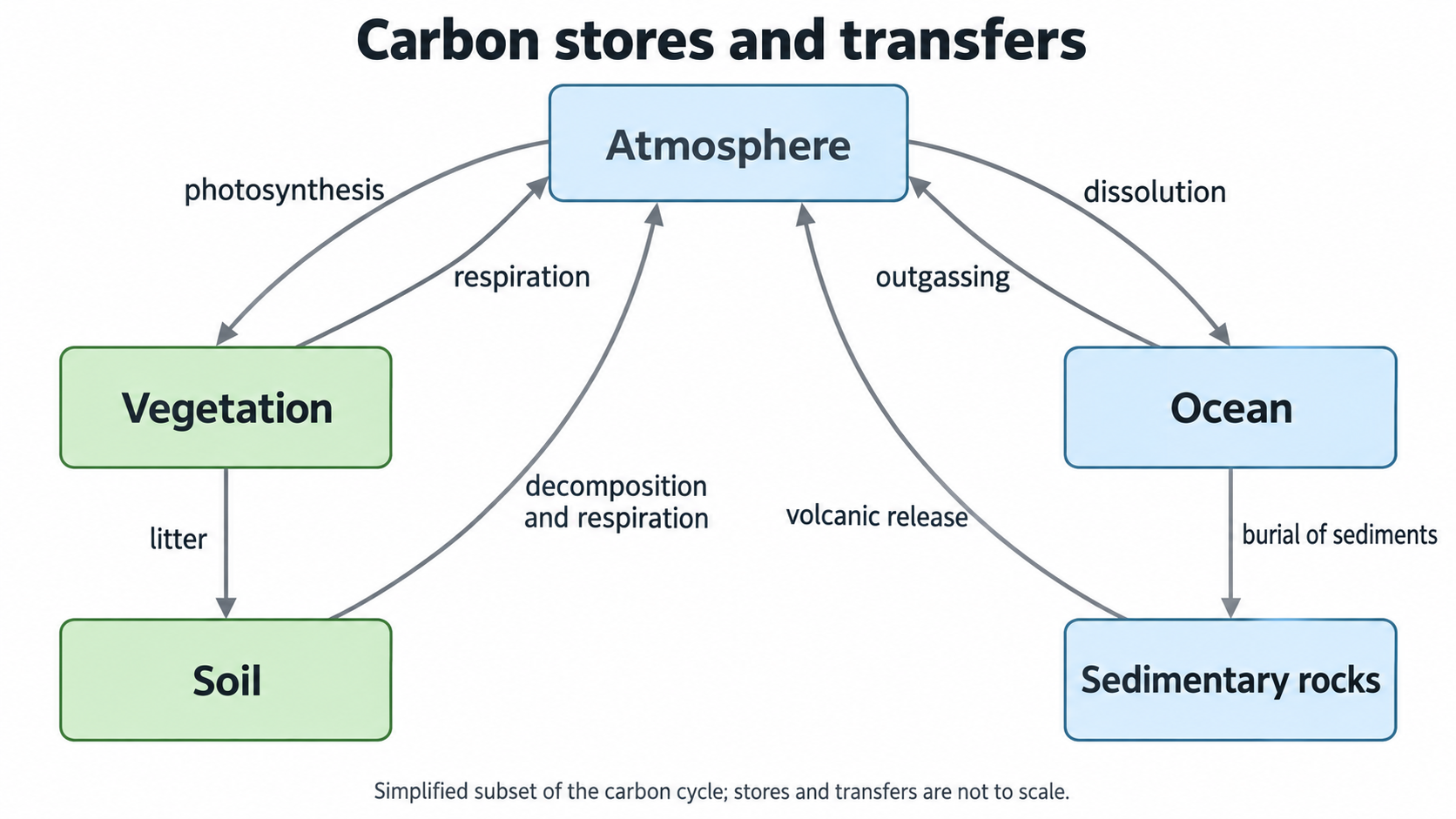
A selected set of processes, not a complete or size-scaled global carbon budget. Fossil-fuel extraction, combustion and weathering are taught separately below.
NASA's carbon-cycle account explains these different forms and timescales. Its numerical estimates were published in 2011; they should not be presented as a measurement of this year's stocks.
Transfers through organisms and soil
Living systems can exchange large amounts of carbon while making only a small net change in their stores.
Photosynthesis uses light energy to incorporate carbon from carbon dioxide into organic molecules. Plants respire as well: respiration releases carbon dioxide while making energy available from organic matter. Growth stores the difference between uptake and losses within the chosen vegetation boundary. Animals acquire carbon by feeding; their respiration and waste transfer it onwards. When leaves fall or organisms die, litter transfers carbon from biomass to soil or surface organic matter.
Decomposers break down organic matter. Their respiration returns carbon dioxide to air or water; some carbon remains in more persistent soil material. Warm, moist, oxygenated conditions commonly speed microbial activity, whereas cold or waterlogging can slow aerobic decomposition. Oxygen-poor decomposition can also produce methane. Slow decay in waterlogged peat allows carbon to accumulate over long periods, provided organic inputs exceed losses.
Combustion oxidises organic carbon, releasing carbon dioxide rapidly. A wildfire moves carbon from vegetation and litter towards the atmosphere, leaving some char and allowing later regrowth. Burning fossil fuels makes a much older geological store available to the active cycle. Both are combustion, but their stores and replacement times differ. A forest can have high photosynthesis and high respiration without being a large net sink.
Ocean exchange and sequestration
The ocean exchanges carbon with the atmosphere and also moves it between the surface and deeper stores.
Carbon dioxide dissolves at the sea surface and can leave by outgassing. The net direction depends on the difference in carbon dioxide conditions between water and air, with temperature and circulation also important. Colder water can generally hold more dissolved carbon dioxide; water warming does not by itself prove that an entire ocean has become a net source.
Phytoplankton incorporate dissolved carbon through photosynthesis. Some organic material sinks after death or feeding, transferring carbon below the surface in the biological pump. Much is decomposed and respired before reaching the seabed, so sinking production is not equivalent to permanent burial. Deep circulation and mixing can retain carbon away from the atmosphere for long periods, but eventual upwelling may return it to the surface.
Sequestration
Sequestration transfers carbon into a store where it is retained for a relevant period. The store, retention time and possibility of later release must be specified.
Some shells and other carbonate material, together with organic particles, become buried sediments. Over geological time they can form carbonate rocks or carbon-rich sedimentary deposits. Ocean uptake and sediment burial are related but distinct: most carbon entering the ocean does not immediately become rock. This distinction explains why fast surface exchange can coexist with much slower geological storage.
Weathering and the geological cycle
Weathering connects atmospheric and soil carbon to dissolved river loads and eventual marine sediments.
Carbon dioxide dissolves in water to form weak carbonic acid. Chemical weathering of silicate minerals consumes carbon dioxide and releases dissolved ions that rivers carry towards the ocean. Subsequent carbonate formation and burial can produce a long-term net transfer from atmosphere to rock. Carbonate-rock weathering also dissolves and transfers carbon, but later carbonate precipitation can return part of that carbon dioxide; it should not be treated as chemically identical to silicate weathering's long-term net effect.
Uplift exposes fresh rock to weathering. Tectonic burial, heating and volcanic activity can return geological carbon to the atmosphere. These transfers usually operate over much longer periods than a leaf's growth or a fuel's combustion. Faster weathering in some warmer and wetter conditions can oppose a rise in atmospheric carbon over geological time, but it cannot be assumed to cancel rapid present-day emissions immediately.
Human extraction moves oil, gas or coal from geological storage towards use; combustion then releases much of its carbon. Extraction itself and burning are different stages. Leakage of methane during fossil-fuel production is another atmospheric transfer. Carbon conservation does not require the atmosphere's stock to remain constant: it requires all transfers across the selected boundary to be accounted for.
Plant, sere and continental scales
Changing scale changes which carbon transfers and timescales are most visible.
An individual plant can take up carbon during a daylight period and return some through respiration at night. Over years, biomass may grow; at death it transfers carbon to litter and soil. A sere is the sequence of communities in ecological succession. After bare ground is colonised, vegetation and soil carbon often accumulate as biomass and organic inputs increase. Later stages can hold large stores while net annual uptake slows because respiration and decomposition also increase. Disturbance, water supply and nutrient limits can interrupt that trajectory; succession is not a guarantee of indefinitely rising storage.
At continental scale, different vegetation zones, soils, fires and land uses produce a spatial mosaic. Summing them can hide a local source within a continental net sink. Time averaging can also hide a drought year's loss within a decade's gain. Compare carbon stocks in units such as tonnes of carbon per hectare, and fluxes in tonnes of carbon per hectare per year; do not compare those as though they were the same quantity.
For an original example, a young woodland stores 20 tonnes of carbon per hectare and gains 3 per year, whereas a mature woodland stores 160 and gains 1 per year. The mature stand has eight times the stock but only one-third of the annual gain. A larger stock and a faster sink are different advantages, and loss of the mature stock would not be quickly repaired by the young stand's annual uptake.