3.1.6.3 - Biomes and tropical rainforest adaptations
Locate major terrestrial biomes and explain tropical rainforest structure and adaptations through climate, soils and seasonal water availability, using Ducke Reserve near Manaus.
Global patterns of terrestrial biomes
A biome is a large ecological region characterised by broad climatic conditions and characteristic vegetation and associated animals. It contains many ecosystems, and its boundaries are transitional rather than precise lines. Vegetation reflects temperature and moisture as well as soils, relief, disturbance and human land use. Two places at the same latitude can therefore have different biomes.
Biome
A broad ecological grouping characterised by its climate and dominant vegetation, with associated animal communities.
Tropical rainforest occurs around the humid equatorial belt, especially Amazonia, the Congo Basin and Southeast Asia. Savanna occupies seasonally wet tropical areas, including East Africa, central South America and northern Australia. Subtropical deserts occur around descending dry air and continental interiors, such as the Sahara and central Australia; cold ocean currents also help explain coastal deserts. Mediterranean shrublands occur around the Mediterranean and on several western continental margins with dry summers.
Temperate grasslands include continental interiors such as the North American prairies and Eurasian steppe. Temperate deciduous woodland occurs in parts of Europe, eastern North America and East Asia with sufficient moisture and a marked cool season. Boreal coniferous forest extends across northern Canada and Eurasia. Tundra lies beyond much of that forest towards the Arctic, where low temperatures and permafrost constrain roots. Mountain ecosystems change with altitude and exposure, adding a vertical pattern to the broad latitudinal one. These locations describe potential ecological patterns; extensive farming and urbanisation have altered actual cover.
Ducke Reserve and rainforest environmental conditions
Ducke Reserve lies near Manaus in Amazonas, Brazil, within the Central Amazon. INPA identifies a 10,000-hectare reserve with a 25-square-kilometre RAPELD research grid inside a wider 64-square-kilometre grid. The reserve, research grids, Amazon basin and Brazilian Legal Amazon are different geographical units. Ducke's terra-firme forest is on land not seasonally inundated by the major river flood pulse; stream valleys within the reserve still differ from upland soils.
Humid tropical conditions can support growth through much of the year. High rainfall does not imply permanently saturated soil: drainage, rooting depth and seasonal evaporative demand determine available water. Where precipitation exceeds potential evapotranspiration after the soil store is replenished, water surplus can drain or run off. A seasonal deficit can occur when demand exceeds precipitation and usable soil water is depleted. Annual totals hide these monthly differences.
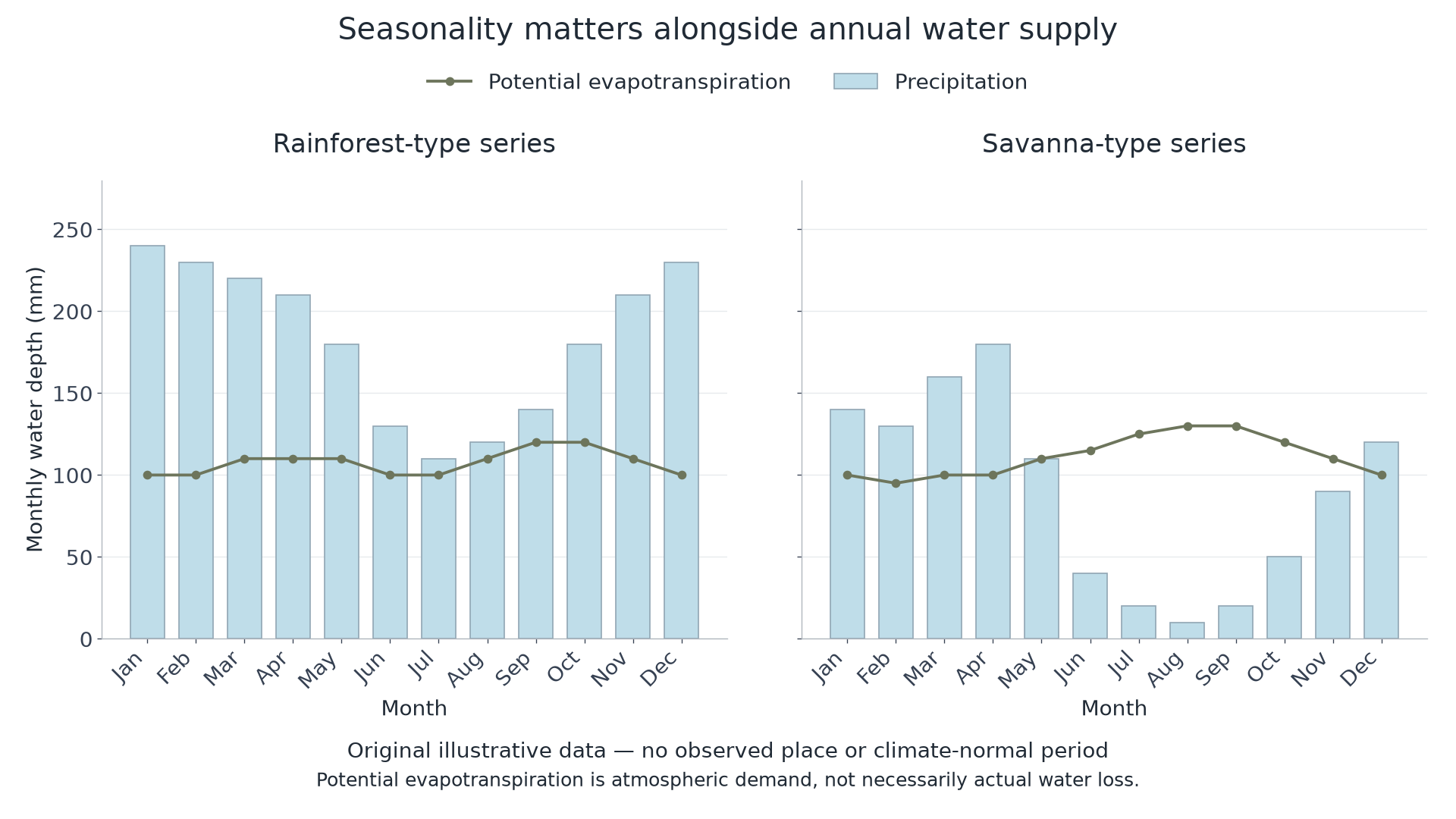
These teaching series are invented comparisons, not observations at Manaus, Ducke or Serengeti. The rainforest-type series remains wetter than atmospheric demand each month; the savanna-type series has a pronounced dry season. Potential evapotranspiration is demand assuming water is available, not necessarily the water actually evaporated.
Continue this lesson.
You’re previewing NovaLearn without an account. Create a free account to read the rest.
Create free account