3.1.5.6 - Wildfire processes, impacts and responses
Wildfire risk depends on ignition, available fuel, weather, topography and exposed communities. This lesson explains those controls and uses the Lahaina fire of 8 August 2023 in Maui, Hawaiʻi, to examine impacts, emergency communication and longer recovery.
Fuel, weather and ignition
A wildfire is uncontrolled combustion spreading through vegetation or other available fuels, with heat, fuel and oxygen sustaining burning.
Vegetation type affects fuel arrangement. Fine grasses can dry quickly and burn rapidly, while shrubs, litter and dead wood vary in density, moisture and energy content. A forest with continuous understory and branches may connect ground fuel to the canopy. Biomass alone does not determine intensity: wet abundant vegetation can resist ignition, whereas dry fine fuel may ignite readily. Continuity helps fire spread; gaps can interrupt it unless flames or embers cross them.
Climate influences the usual seasonal moisture and vegetation, while recent weather controls current fire conditions. Drought can lower live and dead fuel moisture; short-term heat and low humidity can dry fine fuels. Earlier wet periods may grow vegetation that later becomes available dry fuel. Strong wind supplies oxygen, tilts flames towards unburned fuel and carries embers. These influences interact rather than guaranteeing one fixed spread rate. NWCG guidance on weather and fuel moisture distinguishes recent conditions from longer moisture history.
Natural ignition includes lightning. Human causes include escaped burns, discarded ignition sources, machinery and electricity infrastructure; some are accidental and others deliberate. The source of ignition must be distinguished from the conditions enabling spread. A utility fault may start a fire, but dry continuous grass and wind may control how rapidly it escapes. Identifying one does not prove the other or establish legal responsibility.
Fire spread and linked hazards
Fire behaviour describes how a fire moves and releases heat, and different vegetation structures produce different pathways.
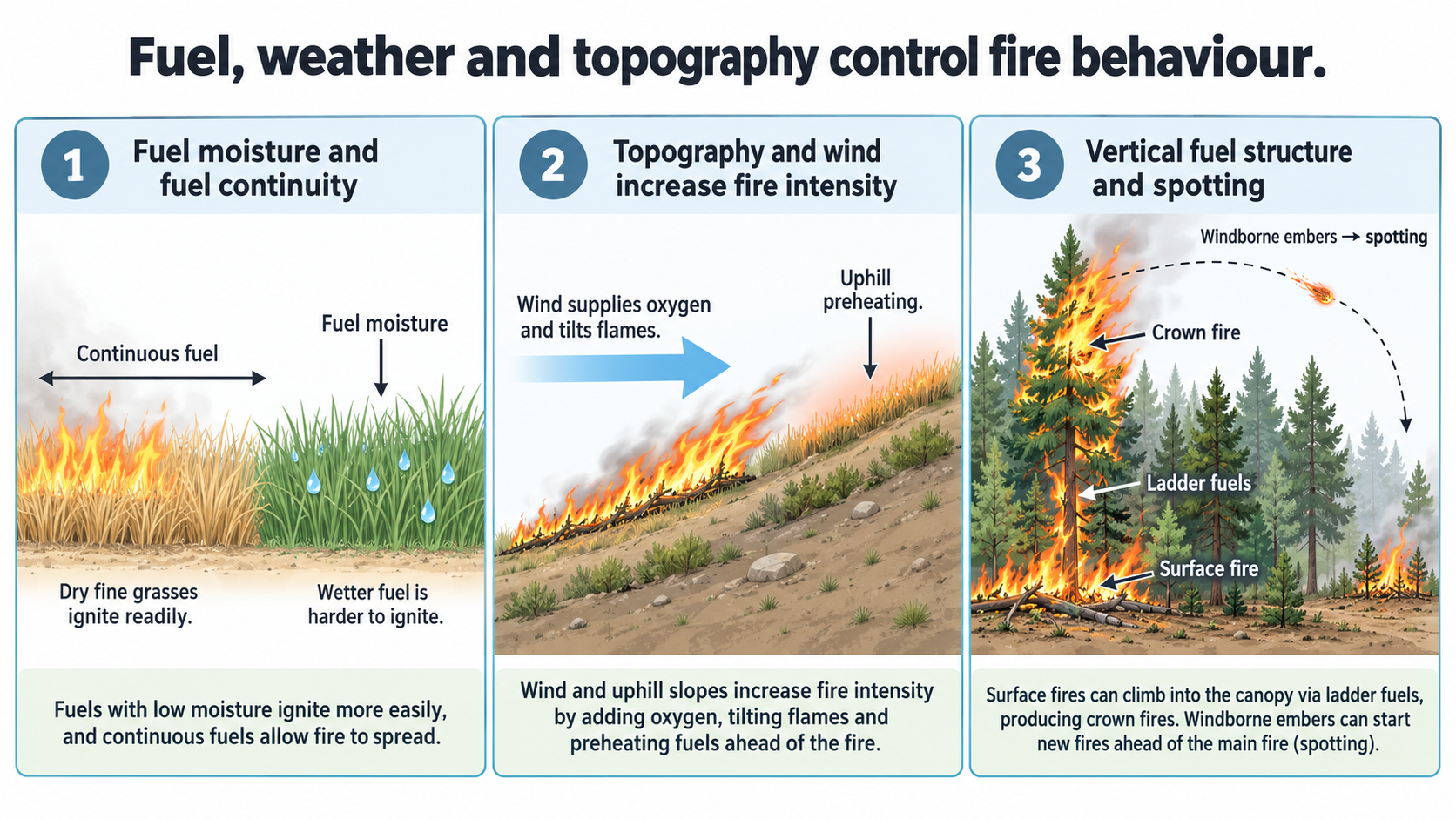
Conceptual pathways: wind direction, slope and fuel structure influence behaviour; the figure does not imply that every surface fire becomes a crown fire.
A surface fire burns grass, litter and low vegetation. Crown fire burns canopy fuel; ladder fuels can connect a surface fire to branches above. Windborne embers can ignite spot fires ahead of the main front, crossing roads or breaks. Heat transfers by radiation, convection and direct contact, drying and preheating fuel before ignition.
Fire often spreads faster uphill because flames and convective heat are nearer the fuel above them. Wind aligned upslope can strengthen this effect; opposing winds or changing fuel can alter it. Wind shifts may expose a previously safer escape route. Intensity concerns heat release, while rate of spread concerns movement; a rapidly moving grass fire and a long-burning heavy-fuel fire may differ on these measures.
Burning causes direct heat, smoke and structural losses. Later rain on burned slopes can increase runoff and erosion where vegetation cover and soil properties have changed. Smoke can affect people beyond the flame footprint. Firebreaks, fuel management and suppression act on particular pathways, but spotting, extreme wind and unsafe access can limit them. A reported contained perimeter is not automatically proof that all smouldering material has been extinguished.
Lahaina: ignition and cascading losses
Lahaina's destructive fire illustrates an accidental ignition followed by rekindling and rapid spread into an exposed town.
The Maui Fire Department/ATF investigation classifies the 8 August 2023 fire as accidental. Re-energised broken utility lines produced sparks and contacted vegetation. The destructive afternoon fire was a rekindle of the morning fire, with hidden smouldering material remaining after suppression. Rekindling was reported around 14:52 local time. The precise transfer route for surviving burning material was not resolved to a single certainty. The report's weather analysis identifies strong easterly flow and local downslope/gap effects; it does not establish Hurricane Dora as a vital cause of ignition and spread. MFD origin-and-cause report, October 2024.
Continue this lesson.
You’re previewing NovaLearn without an account. Create a free account to read the rest.
Create free account