3.2.5.3 - Water supply strategies and a major scheme
Learn how supply strategies change water storage and movement, and use Phase I of the Lesotho Highlands Water Project to connect a major dam network with its benefits and environmental costs.
Matching supply strategies to a setting
A supply strategy works only where the physical resource, infrastructure and management conditions fit the demand.
Catchment management protects source water through erosion control, vegetation, pollution regulation and land-use planning. Cleaner inflow can reduce treatment costs and sediment accumulation. It may restrict farming or development and takes time; planting vegetation does not automatically increase runoff because transpiration can rise.
Diversion redirects a portion of river flow. It can connect a reliable source to users, but transfers pressure downstream and requires rules for low-flow periods. Storage retains wet-season water behind a dam for later use, smoothing a seasonal mismatch and sometimes supporting hydropower. Reservoir flooding removes land and habitat; evaporation, sedimentation and drought constrain useful yield.
Water transfer connects a surplus or less-stressed source to another area through tunnels, pipes or rivers. It can support cities or irrigation while creating donor-region costs, pumping expenses and dependence on another jurisdiction. “Surplus” must allow for ecological requirements and existing users. Storage capacity is a volume held; annual yield is a flow over time. They cannot be substituted.
Desalination removes salts from seawater or brackish water. Coastal supply is less directly dependent on rainfall, but treatment needs energy, skilled maintenance and an intake/discharge system. Brine and chemicals can affect marine environments; inland distribution adds costs. Low-carbon electricity improves one aspect of sustainability without eliminating marine impacts or the cost of membranes.
Choose criteria before judging: dependable usable supply, affordability, environmental effects, equity and resilience. A coastal city may benefit from desalination; a highland transfer can exploit gravity and storage. Neither is universally best.
LHWP Phase I network and beneficiaries
Phase I of the Lesotho Highlands Water Project links highland reservoirs to hydropower in Lesotho and water delivery into South Africa's Vaal system.
The 1986 Lesotho–South Africa treaty established a multiphase project. This case concerns Phase I, including Katse, Mohale, Matsoku and Muela; it does not substitute later Polihali construction for the operating historic case. Phase IA began water delivery in January 1998. LHDA Phase I record.
Katse impounds the Malibamatso River. Mohale impounds the Senqunyane; a transfer tunnel feeds Katse. Matsoku's diversion also feeds Katse. Water passes from Katse through a transfer tunnel to Muela, generating electricity at the Muela hydropower station in Lesotho, then through the delivery tunnel into the Ash River in South Africa. The Ash–Wilge route connects to the Vaal system serving the industrial and urban Gauteng region. A distribution network includes these rivers and downstream supply infrastructure, not just the donor dam.
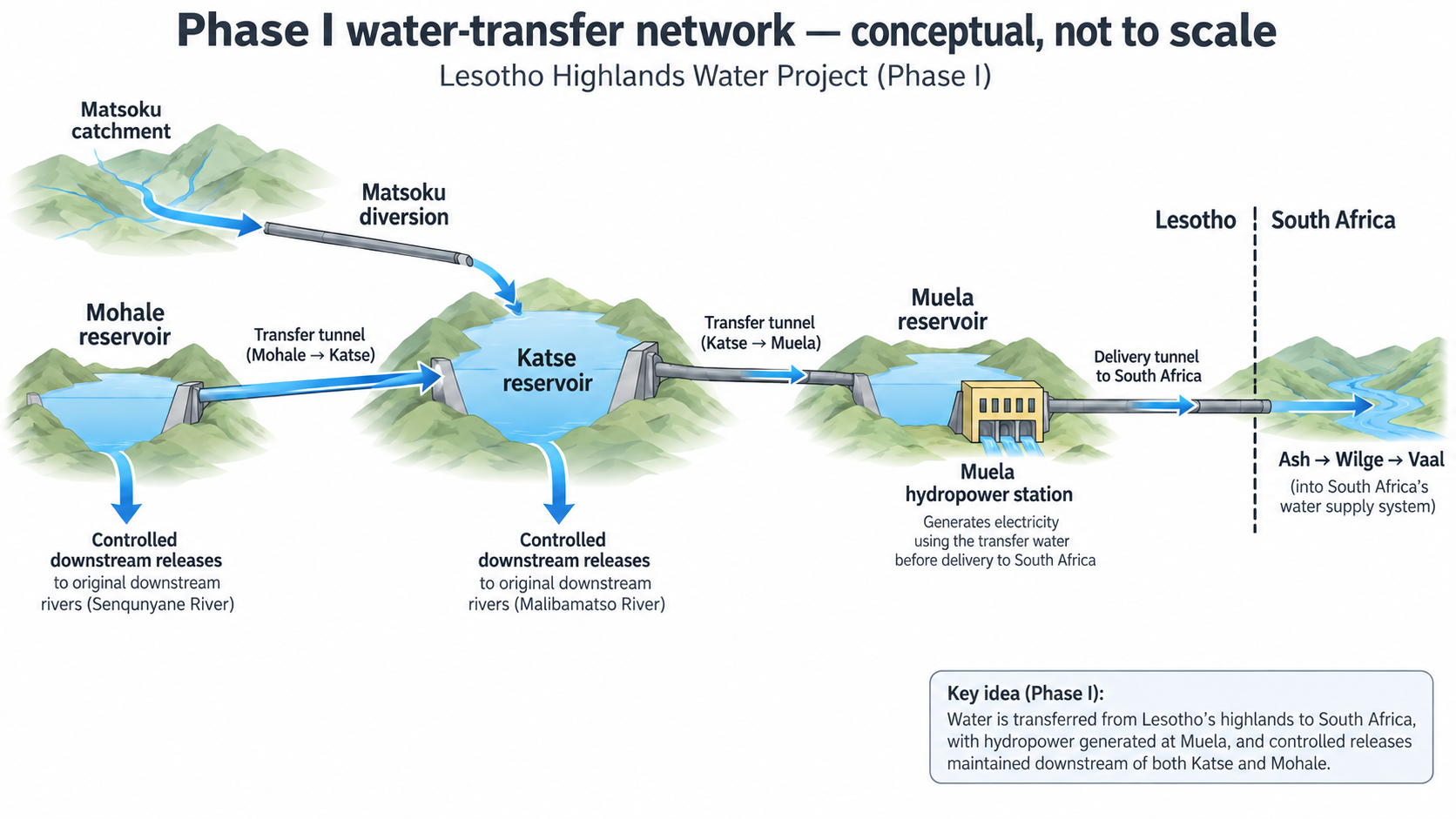
Phase I topological schematic: arrows show connections, not measured volumes or exact positions. Muela remains on the Lesotho side of the international boundary.
Highland runoff and relief allow stored water and hydropower to be combined. South Africa benefits from water supply; Lesotho receives treaty-related payments and electricity opportunities. Roads and employment can add benefits. Benefits at national or urban scale do not establish that every affected highland household gains: reservoir flooding can remove agricultural land, interrupt access and require compensation or livelihood restoration. Treaty; World Bank 2007 completion account.
Impacts and release evidence
The environmental cost of a transfer depends on altered river conditions as well as the reservoir footprint.
Continue this lesson.
You’re previewing NovaLearn without an account. Create a free account to read the rest.
Create free account