3.2.4.3 - A non-communicable disease and global health
Use lung cancer to analyse disease burden, environment and lifestyle pathways, then judge prevention, treatment and the roles of international agencies and NGOs.
Lung cancer and its global burden
Lung cancer involves malignant cell growth in lung tissue and is not transmitted between people as an infectious disease.
Incidence records new diagnoses during a stated year. Mortality counts deaths during that year. Five-year prevalence counts people alive who were diagnosed during the preceding five years; it depends on both earlier incidence and survival. These are different populations, so deaths divided by new cases is not a cohort survival rate.
The current IARC lung-cancer fact sheet is GLOBOCAN 2024 v1.0, dated 8 July 2026, covering trachea, bronchus and lung, both sexes and all ages. It estimates 2,637,005 new cases and 1,861,839 deaths globally in 2024. World age-standardised incidence and mortality rates are 23.9 and 16.3 per 100,000 respectively. These are estimates, with variation in cancer registration and modelling between countries.
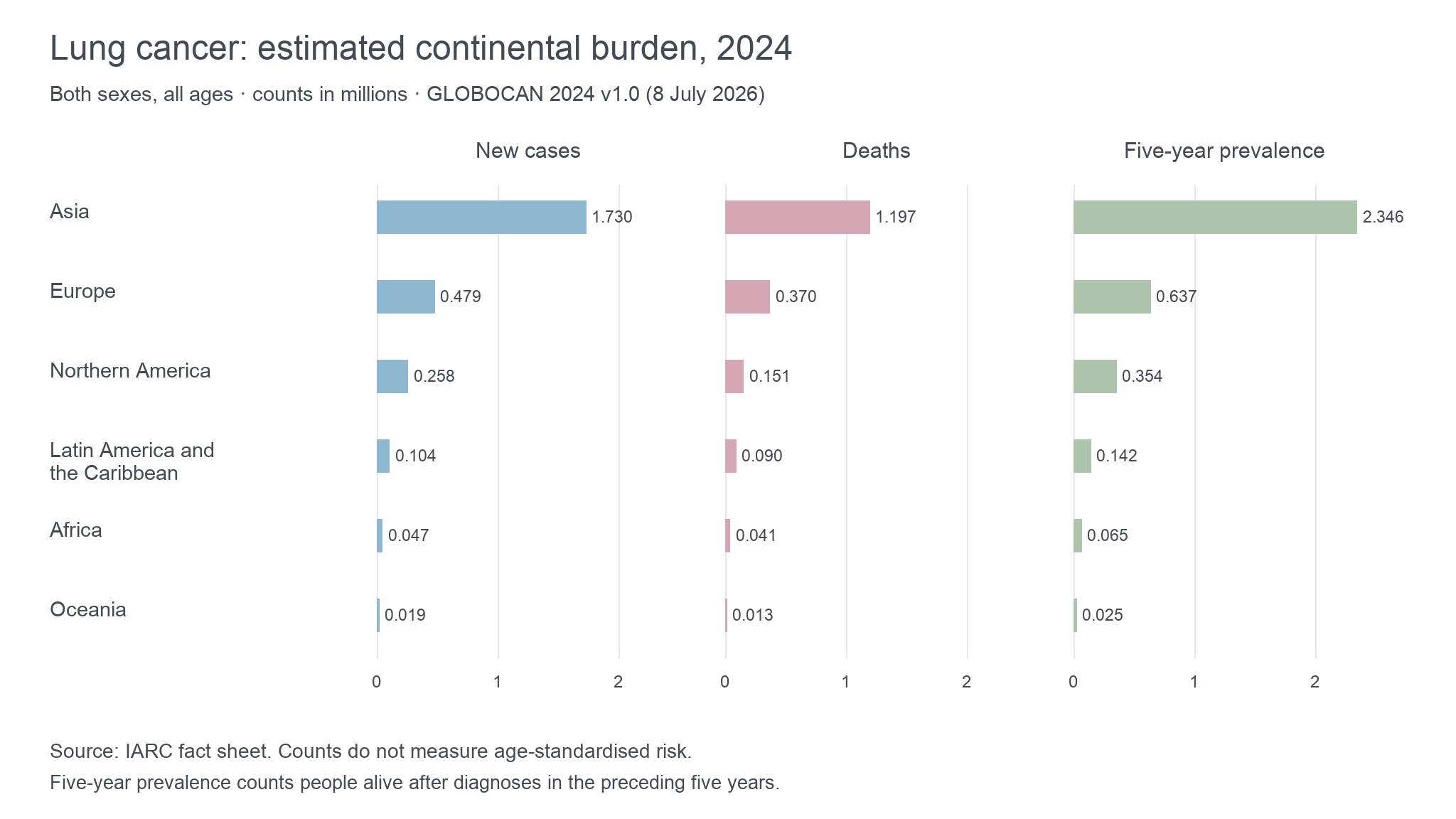
Figure 1. Original plot of the six continental rows in IARC's 2024 fact sheet. Counts measure burden, not each individual's risk; five-year prevalence is a different measure from annual incidence.
Asia has 1,730,334 estimated new cases, compared with 478,683 in Europe and 47,006 in Africa. Population size, age structure, historical exposure and diagnosis help explain counts. Europe can have a smaller count but a different age-standardised risk. Summing the six five-year prevalence rows gives 3,568,718 people; this is an explicit calculation, not a separate world total supplied by the sheet. Do not combine these current 2024 values with an older 2022 series to infer a precise trend.
Environment, lifestyle and unequal risk
Lung-cancer risk reflects cumulative exposures over time, so today's disease distribution can lag earlier behaviour and working conditions.
Tobacco smoking exposes lung tissue to carcinogens; risk rises with cumulative exposure, and quitting reduces future risk over time. Second-hand smoke can expose non-smokers. Radon, occupational asbestos and some other workplace exposures, and outdoor air pollution also contribute. Multiple exposures can interact. Not every case is caused by smoking, and a non-smoker is not risk-free.
Socio-economic conditions shape exposure and protection. Advertising, product affordability, stress and social norms affect tobacco use; workplace regulation influences occupational risk. Poorer housing or access to clean fuels can increase exposure. Education and accessible cessation services can help, but presenting the pattern as a free individual choice alone misses these constraints.
The WHO lung-cancer fact sheet supports these established risk pathways. A district-level association between smoking and deaths does not establish each person's cause or quantify the effect of local air pollution. Age, historical smoking, occupational exposure, diagnosis and long latency must be considered. Cancer registrations and exposure histories are stronger evidence than assuming that the nearest monitor caused a resident's cancer.
Use evidence at the right level: established exposure mechanisms support causal explanation; regional correlations locate patterns but do not identify an individual's cause.
Impacts on health and well-being
Lung cancer affects physical functioning, emotional well-being, household security and health services.
Continue this lesson.
You’re previewing NovaLearn without an account. Create a free account to read the rest.
Create free account