3.1.3.4 - Engineering and sustainable coastal management
Explain how interventions change coastal systems and evaluate hard engineering, soft engineering and integrated management using risk, sediment transfers, time and fairness.
Hard engineering and transferred effects
Structures can reduce local flood or erosion risk while changing wave behaviour and sediment transfers elsewhere.
Sea walls resist wave attack and may reduce overtopping, although design height, condition and extreme water levels determine performance. Reflected waves and scour can narrow or lower a beach at the foot. Rock armour and revetments dissipate energy over rough or sloping surfaces but occupy space and need maintenance. Offshore breakwaters reduce wave energy in their lee, encouraging deposition but potentially changing nearby currents and habitat. Groynes interrupt alongshore sediment movement, retaining a wider updrift beach; reduced supply farther downdrift is a possible consequence that needs whole-pathway evidence.
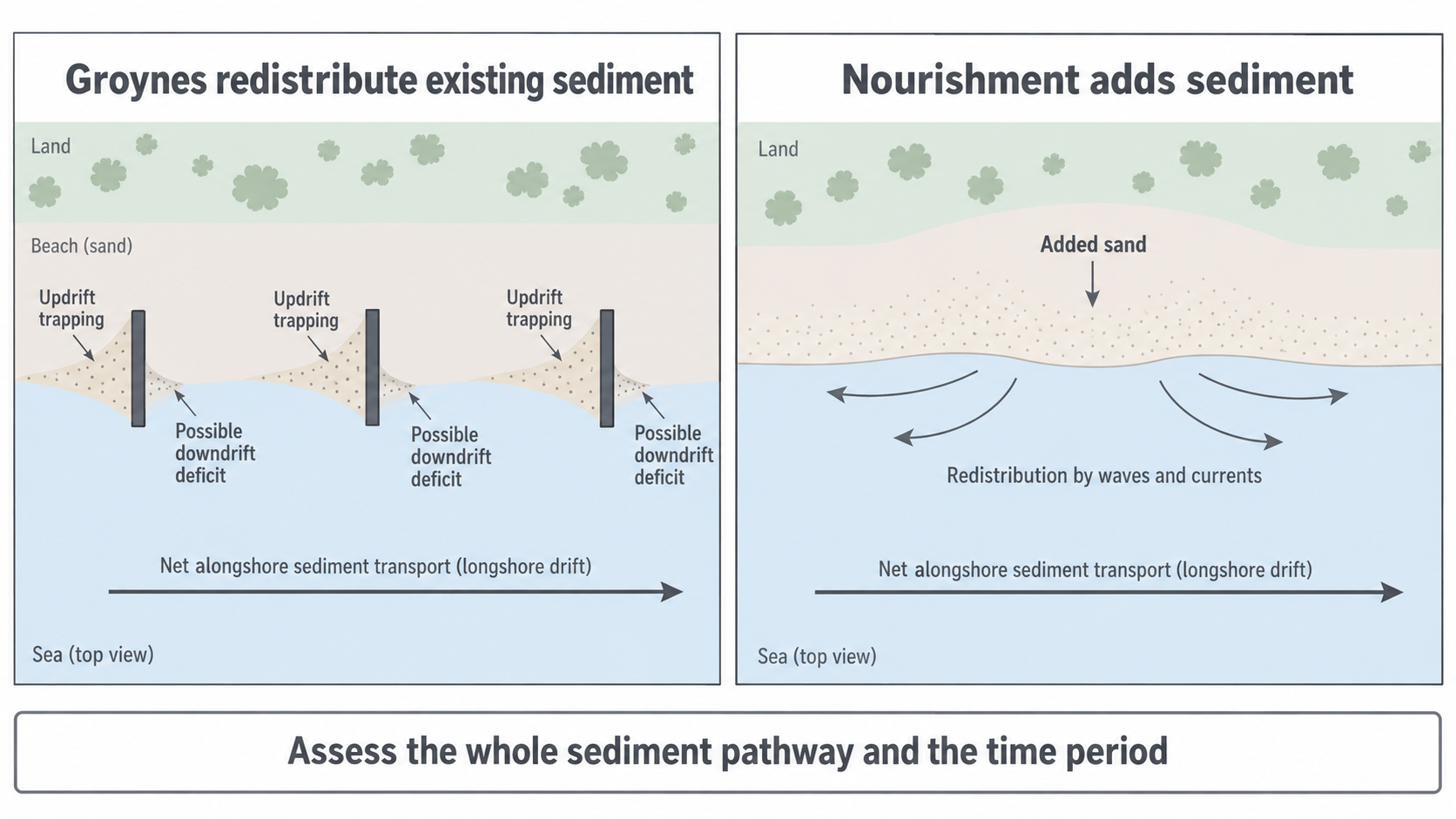
The left panel shows a possible redistribution pattern, not a measured Mappleton outcome. Nourished sediment can move both ways even where annual net drift has one direction.
Erosion defence and flood defence are related but different aims. Protecting a cliff foot does not guarantee protection from overtopping or groundwater-driven failure. A wall may defend valuable buildings in the short term, yet sea-level rise, maintenance and sediment disruption affect its longer-term sustainability. Judge benefit against residual risk, cost, lifespan, habitat, access and distribution of effects. A structure should not be declared successful solely because the shoreline immediately behind it is stable.
Mappleton is a held exception within EA's generally naturally evolving Rolston–Waxholme management unit. Its defended frontage must be considered alongside adjacent retreat, rather than assuming a local engineering result proves a whole-coast solution.
Soft engineering and adjustment space
Soft engineering works with sediment or habitats, but still involves deliberate decisions and continuing costs.
Beach nourishment adds compatible sediment to increase a buffer against waves. It can preserve recreation and natural-looking shorelines, but waves redistribute the material and repeat inputs may be required. Dredging sources, grain compatibility, ecological effects and the timing of works matter. Dune restoration, planting, fencing and controlled access can improve trapping and reduce trampling, although a narrow wet beach may supply little wind-blown sand and extreme storms can still erode the ridge.
Managed realignment deliberately changes a defence line to allow tidal flooding of selected land. Suitable elevations and sediment supply can support mudflat or marsh development and give water more space, while relocating exposed assets may reduce future loss. However, farmland or property may be surrendered, compensation and access require agreement, and habitat establishment is uncertain. Realignment differs from simply abandoning planning: it requires design, permissions, monitoring and arrangements for affected people.
The 2011 Sand Motor in the Netherlands added 21.5 million m³ of sand to a coastal system, using waves, wind and currents to redistribute it. Its 2021 evaluation separates observed beach/dune development from safety, nature and recreation objectives. A large input is a mechanism and design choice, not proof that every intended benefit occurred.
Continue this lesson.
You’re previewing NovaLearn without an account. Create a free account to read the rest.
Create free account