3.2.4.3 - A biologically transmitted disease
Use malaria to connect global and seasonal disease patterns with vector ecology, social conditions, health impacts and the strengths and limits of control strategies.
How malaria is transmitted
Malaria is caused by Plasmodium parasites and is usually transmitted by an infective bite from a female Anopheles mosquito.
Vector
An organism that carries a pathogen between hosts. The malaria mosquito is the vector; Plasmodium is the parasite causing the disease.
A mosquito feeding on an infected person can take up parasites. Parasite development in the mosquito takes time; an infective mosquito can then introduce parasites to another person. In humans, parasites develop through liver and blood stages; infection can cause fever and chills and sometimes severe disease. This is not ordinary direct transmission through touching or coughing.
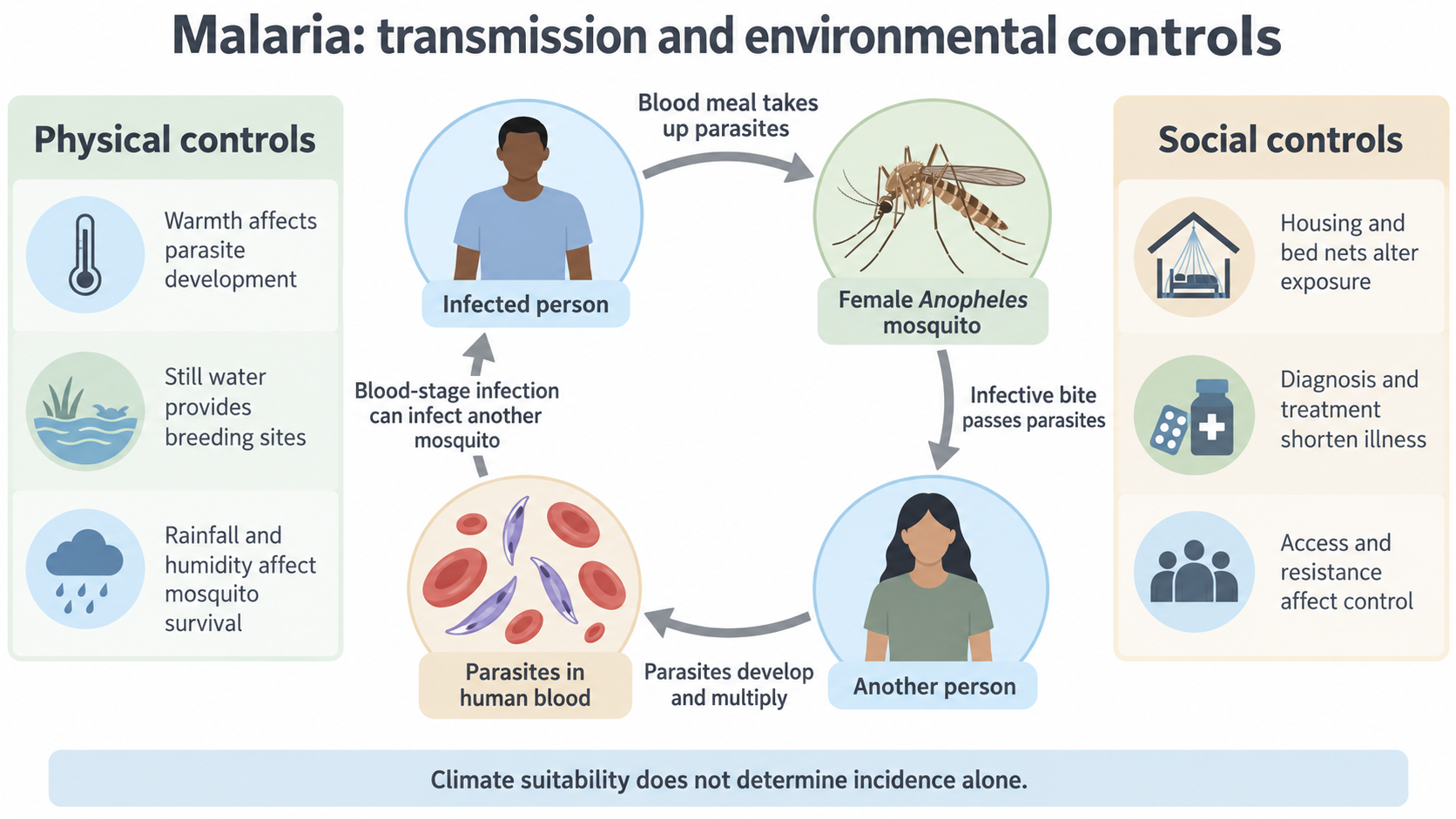
Figure 1. Original conceptual diagram. The human liver stage and detailed parasite stages are simplified; the arrows show transmission and blood infection, not people turning into vectors.
Warmth influences mosquito survival and parasite development, but suitability has upper and lower limits. Water is needed for breeding habitats, and adult survival depends partly on humidity. Mosquito species differ in habitat and biting behaviour. These mechanisms help explain why malaria is concentrated in many tropical/subtropical environments, but climate suitability alone does not prove actual transmission: the parasite, vector, exposure and control conditions must also be considered.
Global distribution and infection prevalence
Malaria burden is strongly concentrated geographically, while prevalence and annual incidence describe different aspects of that burden.
WHO World Malaria Report 2025 estimates about 282 million case episodes and 610,000 deaths globally in 2024. Its African Region accounts for about 94% of cases and 95% of deaths. Transmission also occurs in parts of South and South-East Asia, Latin America and Oceania. Elimination and control can produce low burden in climatically suitable areas. Annual episodes are not 282 million distinct people infected at one point.
Prevalence asks what proportion is infected among a specified population when assessed. Malaria Atlas Project release 202608 models P. falciparum infection prevalence among children aged 2–10, with markedly greater suitability and infection in many parts of tropical Africa than in eliminated or low-transmission settings elsewhere. This is a modelled, age-standardised infection measure; it is not all-species, all-age global prevalence. The Nigeria national mean for 2024 is about 24.08%, with wide model bounds. A global API number is excluded here because its aggregation denominator and weighting were not confirmed.
The Nigeria Malaria Indicator Survey 2021, fieldwork October–December, provides measured infection evidence for a different group. Microscopy found parasites in 22.3% of tested children aged 6–59 months; rapid diagnostic tests gave 39.6%. Microscopy prevalence was 10.5% urban and 26.7% rural. A difference of 16.2 percentage points is a supported survey contrast; it is not proof that every rural child is more exposed. Testing methods, ages, season, sampling and model assumptions prevent treating these figures as directly comparable trend points.
Global prevalence analysis therefore needs located infection evidence and honest gaps as well as burden counts. State the parasite, age range, test/model, geography and time before interpreting a percentage.
Seasonality and unequal transmission
Rainfall can create a seasonal transmission peak, but a lag and social conditions separate rainfall from recorded incidence.
After rains form suitable pools, larvae develop, adults emerge and parasites develop in surviving mosquitoes. Infective bites, symptoms and diagnosis follow later. Recorded case peaks can therefore lag rainfall. In wetter equatorial settings, transmission may persist through much of the year; strongly seasonal settings can have a concentrated peak. Extremely heavy rain may flush habitats, and irrigation can maintain breeding water during a dry season. An annual average conceals these timing differences.
Continue this lesson.
You’re previewing NovaLearn without an account. Create a free account to read the rest.
Create free account