3.1.5.2 - Plate margins, landforms and magma plumes
Different directions of plate movement create different landforms and hazard patterns. This lesson links each margin's mechanism to the shape, location and depth of its associated features, then distinguishes a mantle-plume chain from a subduction island arc.
Constructive margins, rifts and ridges
A constructive margin is a divergent boundary where plates move apart and new crust can form.
Tension stretches continental lithosphere and produces normal faults, along which rock blocks move downward relative to adjacent blocks. A lowered block between faults forms a rift valley. Thinning and hot mantle upwelling can raise the wider region while the fault-bounded valley subsides within it. Rift valleys are not primarily valleys cut by a river. If rifting progresses, the continent can split and a new ocean basin develop; not every rift necessarily reaches that stage.
Under an ocean, decompression melting supplies basaltic magma to a spreading centre. New crust and hot, buoyant lithosphere produce an ocean ridge, an extensive elevated seafloor system. Cooling lithosphere subsides away from the ridge. Faulting and brittle fracture cause mostly shallow earthquakes, because the hot thin lithosphere does not maintain a cold brittle slab to great depths. Basaltic fissure eruptions are common, often underwater, although emerged ridge sections such as Iceland expose activity on land.
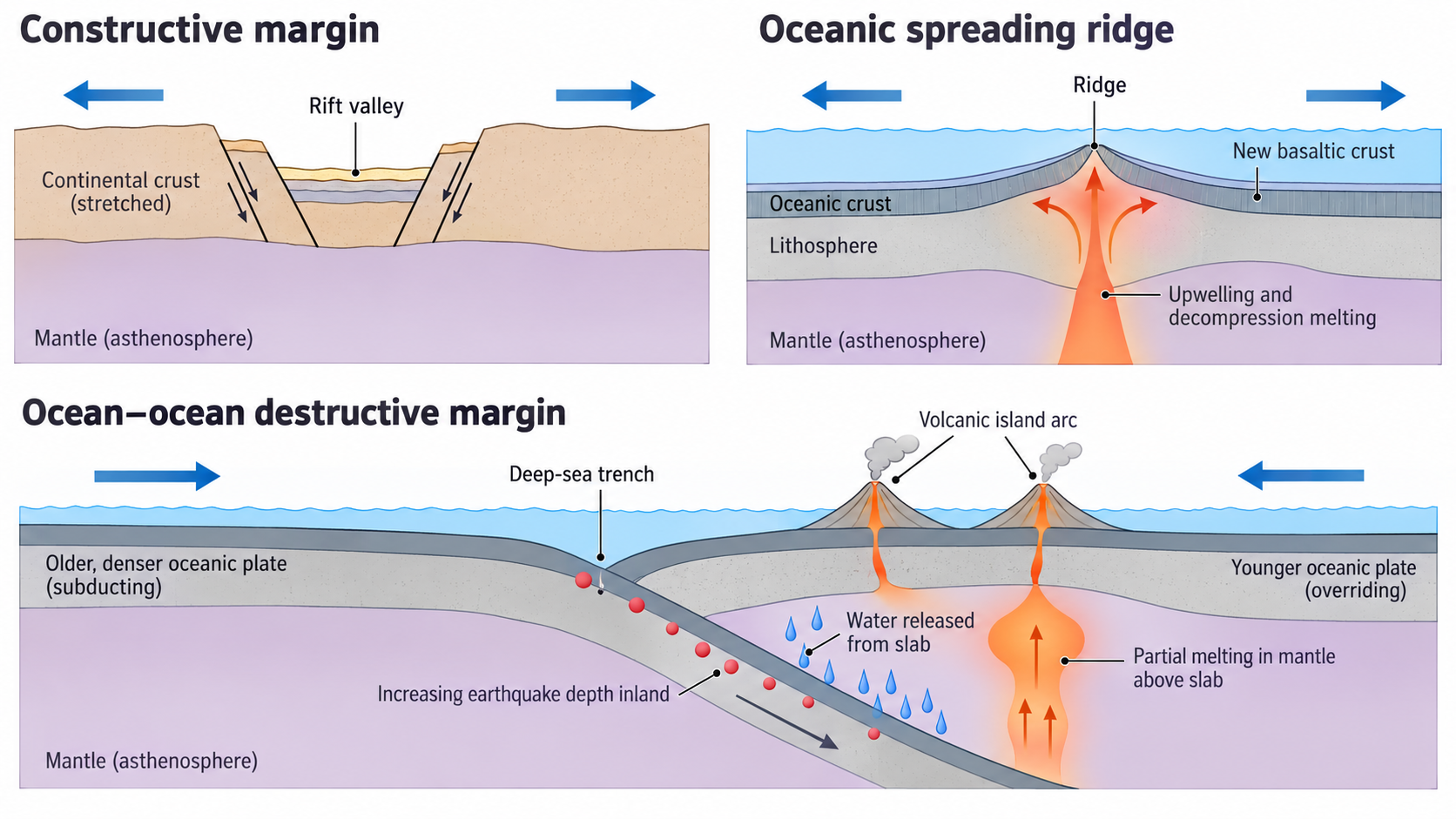
The panels connect motion to landform relationships; they are not an exact map, cross-section scale or measured earthquake catalogue.
Destructive margins, trenches and island arcs
A destructive margin is a convergent boundary where oceanic lithosphere descends beneath another plate and is recycled into the mantle.
In ocean–ocean convergence, usually the older, colder, denser plate subducts. Bending of the descending plate creates a deep-sea trench, a long narrow depression alongside the margin. Friction and stress along the plate interface generate shallow earthquakes; earthquakes also occur within the cold descending slab at progressively greater depths inland. This inclined zone explains a depth pattern rather than a random scatter of all earthquake depths everywhere.
Water released from minerals in the descending slab lowers the melting temperature of mantle rock above it. Partial melting produces magma that rises through the overriding plate. Successive eruptions build a chain of volcanic islands roughly parallel to the trench: an island arc, as in the Aleutian system. The volcanoes stand on the overriding plate, displaced from the trench, not directly inside it. The slab need not melt wholesale to produce the arc's magma.
At ocean–continent convergence, the oceanic plate subducts beneath more buoyant continental lithosphere. A trench offshore and a continental volcanic arc can form, as along the Andes. Magma composition and gas content vary, but more viscous, gas-rich magma can favour explosive activity. Compression also deforms and uplifts the continental margin. Large interface earthquakes can generate a tsunami if they displace the seabed vertically; subduction itself does not guarantee that every earthquake produces one.
The USGS plate-motion account locates these boundary types and illustrates their principal landforms. Distinguish their spatial arrangement before adding event-specific evidence.
Collision and young fold mountains
When an ocean closes and two continents converge, their buoyant crust resists deep subduction and thickens under compression.
Continue this lesson.
You’re previewing NovaLearn without an account. Create a free account to read the rest.
Create free account