3.1.6.5 - Coral reef processes, threats and futures
Explain warm-water reef development and stresses, analyse the Great Barrier Reef's changing condition, and evaluate how management and future climate affect its prospects.
Where warm-water coral reefs develop
Warm-water reef-building communities occur mainly in tropical and subtropical seas, including the Caribbean, Red Sea, Indian Ocean and western Pacific. The Great Barrier Reef lies off Queensland on Australia's northeast coast. Its offshore reefs, inshore habitats and mainland catchments form connected but different geographical areas. A catchment pressure does not affect every reef equally; proximity, currents and flushing influence exposure.
Coral polyps are animals. Many reef-building corals host photosynthetic algae within their tissues; these supply energy, while the coral offers a protected environment and materials the algae use. Corals build calcium-carbonate skeletons that create complex habitat for fish, invertebrates and other organisms. Symbiosis means a close biological association; it does not mean all algae around a reef are beneficial.
Warm, sufficiently clear and sunlit water supports the algal partner. Sediment can reduce light or smother organisms. Suitable salinity and a stable substrate help growth, while wave energy, depth and water movement influence reef form. Fringing reefs border shores, barrier reefs are separated from land by lagoons, and atolls surround lagoons where their geological history permits. Conditions and tolerances vary among species and places; one fixed temperature threshold cannot describe every reef. Deep cold-water corals also exist, but differ from the sun-dependent warm-water ecosystems studied here.
Heat, acidity, salinity and algal stress
Sustained temperatures above locally normal conditions can disrupt the coral–algal partnership. Bleaching involves loss of algal partners or their pigments, revealing the pale skeleton. A bleached coral is stressed but can survive if conditions improve; prolonged or repeated stress can cause mortality. Exposure duration, species, depth and previous condition influence the outcome. Natural fluctuations and human-driven warming interact rather than forming wholly separate categories.
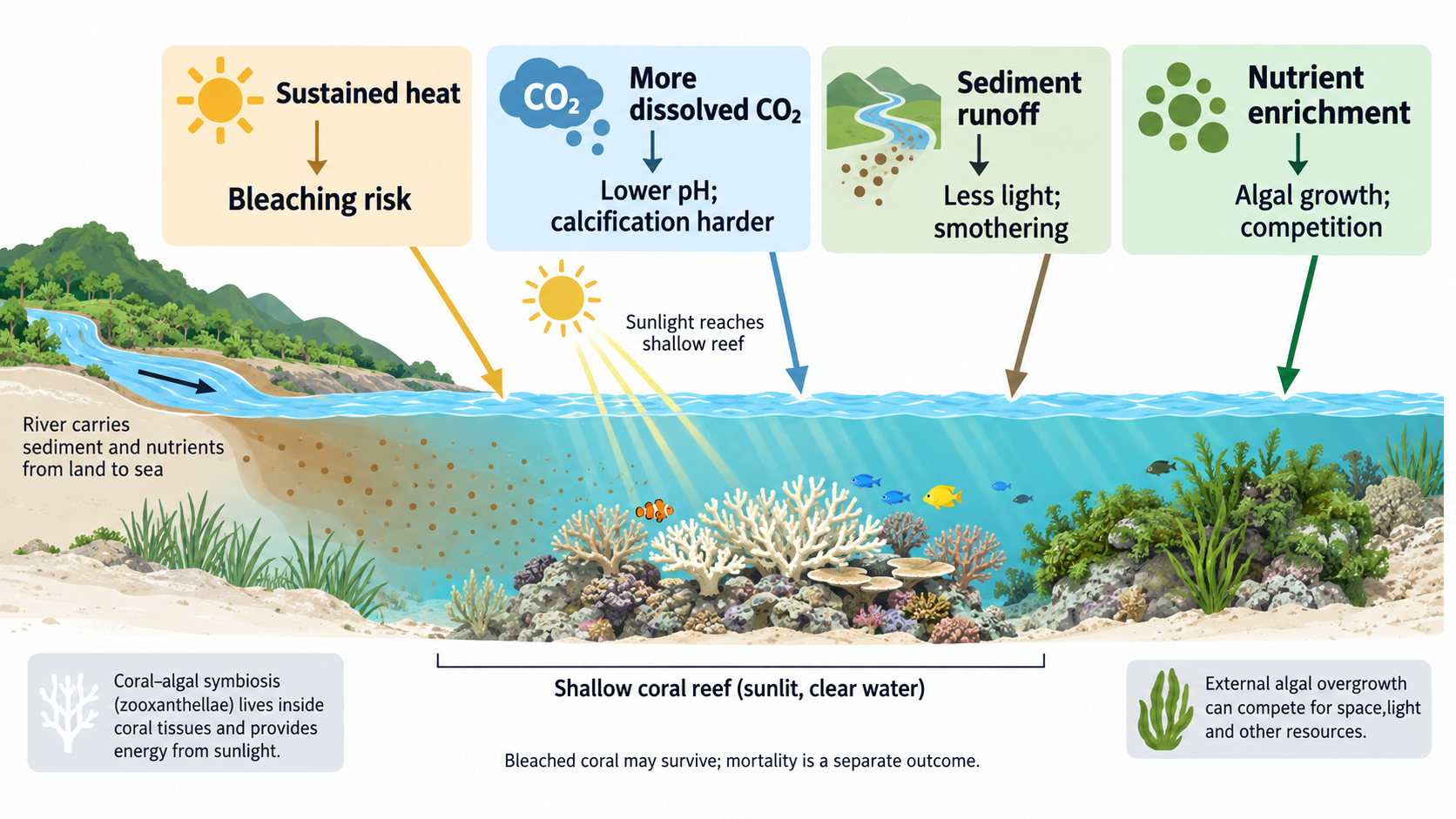
This conceptual diagram separates internal symbiotic algae from external algal overgrowth. It illustrates mechanisms, not measured damage at one reef.
More dissolved carbon dioxide alters seawater chemistry, lowers pH and reduces carbonate availability, making skeletal formation harder. Ocean acidification is a shift towards greater acidity; seawater need not become acidic below pH 7. Heat and acidification are different mechanisms that can act together.
Flood plumes can reduce salinity abruptly; concentrated saline discharge can increase it locally. Large departures from tolerable conditions stress organisms through water and ion balance. Algal blooms may reduce light, while decomposition of excess organic material can reduce dissolved oxygen. Nutrient enrichment and reduced herbivory can encourage external algae to compete for reef space. Reef health depends on both biological interactions and water quality.
Drainage schemes, coastal development and desalination
The Burdekin basin in Queensland contains large irrigation schemes supplied by dam and groundwater sources. Farming, erosion and drainage connect catchment management to receiving coastal waters. Fine sediment can reduce light and smother coral; nutrients can encourage algal growth, and pesticides can harm photosynthetic organisms. A dam can trap some sediment while downstream erosion and diffuse agricultural sources continue to supply pollutants, so a major scheme does not simply increase every material flux by the same amount.
Onshore development can remove coastal habitats, create runoff, introduce waste and require dredging or port infrastructure. Dredging can produce turbidity and direct habitat disturbance, depending on location, methods and sediment transport. Urban wastewater, agricultural chemicals and industrial contaminants are distinct pollution sources with different controls. Improvements need monitoring of pollutant loads and biological responses, not merely a treatment facility's completion.
Desalination produces freshwater and a concentrated saline waste stream. Poorly dispersed brine can increase local salinity; intake systems may affect organisms, and treatment chemicals require control. A historical example is the Queensland Coordinator-General's May 2010 evaluation of GLNG construction accommodation on Curtis Island near Gladstone. Section 9.2.1 raised concern about proposed brine and effluent discharge into Port Curtis and considered shared treatment or mainland piping alternatives. This was a proposal assessment, not evidence that an operating plant caused observed coral injury. Port Curtis in the wider Great Barrier Reef coastal setting must not be described as an offshore reef or treated as identical to the Marine Park.
Continue this lesson.
You’re previewing NovaLearn without an account. Create a free account to read the rest.
Create free account