3.1.5.2 - Earth structure and plate movement
Plate tectonics connects Earth's internal heat and gravity to the creation, movement and recycling of crust. Understanding these drivers helps explain where tectonic hazards and landforms develop.
Earth structure and internal energy
Earth can be divided by composition into crust, mantle and core, and by mechanical behaviour into rigid and more slowly deforming layers.
The crust is the thin outer rock layer. Oceanic crust is largely basaltic, comparatively thin and dense; continental crust is generally thicker and less dense. The mantle beneath is mainly solid silicate rock. High temperature allows it to deform and flow very slowly over geological time: solid does not mean immobile. The core is mainly iron and nickel; its outer part is liquid and inner part solid, because pressure as well as temperature influences state.
Lithosphere and asthenosphere
The lithosphere consists of the crust plus the rigid uppermost mantle and is divided into tectonic plates. The asthenosphere is a weaker, mainly solid part of the upper mantle beneath it that deforms slowly. A plate is not just its crust.
Internal energy comes partly from heat retained from Earth's formation, including impacts and differentiation as dense material moved inward, and partly from ongoing radioactive decay within Earth. Heat moves by conduction and large-scale convection. Convection transfers heat with moving material: hotter, less dense mantle can rise while cooler, denser material sinks. Pressure-dependent melting can occur locally, but the mantle is not a global ocean of magma beneath floating continents.
The distinctions matter for hazards. A plate can include both continental and oceanic lithosphere, so a coastline is not necessarily a plate boundary. The rigid lithosphere can store elastic stress; the deeper deforming mantle behaves differently. Compare the USGS definition of a tectonic plate with a simplified crust-only sketch to identify what the sketch leaves out.
Gravity, convection and plate forces
Plate movement reflects interacting forces associated with density, elevation and mantle motion, rather than a single rigid conveyor belt.
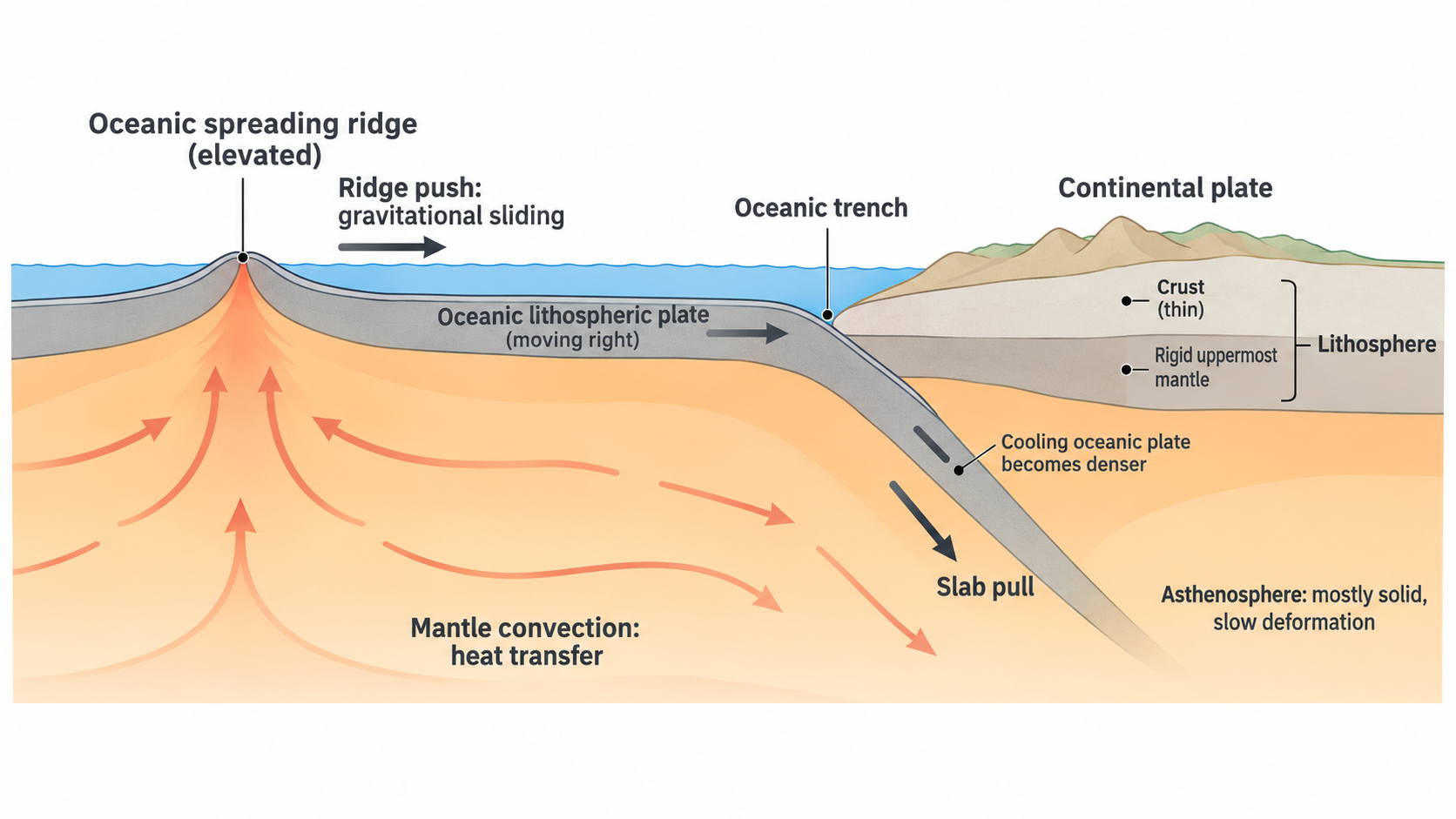
Conceptual cutaway, not to scale. Arrows indicate mechanisms; they do not measure the relative speed or strength of every plate.
Continue this lesson.
You’re previewing NovaLearn without an account. Create a free account to read the rest.
Create free account