3.1.3.3 - Depositional coastal landscapes
Explain how sediment supply, waves, currents and wind produce beaches, spits, bars, barriers and dunes, using Cape Cod beyond the UK while distinguishing similar-looking forms.
Beaches and changing profiles
A beach is a sediment store whose form changes as waves and currents move material along and across the shore.
Deposition becomes possible when sediment is supplied faster than it is removed locally. Lower-energy wave conditions can move sand landward and build a berm, a ridge near the upper limit of swash. Storms can erode the upper beach and move sediment into submerged bars. A beach can therefore change profile while retaining much of its sediment within the active coastal system. Seasonal generalisations need local checking: direction, grain size, storm timing and sediment supply all vary.
Beach gradient reflects interactions among wave conditions, grain size and permeability. Coarse sediment often allows rapid infiltration, reducing backwash and supporting a steeper profile. Fine sand commonly forms a gentler beach. These are tendencies, not rules for predicting slope from grain size alone. Sheltered bay beaches depend on wave refraction, boundary shape and supply; a sheltered coast with little available sediment need not build a large beach.
Beyond the UK, Cape Cod, Massachusetts, has a glacially inherited supply of unconsolidated sediments. USGS Circular 1417 (2015) describes erosion and redistribution supporting beaches, spits, barriers, dunes and marshes. This landscape shows different stores linked by transfers; it is not evidence that every beach grows. Profile monitoring and shoreline records address different changes, so identify which variable a source measures before making a claim about gain or loss.
Spits, recurves and tombolos
Deposition at a shoreline bend can extend a ridge into open water, while wave direction and tidal flows shape its end.
Spit
A narrow depositional ridge attached to land at one end and projecting into water at the other.
Alongshore sediment transport can continue beyond a bend or an estuary entrance, where reduced transport capacity allows a spit to grow. Changing wave directions or refraction can turn the end landward into a recurved hook. Strong tidal currents through the inlet can remove material and prevent the ridge from closing it. Growth therefore depends on sediment supply, wave approach and inlet flow, not simply on a fixed wind direction.
A simple spit has one main ridge. A compound spit records successive ridges or recurved laterals added during different phases; one hooked tip alone is insufficient evidence of a compound history. Provincetown Hook on Cape Cod illustrates long-term spit development in a sediment-fed landscape. Spurn in the UK adds a useful comparison, but its shapes and breached neck have changed and old maps should be dated.
A tombolo connects an island to the mainland or another island by a sediment ridge. Wave refraction and diffraction can create sheltered water behind an island, favouring convergence and deposition there if material is available. It differs from a spit because it completes a connection. Whether the connection is exposed at all tidal stages must be stated.
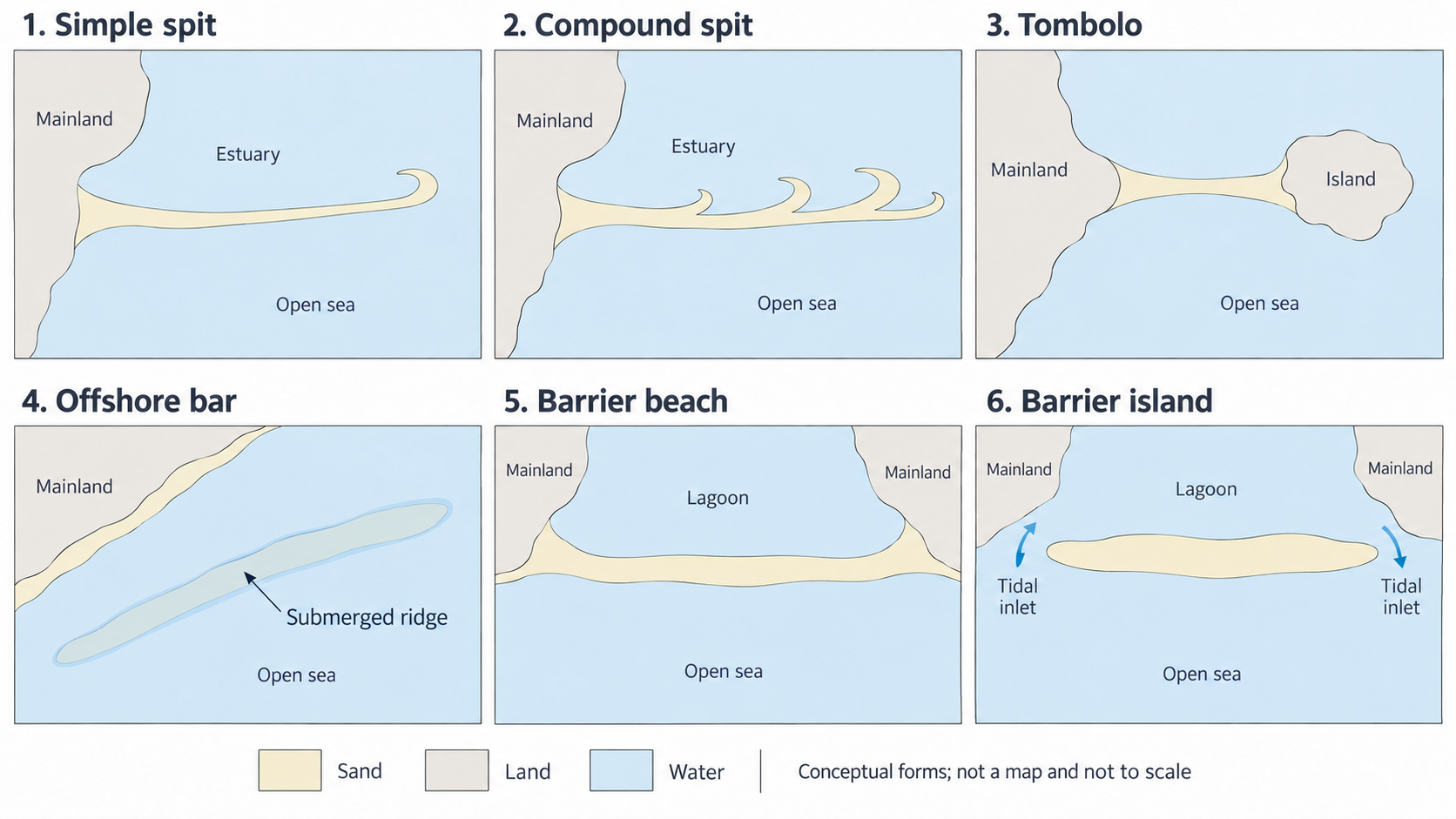
The panels distinguish connections and water gaps. They are conceptual forms, not maps of Cape Cod or Spurn.
Continue this lesson.
You’re previewing NovaLearn without an account. Create a free account to read the rest.
Create free account