3.1.3.3 - Estuaries, mudflats and saltmarshes
Explain how tidal water, sediment and vegetation build estuarine landscapes, and judge why mudflat or saltmarsh growth can vary within the same estuary.
Tidal water and mudflat formation
An estuary connects river and sea, with tidal exchange and river flow controlling where fine sediment accumulates.
Freshwater and seawater mix to varying degrees. Rivers can supply sediment, while flood tides can import marine material. Sheltered margins and slack-water periods provide lower velocities, allowing suspended particles to settle. Saline mixing can promote flocculation, in which fine clay particles aggregate into larger flocs that settle more readily. The estuary's fine deposits therefore need not all come from the river.
Mudflat
A low-gradient intertidal surface dominated by fine sediment, exposed at lower tide and flooded at higher tide.
Deposition during one part of the tide can be followed by resuspension during stronger flows. Tidal channels can remain erosive while nearby margins accumulate mud. A net mudflat gain requires deposition to exceed removal over the chosen period. Estuary shape, tidal range, river discharge, available sediment and wave penetration all matter. A sheltered tidal lagoon behind a spit or barrier may favour accumulation, but an open inlet can maintain currents and sediment exchange.
The Cape Cod landscape described by USGS includes sheltered coastal wetlands alongside beaches and barriers. This beyond-UK example links open-coast transport to protected intertidal stores. It should not be used to infer a particular marsh accretion rate without dated measurements.
Saltmarsh growth and vegetation feedback
Salt-tolerant plants can colonise sufficiently stable, elevated mud, changing the conditions for later sediment accumulation.
Pioneer plants tolerate frequent saline flooding. Their stems slow flow and trap suspended sediment; roots bind the substrate. Organic material also contributes to soil. As accretion raises the surface, inundation becomes less frequent and vegetation communities can change. Creek networks drain and flood the marsh, so the surface is not a uniform staircase. Elevation, drainage, salinity and disturbance influence zonation alongside age.
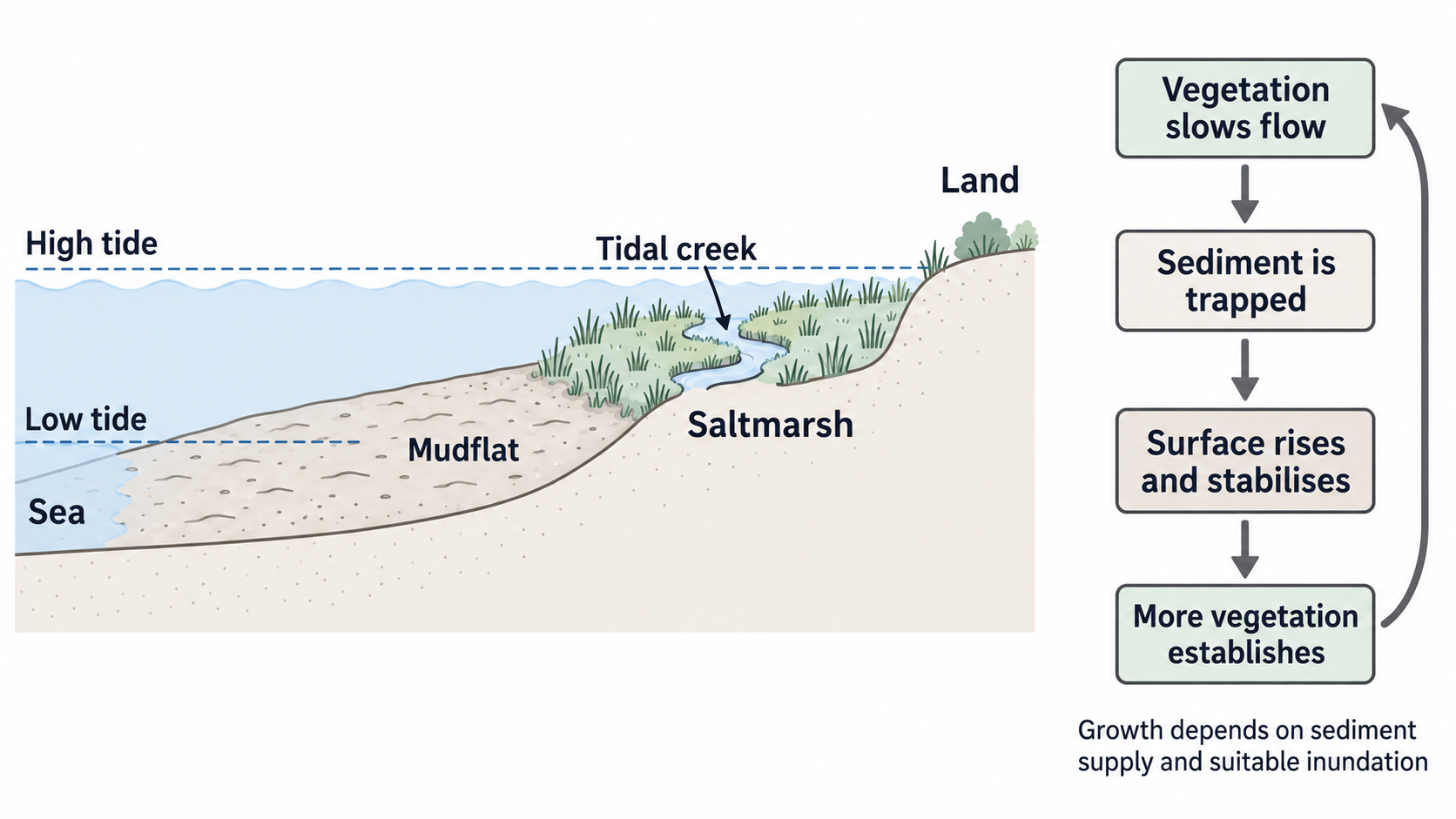
Sediment trapping can reinforce vegetation establishment, but growth remains conditional on supply and inundation.
The feedback is positive when vegetation encourages deposition, a higher stable surface supports more vegetation, and this further enhances trapping. It has limits: less frequent flooding can reduce sediment delivery, erosion can cut the marsh edge, and unsuitable salinity or prolonged deep inundation can damage plants. A marsh must gain sufficient elevation to keep pace with local relative sea-level rise. If it cannot expand inland because of a fixed embankment or development, habitat can narrow through coastal squeeze.
Continue this lesson.
You’re previewing NovaLearn without an account. Create a free account to read the rest.
Create free account