3.2.2.2, 3.2.2.2.1 - Flows, connections and external forces
Learn how flows and decisions connect places across geographical scales, how to distinguish continuity from change, and why the same change can affect people's lives differently.
Flows reshape place character
Connections alter places by moving people, resources, money and ideas across their boundaries.
Flow
Movement between places, such as migration, deliveries, payments, investment or the spread of information and ideas. Its direction, size, timing and recipients affect its consequences.
Flows of people include migration, commuting and tourism. Migration changes where people usually live and can alter age structure, households and cultural networks. Commuting supplies labour without necessarily increasing the resident population. Tourism adds temporary demand for accommodation and leisure. The effect depends on duration and who arrives or leaves: losing young adults and receiving retired residents have different consequences for employment and services.
Flows of resources include energy, water, food, raw materials and manufactured inputs. A factory depends on incoming components and outgoing products. A break in supply can reduce production even if the building and workforce remain. Resource connections can create specialist transport infrastructure and link the locality to distant extraction or manufacturing places. Local activity may therefore depend on environmental or political events far away.
Money flows include wages, household spending, remittances and profits. Investment commits finance to assets or productive activity, such as a building, equipment or training. Investment can create work and improve infrastructure, but ownership matters: profits may leave the locality, and incoming finance may be concentrated in a few sites. Rising property demand can increase rents, helping some owners while reducing access for tenants. Do not equate the amount invested with benefits to every resident.
Flows of ideas include technologies, cultural practices, design approaches, political arguments and representations of place. They travel through migration, education, professional networks and media. An imported production method can change skills required; a new account of a waterfront can attract visitors or investment. People can adapt or resist ideas rather than simply receive them. Everyday language, food businesses and cultural organisations may change alongside the economy.
The flows interact. A new employer's investment can attract commuters and migrants, increase spending and create demand for housing; recruitment brings skills and social networks. Connections can be studied through demographic and cultural change or through economic change and social inequalities. Both lenses are useful. Our worked Salford–Detroit comparison will focus particularly on economic change and inequalities while examining how people experience them; the demographic and cultural lens also receives its own teaching.
External actors and power
The effect of a connection depends partly on who can direct it and whose interests their decisions serve.
Government policies set rules and allocate resources. Local planning decisions can change permitted land use; regional transport spending can alter access; national funding or migration policy can affect investment and population flows. An influence can be external to a neighbourhood even if it is decided within the same city. The relevant boundary and scale must be stated.
In a 17 January 2023 account, the UK government recorded an allocation of over £13 million from the Levelling Up Fund for Salford Rise, including a planned raised pedestrian and cycle route across Frederick Road in the Salford Crescent area. This is a national funding decision directed towards local connectivity. It is a different Salford locality from the Quays. Better access could widen residents' ability to reach opportunities, but the allocation and proposed route do not demonstrate that every intended job or benefit was delivered. This distinction separates policy intention from observed outcome. UK government: Salford Rise.
A transnational corporation (TNC) operates in more than one country. Its decisions about production, sourcing, technology or plant location can redirect investment and employment between places. Local skills, buildings and transport influence its choice, while wider markets and corporate strategy also matter. A place can therefore retain a manufacturing function while the product, technology and supply relationships change.
Michigan's government reported on 19 January 2021 that General Motors was investing US$2.2 billion to reconfigure Factory ZERO for electric-vehicle assembly, alongside a state grant for road improvements. The plant straddles the Detroit–Hamtramck municipal border. The report linked poor surrounding roads to concerns about timely deliveries and damage to parts and trucks. This provides a concrete interaction: a TNC's technological investment depends on local infrastructure, and government spending can help reshape it. The investment is a plant-level fact, not a measure of benefits throughout Detroit city; the announcement's employment expectations must not be treated as an observed final total. Michigan government: Factory ZERO and transport grant.
International and global institutions operate through agreements, rules, funding, standards or networks. Their influence differs from government command or ownership of a factory. UNESCO's Creative Cities Network lists Detroit as a City of Design from 2015 and describes intended collaboration with other design cities. This can connect local practitioners with international ideas and support a representation of Detroit through design. Membership alone does not prove employment growth or equal access to those networks. The UNESCO profile also refers to a “metropolis”; its undated metropolitan population and design-sector totals must not be substituted for municipal Census counts. UNESCO: Detroit.
For each actor, explain a chain: decision → affected flow or rule → local change → effects on groups. Assess influence using evidence of reach, control and outcomes. A large announcement may be important, but residents, workers, local firms and community organisations can negotiate, adapt to or challenge it.
Connections across scales and time
A place belongs to overlapping networks, so a change at one scale can have consequences at several others.
Local refers here to a neighbourhood or settlement; regional to a wider area such as Greater Manchester or Michigan; national to the UK or USA; international to links between countries; global to processes or networks with worldwide reach. These are analytical scales, not five separate causes. A daily journey can be local even if the employer belongs to a global company. A particular cross-border partnership is international without necessarily spanning the world.
Trace one connection rather than listing the scales. In the Salford example, a household's journey through a neighbourhood can connect to employment across Greater Manchester. National funding can alter the route available. A media or digital business can work with partners abroad and distribute material globally. The place remains a specific locality, but its opportunities and representations depend on relationships beyond it.
The Detroit–Hamtramck plant example similarly connects a particular production site, workers and suppliers in the region, US transport and industrial decisions, and the wider markets of a TNC. The official 2021 account does not identify every supplier's country, so it cannot be used to invent a mapped global supply chain. It does demonstrate why an apparently local road problem can matter to a firm's wider production strategy.
Past connections leave inherited characteristics that affect present possibilities. Salford's Manchester Ship Canal opened in 1894; the old docks later became Salford Quays. A shipping relationship supported docks and industrial land uses. After shipping activity ceased, waterside infrastructure and available sites helped frame subsequent redevelopment. The use changed, yet the basins and the significance attached to a dockland past could continue. A new relationship may reuse an earlier one rather than erase it. Salford City Council: heritage.
Distinguish this historical sequence from a claim of inevitability. Former docks do not automatically become successful mixed-use districts: decisions, finance, demand and local conditions mediate the outcome. Nor do present networks erase people's memories. A former worker and a new office worker may attach different meanings to the same retained structure. Connections embed places across time as well as space.
Reading continuity and change
Matched evidence helps identify what changes, what continues and what cannot yet be explained.
Begin with the variable, unit, boundary and dates. For maps, compare the same extent, orientation, scale and categories. Identify persistent features and conversions at particular locations; a difference in map style or resolution can otherwise look like real change. For numbers, check whether counts, percentages and definitions are comparable before interpreting a trend.
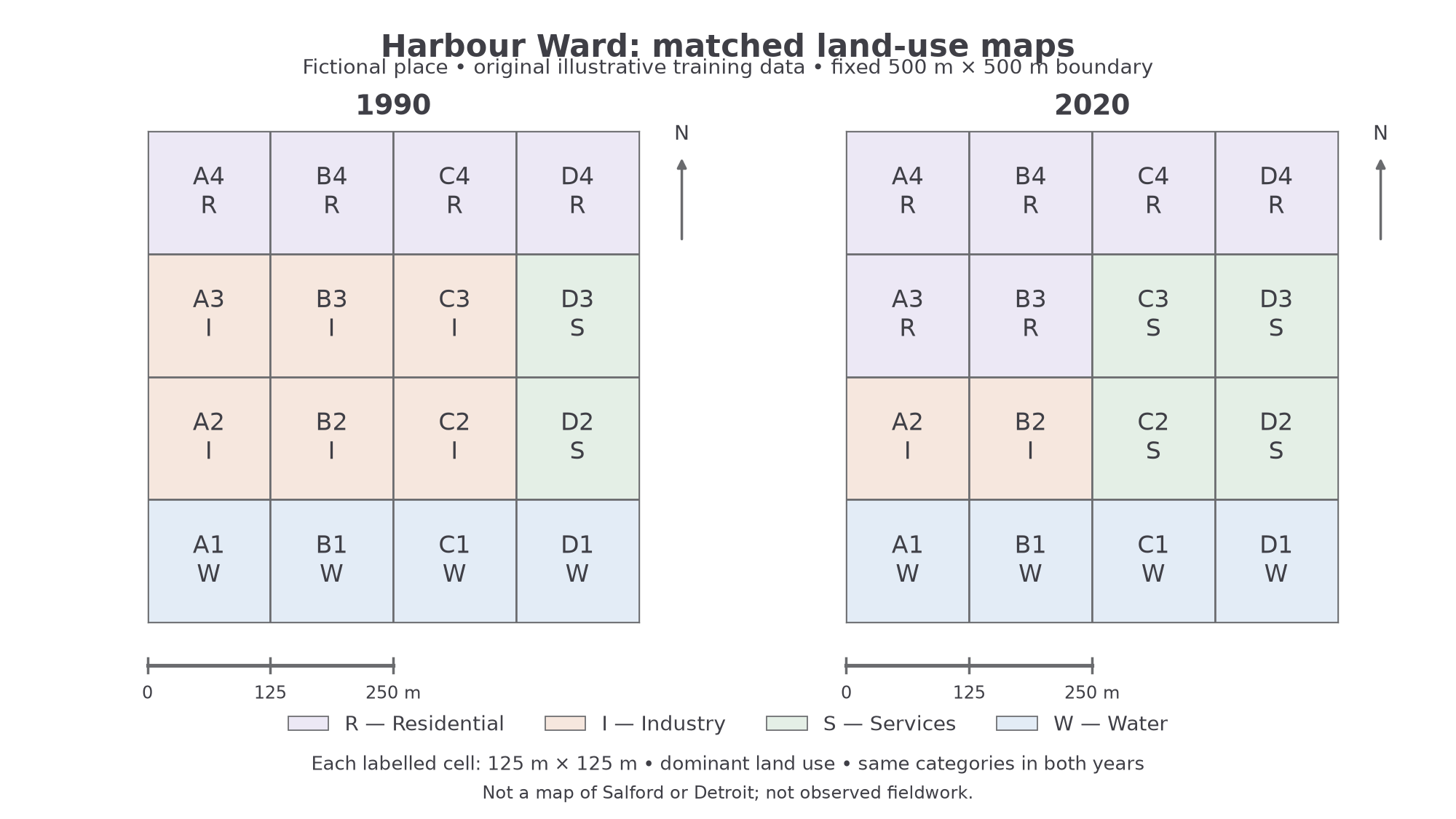
Original illustrative training maps of fictional Harbour Ward, not observed fieldwork or maps of Salford or Detroit. Both show the same 500 m × 500 m square. Each of the 16 cells represents 125 m × 125 m and is labelled by its dominant land use. The water boundary and grid are unchanged.
Industrial use falls from six cells in 1990 to two in 2020. Two former industrial cells in the north of the industrial block become residential, and two on its eastern side become services. The four water cells continue, so redevelopment has changed adjoining functions without removing the mapped waterside setting. Residential use rises from four to six cells and services from two to four. These are changes in mapped dominant land use, not direct measurements of population or employment.
Percentage change = .
Each cell covers 15,625 m². Industrial area therefore falls from 93,750 m² to 31,250 m²: a fall of 62,500 m², or to one decimal place. The share of all 16 cells falls from 37.5% to 12.5%, a 25 percentage-point fall. Percentage change and change in percentage share answer different questions. The map alone cannot establish whether jobs fell by 66.7%, because different activities employ different numbers of people per unit of land.
Real place evidence shows a different comparison:
| Geographical unit | Earlier Census population | Later Census population | Supported change |
|---|---|---|---|
| Salford local-authority area, England, E08000006 | About 233,900, 2011 | About 269,900, 2021 | About +36,000; ONS reports +15.4% |
| Detroit city, Michigan, USA | 713,777, 1 April 2010 | 639,111, 1 April 2020 | −74,666; calculated −10.5% to one decimal place |
Sources: ONS Salford population change and US Census Bureau QuickFacts. Salford values are rounded; the decades are not identical. Both units are city-level administrative areas rather than equivalent neighbourhoods. This establishes a contrast in population direction in those periods, not a claim about their current population or a controlled test of one cause. Births, deaths, migration and boundary/measurement issues must be considered before explaining it.
Apply the same method to your own local place: choose a defensible boundary around where you live or study, obtain compatible past and present maps or records, quantify a specific change and identify continuity. Do not replace missing local evidence with these worked examples. Record changes of boundary or category, and add appropriate evidence of processes and lived experience before drawing a causal conclusion.
Uneven change and lived experience
Continuity and change affect opportunities, identities and daily life differently because people occupy different positions within a place's connections.
A new employer can provide jobs, spending and a stronger tax base while requiring skills some established residents lack. A better transport link can widen access for people able to use it, but fare costs, disability access and shift times can limit its reach. Increased housing demand may increase an owner's wealth while raising a tenant's rent. These mechanisms explain social inequalities: unequal access to resources and opportunities between groups and areas. Economic growth and inequality can therefore increase together.
The demographic and cultural lens asks who arrives or leaves, how household and age patterns change, and how languages, practices and social networks develop. The economic and inequality lens asks how jobs, income, ownership, costs and access change. The lenses connect: recruitment can attract migrants and alter cultural life while uneven skills or housing access shapes benefits. Neither lens captures lived experience through totals alone.
For Salford, a Quays redevelopment account can describe new functions while a city-wide population trend describes another scale. Combining them is useful, but the two do not prove that Quays investment caused the authority's entire population increase. For Detroit, a major plant investment can coexist with a longer-period fall in municipal population. Different dates, spatial units and groups can produce apparently contradictory evidence without either source being false.
To investigate the effects, combine quantitative records with situated accounts of daily routines, belonging and access. These original illustrative accounts demonstrate questions to ask, rather than report interviews:
| User of a changing place | Possible experience | Evidence needed to test its wider significance |
|---|---|---|
| A worker gaining access to a new job | A shorter commute or new opportunities; stronger attachment to the area | Employment and access evidence for different worker groups, not just total jobs |
| A tenant facing rising housing costs | Greater insecurity despite attractive new buildings | Comparable rent and income records, plus accounts from tenants in different locations |
| A long-term resident using a retained meeting place | Continuity in social ties despite changes nearby | Past and present accounts of use, alongside evidence of who can still access it |
Meanings and representations interact with relationships. Marketing can present an area as an investment opportunity, attracting finance; finance changes buildings and activities; those changes alter experiences and future representations. A resident may interpret retained dock structures through family memories while a visitor sees a leisure destination. A representation's effect is a hypothesis to investigate, not proof that everyone accepts it.
For a learner, the relevant consequences may include journeys to school, opportunities for work, housing costs, access to meeting places or changing feelings of belonging. Start from a concrete routine and identify a connection that might explain a change. Then compare other users, times and parts of the locality. Your own experience provides a perspective, not permission to invent other people's accounts or certify fieldwork. Salford is the provider's worked local example; your local study must use the place where you live or study, and an appropriate further contrasting place must be researched on its own terms.