3.2.3.5 - Evaluating an urban river restoration project
Use the River Quaggy at Sutcliffe Park to explain restoration choices and evaluate flood, ecological and social outcomes with appropriate evidence limits.
The Quaggy project and its reasons
River restoration aims to recover river processes, habitat and connections while accommodating the constraints of an urban setting.
The River Quaggy in south-east London had been confined in channels and culverts, separating it from people and its floodplain. Flood risk remained downstream. Enlarging engineered channels would transfer water rapidly and could damage habitat. At Sutcliffe Park in Greenwich, restoration completed in June 2004 opened a low-flow channel and made the park a flood-storage area. This local project sits within the wider 4.3 km Sutcliffe–Lewisham scheme reported by the Environment Agency in 2007.
The aims combined flood-risk reduction, habitat improvement and better public access. Keep scales clear: the park's design storage capacity is 85,000 m³; the wider scheme also includes Weigall Road storage and downstream works. Scheme-wide claims about 600 premises cannot be relabelled as a Sutcliffe-only outcome. This is a specific restoration case, distinct from Salford Quays basin aeration or a conventional Irwell flood-defence wall.
Stakeholders and competing priorities
Restoration required cooperation between organisations controlling engineering, land and community knowledge.
The Environment Agency provided flood-management expertise and delivery. Local councils controlled park and public-space decisions; landowners and residents were affected by downstream works and access. The Quaggy Waterways Action Group's Operation Kingfisher proposals in 1994–95 advocated restoring river and floodplain connections rather than simply enlarging channels. Local expertise helped build an alternative vision and sustained campaigning.
Flood protection, wildlife, sport, safety and everyday access can pull design in different directions. A lowered park must sometimes flood, potentially restricting use during storms; downstream gardens require appropriate boundaries and construction arrangements. Consultation and careful access design can address concerns but do not prove unanimous support. QWAG's account is primary evidence of a participant's role and priorities, rather than an independent survey of every resident's view.
Restoration activities and process links
The Quaggy works changed both channel form and the route taken by floodwater.
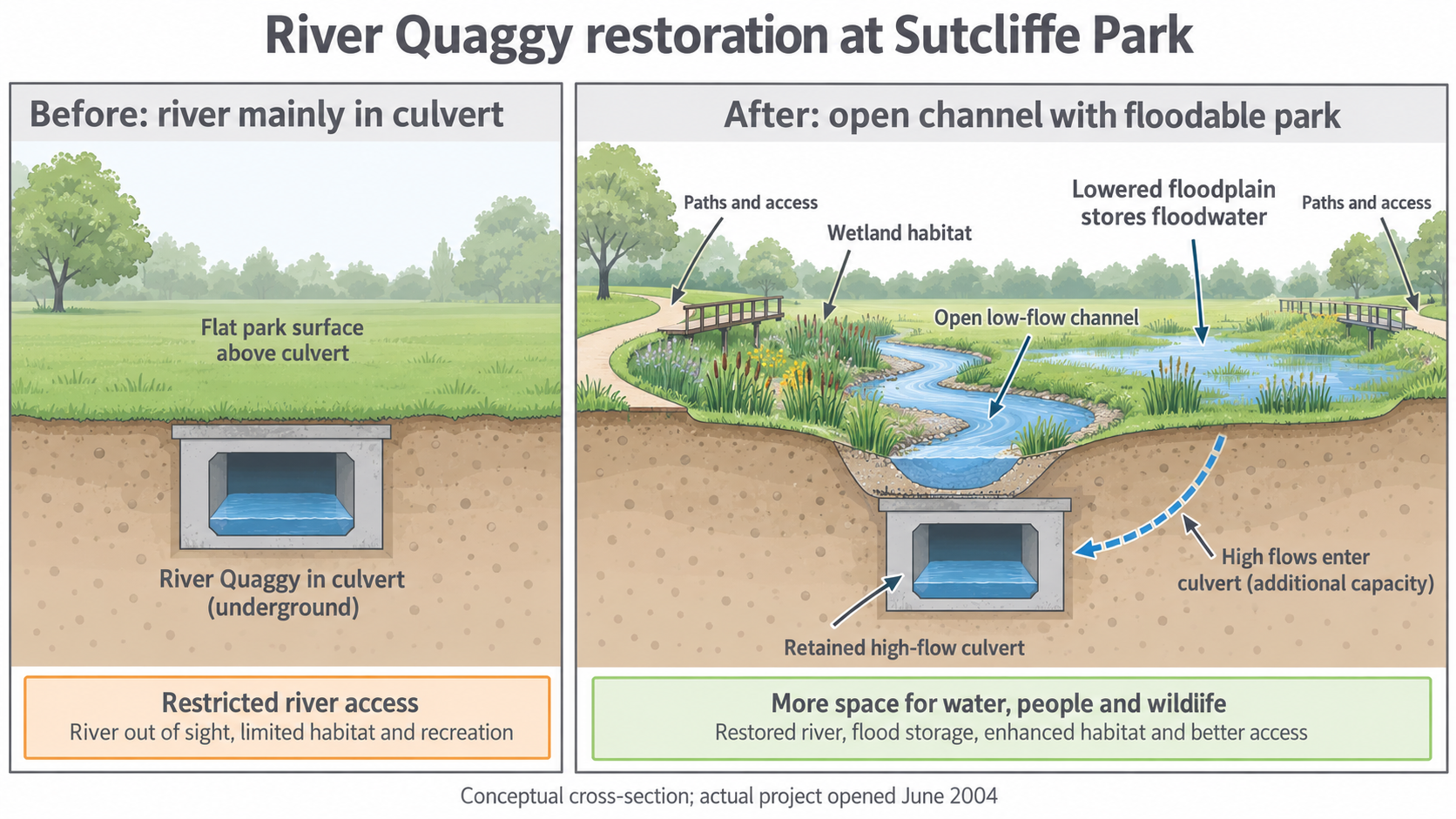
Conceptual cross-section, not an exact surveyed map; a high-flow culvert was retained alongside the restored channel.
Continue this lesson.
You’re previewing NovaLearn without an account. Create a free account to read the rest.
Create free account