3.1.4.3, 3.1.4.4 - Glacial transport and depositional landforms
Glaciers move debris and leave sediment when transport changes or ice melts. Distinguish the material, process and form, then connect depositional features into a landscape.
Transport through a glacier
Glacial transport moves rock supplied by erosion at the bed and weathering on surrounding slopes. Supraglacial debris lies on the surface; englacial debris is enclosed within ice; subglacial debris lies beneath it. Rockfall initially adds angular surface material, while crevasses, burial by snow and changing internal flow can incorporate it. Basal erosion adds fragments and fine sediment beneath the glacier.
Unlike flowing water, ice can carry a wide mixture of particle sizes together, including very large boulders. Some material is crushed and abraded, but short-distance rockfall debris may remain sharp. Abraded clasts can carry scratches and flattened surfaces. Transport distance cannot be inferred confidently from roundness alone because rock type, debris position and later meltwater reworking also affect it.
Deposition occurs when ice melts out its load, when material is released from its base or when movement pushes and accumulates sediment at a margin. Retreat exposes deposits while ice may continue flowing forwards. Sediment is therefore not left only during complete glacier disappearance.
Till
Till is sediment deposited directly by glacier ice, generally poorly sorted and containing a mixture of sizes. Meltwater can later rework it into better-sorted sediment.
Moraines and erratics record transport and margins
A moraine is a landform or accumulation of debris associated with a glacier. Lateral moraines form beside valley ice from wall debris and ice transport. When tributary glaciers merge, their adjoining lateral debris can become a medial stripe, which may be left as a central deposit after melting. A terminal moraine marks an ice-margin position; smaller recessional moraines can mark pauses or readvances during an overall retreat. A stillstand can accumulate a ridge while ice flows into a stationary margin.
An erratic is a transported rock whose geology differs from the local bedrock. Matching its lithology to a possible source can support reconstruction of transport, especially with striations and other deposits. A large boulder alone is not sufficient: it might have fallen locally or been moved by another process.
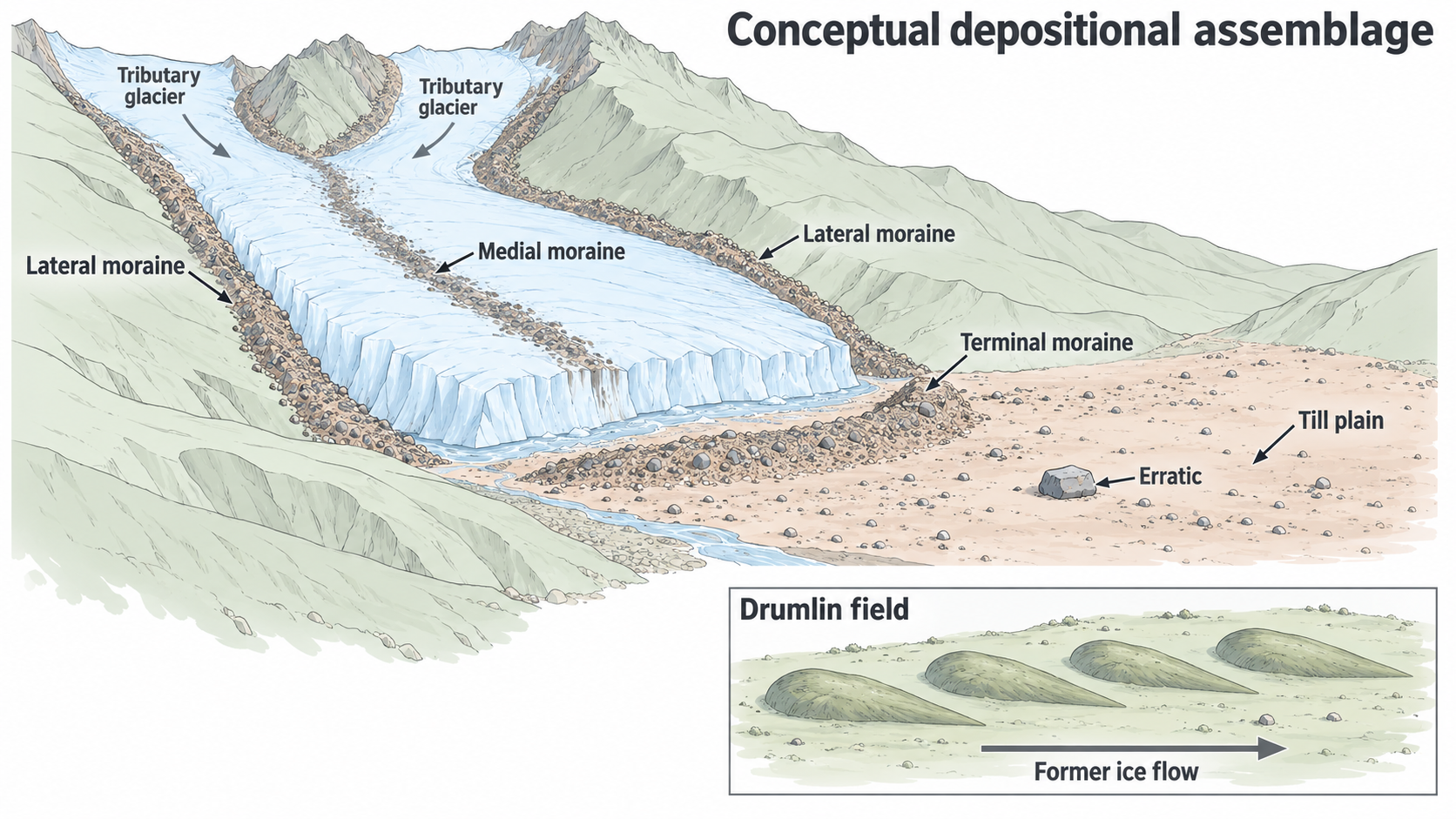
Conceptual depositional relationships. The drumlin inset shows one possible streamlined form and former flow orientation; it does not measure a real field or demonstrate a single universal formation mechanism.
Continue this lesson.
You’re previewing NovaLearn without an account. Create a free account to read the rest.
Create free account