3.2.3.4 - Urban climate, wind and air quality
Explain how urban form modifies heat, rainfall and airflow, then connect particulate and photochemical pollution to practical management.
Urban heat islands and energy exchanges
An urban heat island is a temperature contrast between an urban area and its surrounding reference area.
Buildings and paved surfaces store solar energy and release it later, so the air-temperature contrast is often greatest after sunset in calm, clear conditions. Reduced vegetation lowers evapotranspiration and its cooling effect. Dark surfaces can absorb more radiation; street canyons can restrict long-wave energy loss to the sky. Vehicles, industry, heating and cooling add anthropogenic heat. These mechanisms vary with season, moisture, materials and city form.
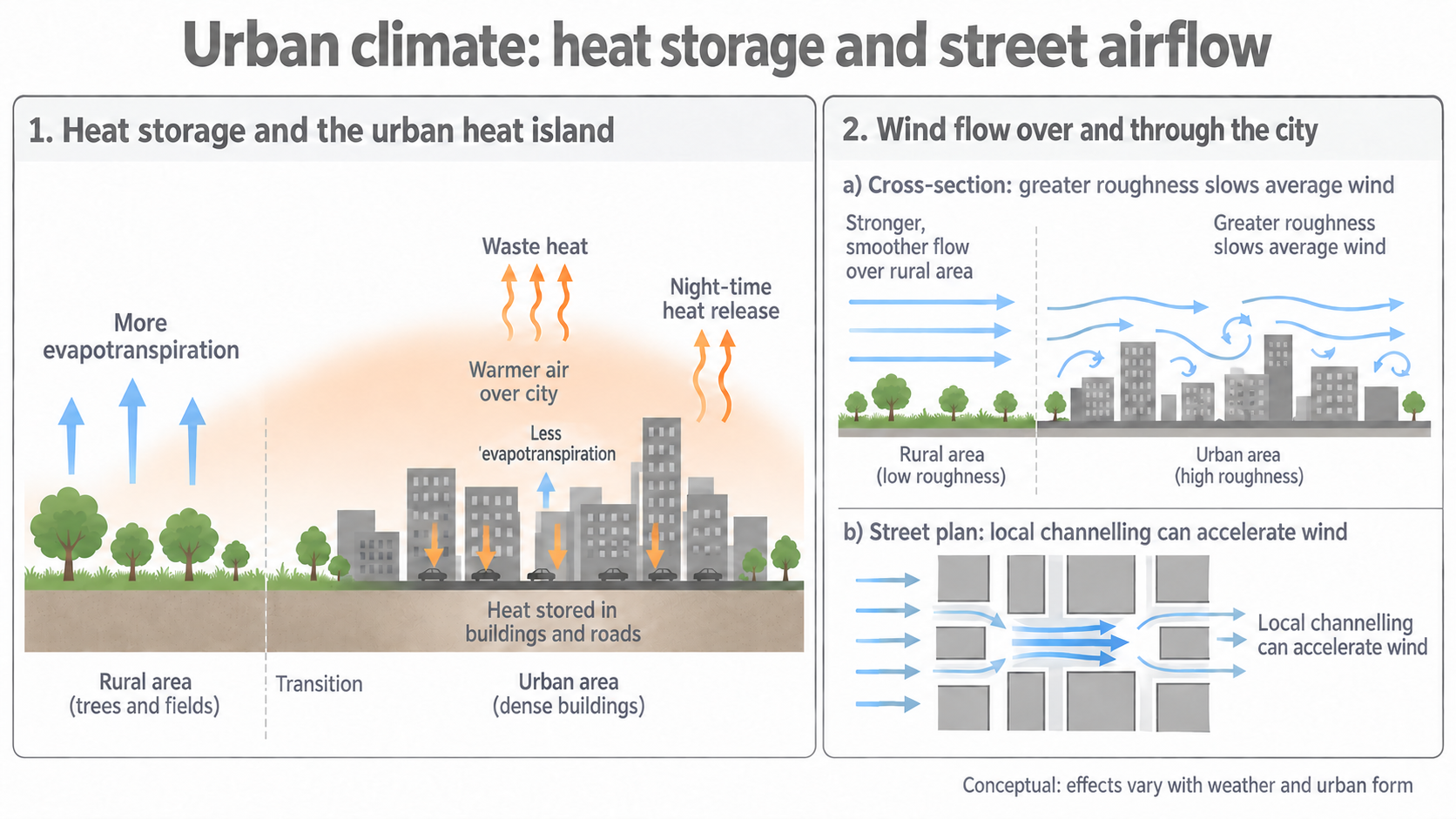
Average wind reduction across rough urban terrain and local street acceleration are different effects.
Surface heat islands measured from infrared imagery differ from air heat islands measured by thermometers. A hot roof does not directly give pedestrian air temperature. For an original training example, a city air temperature of 24°C and simultaneous rural reference of 20°C gives a 4°C contrast. Match time, sensor height and weather; a shaded park may be cooler than a nearby street, so one sensor cannot represent the whole city. Heat raises health risks and cooling demand, especially where people lack shade or suitable housing.
Rainfall, fog and thunderstorms
Urban effects on atmospheric moisture and uplift are conditional, so cities do not invariably receive more rain or fog.
Warm urban air can rise through convection, while buildings add mechanical turbulence. Aerosols can act as condensation nuclei. With sufficient moisture and instability, these influences can modify cloud formation, rainfall frequency or intensity, including downwind rather than directly over the centre. Strong uplift can contribute to thunderstorms, but heat alone cannot produce one without suitable atmospheric conditions. Regional weather and topography may dominate.
Fog requires near-surface air to reach saturation. Pollution particles can encourage droplet formation, and local water or weak ventilation can favour fog. However, urban warmth can lower relative humidity and reduce radiation fog compared with a cooler rural site. Historical smoky fog and present-day fog frequency are therefore not interchangeable. Compare records over several weather situations and account for changes in emissions, instruments and locations.
A heavier shower creates a larger input to drainage systems, but even unchanged rainfall can produce worse flooding when surfaces are sealed. Keep the atmospheric cause and catchment response distinct.
Continue this lesson.
You’re previewing NovaLearn without an account. Create a free account to read the rest.
Create free account