3.2.1.1 - Globalisation flows and driving forces
Learn how different flows connect people and places, why global production networks develop, and how technology and institutions make those connections possible. Use evidence to distinguish increased connectivity from equal participation.
Five connected flows
Globalisation connects decisions and activities in distant places through flows that often reinforce one another.
Globalisation
The increasing interconnectedness and interdependence of people, places and economies through flows across space, including across national borders.
Capital is money or assets used to finance activity. An investor financing an overseas factory creates a capital flow. Foreign direct investment (FDI) involves a lasting ownership interest and influence over an enterprise abroad; buying a small holding of foreign shares is portfolio investment. Loans and profits transferred overseas are other financial flows. These movements differ in purpose and stability.
Labour flows move people who can work, rather than moving their money. Migration may supply workers to a destination with vacancies while reducing available workers at the origin. A migrant's remittance, money sent home, is a financial flow generated by a labour flow. Migration also transfers skills, experiences and social connections. Border rules, recruitment costs and family obligations mean labour is often less mobile than digital information.
Product flows move tangible goods such as components or clothing. Service flows provide activities such as transport, insurance, tourism or software support. A tourist travels to consume a service abroad; a remotely delivered service can cross a border without the supplier moving. Information flows carry designs, prices, news and instructions. A digital message is information; a paid overseas design service uses that information but is also a service transaction. The categories overlap without being identical.
Production, marketing and consumption
A production network links places that perform different tasks rather than placing every task beside the final customer.
Design and finance may concentrate in a city with specialist workers, assembly near suppliers and suitable labour, and distribution beside ports or large markets. Production makes the product, distribution moves and stores it, and consumption uses it. A firm's choice depends on total costs, skills, reliability, regulation and market access, not wages alone. Assembly can move while control, design and much of the profit remain elsewhere.
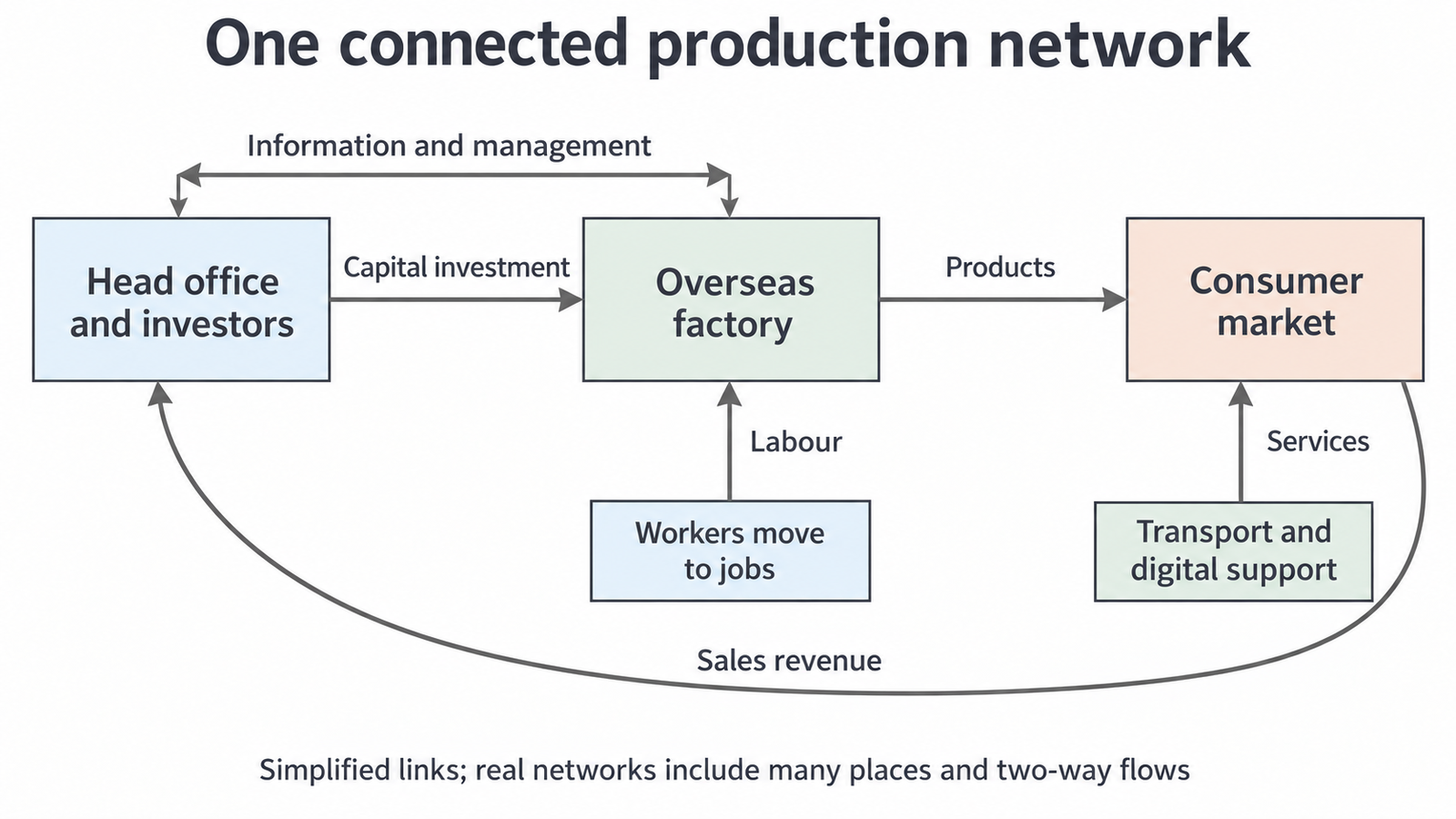
This conceptual schematic shows directions of selected flows, not locations or measured volumes. Sales revenue comes from the consumer market. Real networks also contain component suppliers, governments and flows returning to several places.
Global marketing seeks customers across national markets using brands, advertising, platforms and distribution. A recognisable brand can spread common consumption patterns. Firms also adapt language, pricing, food ingredients or product sizes to local income and culture. Marketing both responds to demand and helps create it. A globally advertised product is not necessarily made in one country or affordable to everyone.
Finance and transport reduce distance costs
Cross-border activity becomes more feasible when firms can pay, borrow and deliver reliably.
Banks, foreign-exchange markets and payment networks enable transactions between different currencies and jurisdictions. Trade finance, such as a bank's promise to pay an exporter when specified documents are supplied, can reduce the risk of shipping before payment. Insurance transfers some losses to an insurer. These systems allow an exporter to deal with a distant buyer it does not know personally. They facilitate flows; they cannot remove insolvency, exchange-rate risk or political restrictions.
Containerisation uses standard-sized units that transfer between ship, rail and lorry without repeatedly handling individual goods. Ports, cranes, schedules and inland connections are as important as the container. Larger loads and less handling can reduce unit costs; reliable delivery allows firms to coordinate dispersed suppliers. Air freight suits some high-value or perishable goods, but its cost prevents universal use.
Time–space compression means that improved transport and communication reduce the time or cost of connecting places. Physical distance remains. A coastal factory beside an efficient port may access customers more easily than a geographically closer inland factory with unreliable roads. Cheap transport also enables longer supply chains, increasing exposure to disruption at a shared port or shipping route.
Digital coordination and management
Fast communication supports global networks only when organisations can turn messages into coordinated decisions.
Fibre-optic cables, satellites and mobile networks transmit communications between places. Information systems store and process data: stock records, electronic customs documents and tracking systems help a firm identify what is available and where. Management systems organise responsibilities, standards, supplier contracts and production schedules. A delivery alert is information; a manager changing an assembly schedule is a decision based on it.
For an original illustrative example, imagine a garment retailer detecting rising sales in one market. Its stock database flags falling inventory, managers authorise an order, a supplier receives the specification, and tracking data inform the distribution centre of the arrival time. Communications connect the stages; data quality and compatible standards make the connection useful. An internet cable alone does not create a functioning supply chain.
Coordination can support just-in-time delivery, where inputs arrive near the moment of use, reducing storage costs. This also makes production vulnerable if a delayed input has no substitute. Firms may therefore hold reserves or use several suppliers. Digital systems alter where tasks can occur, but electricity, skills, cybersecurity and dependable transport still constrain participation.
Security and trade rules enable connections
Global networks depend on trust, protected routes and predictable rules as well as technology.
Security systems protect ships, cargo, payments and information. Port inspection, secure identity checks and cybersecurity can reduce theft, fraud or attack, making firms more willing to trade. Insurance and risk assessment affect which routes firms use. Extra controls can also delay freight. UNCTAD reported in February 2024 that attacks on commercial vessels in the Red Sea had disrupted shipping through the Suez Canal. Rerouting illustrates how a security problem in one corridor can change distribution between distant markets. This is a dated example, not a claim that the same route conditions persist today. UNCTAD report announcement.
A tariff is a tax on imports; a quota limits the quantity imported. Trade agreements may reduce such barriers, simplify customs procedures or align selected rules. Lower expected costs and greater certainty can make overseas production or sales worthwhile. An agreement does not abolish every border control, transport cost or product standard. Eligibility rules and implementation matter.
The drivers interact. A tariff reduction helps little if a shipment cannot travel safely; an excellent port helps little if payments are prohibited. Governments can promote connections and deliberately restrict them. Globalisation is therefore shaped by political choices rather than being an inevitable result of new technology.
Reading evidence of uneven connections
Evidence of growing flows must identify who is connected, what moves and how it is measured.
A flow map needs an origin, destination, arrow direction, period and key. Arrow width may represent value, people or physical quantity; those measures are not interchangeable. A schematic without a scale cannot establish the largest flow. A map of total flows also favours large populations and economies: per-person measures can reveal a different pattern.
ITU's 2024 estimates give a useful digital example:
| Population group | People using the internet, as a percentage of that group's population, 2024 |
|---|---|
| World | 68% |
| High-income countries | 93% |
| Low-income countries | 27% |
The income-group gap is 66 percentage points, not 66%. Internet use can facilitate information and services, but this table does not measure connection speed, affordability or the value of cross-border transactions. Group averages also hide differences within countries. ITU, Facts and Figures 2024: internet use.
For a financial example, the World Bank's December 2024 estimate put officially recorded remittances to low- and middle-income countries at US$685 billion for 2024. That is a flow over a year, not accumulated wealth, and informal transfers are not fully recorded. It demonstrates a substantial link between migrants and households elsewhere; it does not prove every receiving household benefits equally. World Bank estimate, 18 December 2024.
Explain a connection through its actors, flow, enabling systems and spatial consequences. Then ask which people or places the evidence includes and which it hides.