3.1.2.1 - Climate, soils and vegetation at desert margins
Connect hot-desert and semi-arid climates to soils and vegetation, and use a water balance and aridity index to compare water limitation without confusing dryness with land degradation.
Rainfall, temperature and seasonal margins
Hot-desert rainfall is scarce and often irregular. Long dry intervals can be interrupted by intense storms. Clear skies allow strong daytime heating and rapid night-time radiative cooling, often giving a large daily temperature range. Seasonal ranges vary with latitude, altitude and distance from the sea; a hot desert need not be hot every night or every winter day. Potential evapotranspiration describes atmospheric demand where water is available; actual evapotranspiration is limited by the available water.
Semi-arid margins usually have more rain, often concentrated in a short season. A climate graph should be read for annual total, wet-season length and monthly timing as well as temperature. Two places with the same annual rainfall may have different growing conditions if one receives small frequent events and the other a few runoff-producing storms. Furnace Creek's NPS historical table for 1911–2007 reports annual rainfall of 1.94 inches, about 49 mm; this is a station-period example, not a current average for all Death Valley elevations.
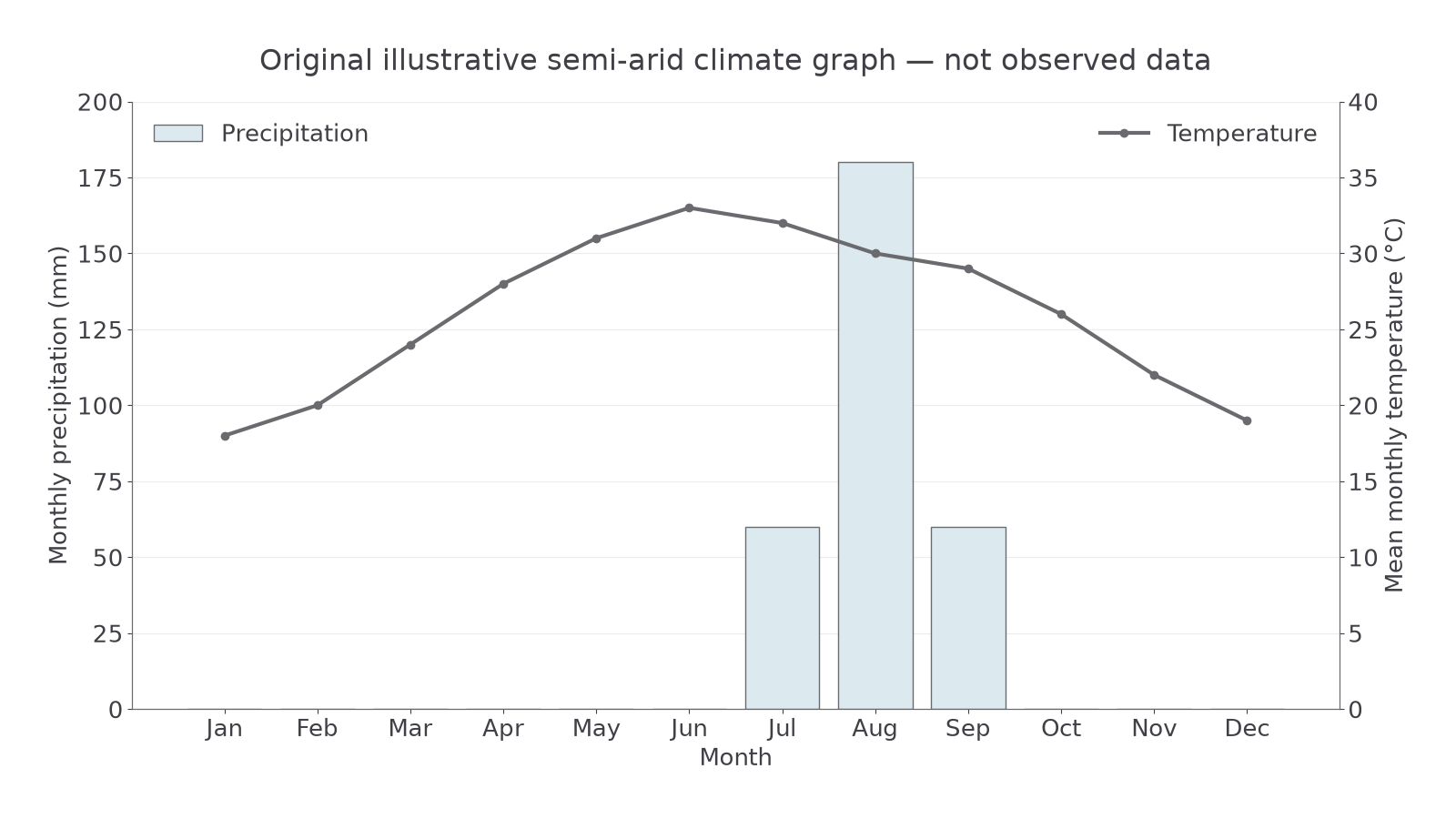
Read the axes separately: bars use millimetres on the left, the line uses degrees Celsius on the right. The training place receives 300 mm in July–September, with an August peak of 180 mm, while its highest mean temperature is 33°C in June. Nine rainless months and high warm-season demand indicate a long potential deficit, but no PET series is supplied to quantify it. This is a constructed example, not a real station record.
Soils and vegetation influence each other
Sparse vegetation supplies little litter, so many desert soils have low organic matter and weakly developed horizons. Slow leaching allows salts or carbonates to accumulate where evaporation exceeds replenishment. Some soils are sandy and permeable; others have fine material or crusts that restrict infiltration. These differences matter: 'all desert soils are sand' cannot explain stony surfaces, clay playas or alluvial soils.
Plants survive water shortage through different adaptations. Small or waxy leaves reduce transpiration; some plants store water in succulent tissues, use deep roots or extensive shallow roots, or remain dormant until rain. Short-lived plants can complete their life cycle rapidly after wetting. At margins, grasses and shrubs may provide greater seasonal cover, but drought and pressure from grazing can reduce it.
At semi-arid margins, more seasonal water and plant cover can increase organic inputs and allow more leaching than in hyper-arid interiors. Dry seasons, intense rain, grazing and local soil texture still produce patchy conditions rather than universally fertile margin soils.
Vegetation shades soil and adds organic matter; roots and surface litter slow runoff and bind sediment. Better infiltration supports plants, a reinforcing recovery feedback. Loss of cover can expose the surface to wind and runoff, remove nutrients and reduce future growth. An intense shower may run off a crusted bare slope while infiltrating nearby vegetated patches: climate, soil and vegetation must be analysed together.
Continue this lesson.
You’re previewing NovaLearn without an account. Create a free account to read the rest.
Create free account