3.2.3.5 - Urban water cycles and sustainable drainage
Trace urban water through stores and transfers, interpret changed hydrographs and explain sustainable drainage under realistic ground and capacity constraints.
Rainfall, surfaces and catchment stores
Urbanisation changes how rainfall is partitioned between runoff, evaporation, infiltration and storage.
Roofs and sealed roads reduce infiltration and route water rapidly to drains. Vegetation loss reduces interception and evapotranspiration; compacted soil may also infiltrate poorly. Soil-water and groundwater recharge can fall, while temporary surface storage may move into tanks, ponds or sewers. The effect depends on rainfall intensity and duration, antecedent moisture, slope, geology and the proportion of connected impermeable surfaces. Water from an isolated paved courtyard need not reach the river as rapidly as water entering a connected drain.
Urban catchments also import piped water and export wastewater. Leaking mains can add groundwater recharge, while abstractions and sewer systems move water across natural catchment boundaries. Therefore reduced rainfall infiltration does not prove that total urban groundwater storage always falls. Identify inputs, outputs and changes in storage explicitly; water is redistributed rather than destroyed.
Hydrograph response and causal interpretation
A storm hydrograph shows river discharge through time and helps reveal changes in runoff routing.
For the same storm, connected drains and reduced infiltration often shorten lag time, steepen the rising limb and raise peak discharge. Detention can delay and flatten the peak by releasing stored water gradually. Storm duration, baseflow and catchment size also affect the curve, so comparing different storms cannot isolate urbanisation alone.
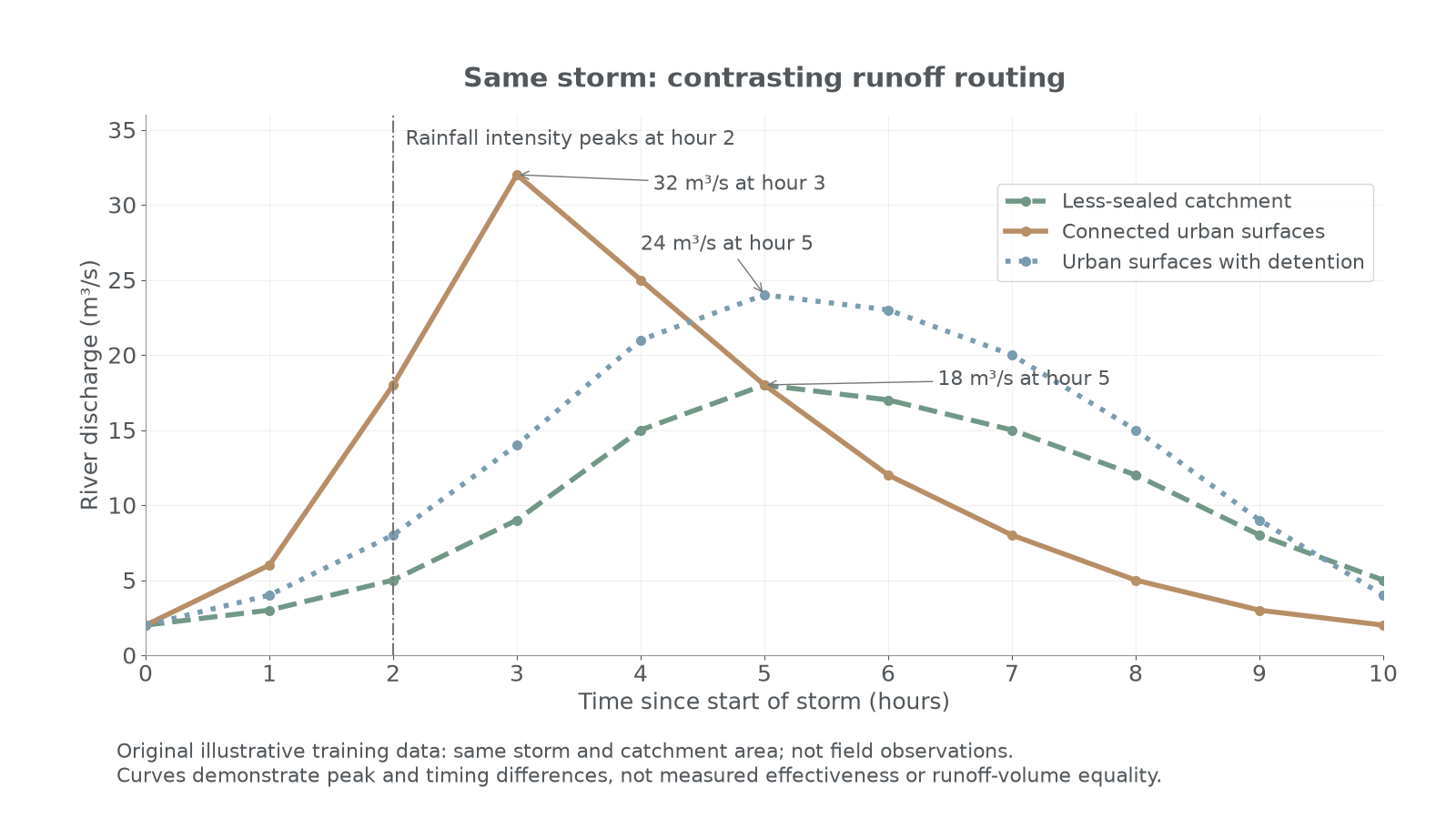
Training data, not field observations: rainfall peaks at hour 2; discharge is in cubic metres per second.
In this original illustration, the urban peak is 32 m³/s at hour 3; the less-sealed peak is 18 m³/s at hour 5. Their peak lags after rainfall are 1 and 3 hours. With urban detention, the peak is 24 m³/s at hour 5: an 8 m³/s, or 25%, reduction relative to the urban peak. These values demonstrate interpretation, not a forecast for a real project. Lower peak discharge does not establish that runoff volume disappeared or that every downstream location benefits.
Urban drainage problems and management
Urban drainage must manage flood risk, water quality and competing uses of limited space.
Intense rainfall can exceed drains and cause surface-water flooding even away from rivers. Blocked inlets and poor maintenance reduce effective capacity. Combined sewers carry foul water and storm runoff; overload can cause sewage releases or basement flooding. Road runoff carries oils, metals and sediment, while misconnections can send foul water into surface drains. Accelerating water away from one site can raise downstream flood risk.
Continue this lesson.
You’re previewing NovaLearn without an account. Create a free account to read the rest.
Create free account