3.1.5.3 - Volcanic hazards and their patterns
Volcanic hazards differ in material, speed, route and duration. Their distribution reflects tectonic settings, but predicting a particular eruption requires local monitoring and careful interpretation of uncertain evidence.
Tectonic setting and eruption style
Vulcanicity is the movement of magma and gases within and onto Earth's surface, with different tectonic settings supplying different pathways for melting and eruption.
At constructive margins and many plumes, rising hot mantle undergoes decompression melting. Basaltic magma commonly has relatively low viscosity, meaning it flows readily. At subduction zones, water released from the descending slab promotes partial melting above it; magma can evolve as it rises and interacts with crust. More silica-rich magma is often more viscous. Dissolved gases expand as pressure decreases near the surface. If they escape readily, eruption may be comparatively effusive; if viscous magma traps gas, fragmentation and explosive release become more likely.
These are tendencies, not rules that every ridge eruption is harmless or every subduction eruption identical. Water–magma interaction can fragment basaltic magma explosively, and a volcano can change style through an eruptive sequence. Magma is molten or partly molten rock below ground; lava is erupted molten rock at the surface. A hazard explanation should connect composition, gas, pressure and pathways to the material released rather than infer impact directly from the plate-margin label.
Volcanoes also differ in shape. Repeated fluid lava flows can build broad shields; layers of lava and fragmental material can build steeper composite cones; viscous lava can form domes prone to collapse. These shapes influence routes and instability, but exposure and management still determine whether the physical hazard becomes a major disaster.
Lava, tephra and pyroclastic currents
Lava and fragmented volcanic material threaten places through different transport mechanisms, so one evacuation rule cannot be assumed to fit them all.
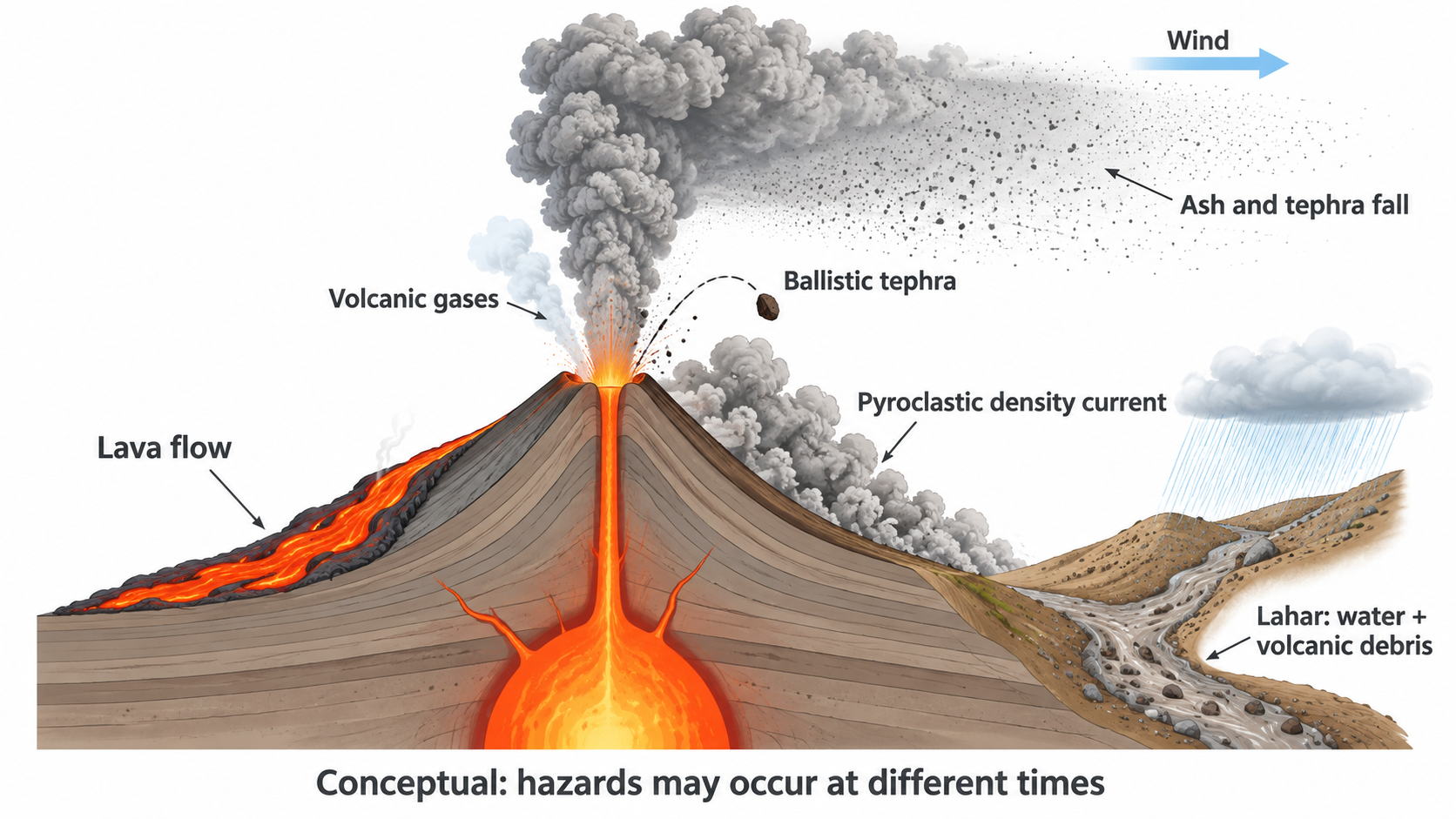
Conceptual pathways. Not all shown hazards occur together in one event; valley direction and wind alter the affected area.
Lava flows follow topography, burn or bury vegetation and structures, and can sever roads and utilities. Flow speed depends on supply, viscosity, slope and confinement. Some flows advance slowly enough for evacuation, but fast flows, new vents and cut escape routes can still threaten life. Their long-lived solid deposits can obstruct access after visible activity ends.
Tephra is fragmental material ejected during an eruption, ranging from fine ash to lapilli and larger blocks or bombs. Large ballistic fragments can fall near the vent along trajectories independent of the prevailing wind. Ash consists of particles smaller than 2 mm of fragmented rock, mineral and volcanic glass; it is not soft soot. Wind can spread it far beyond the cone. Inhalation, poor visibility, abrasion of machinery, engine damage, contaminated water and roof loading create risks. Wet ash can impose particularly heavy loads. A thick local deposit and a fine distant ash cloud are different forms of exposure.
Pyroclastic density currents are hot mixtures of gas and volcanic fragments moving rapidly near the ground, often after eruption-column or lava-dome collapse. Dense flows commonly follow valleys; more dilute surges can spread differently and cross some topographic barriers. Nuées ardentes, meaning glowing clouds, is a traditional term associated with these searing gas-and-fragment currents, especially dome-collapse activity. They are not ordinary cool mudflows or a harmless airborne ash plume. Their heat, speed and burial can destroy vegetation and buildings and make escape after arrival unrealistic. USGS describes their mechanisms and secondary effects.
Continue this lesson.
You’re previewing NovaLearn without an account. Create a free account to read the rest.
Create free account