3.1.6.2 - Ecosystem structure, energy and nutrient cycling
Use ecosystem boundaries, food webs and budgets to distinguish energy flows, biomass production and mineral nutrient cycling.
Ecosystem structure and feeding relationships
An ecosystem combines a community of organisms with its non-living environment and their interactions. Biotic components include plants, herbivores, predators and decomposers. Abiotic components include light, water, temperature, soil minerals and relief. The boundary is chosen for the enquiry: a pond, a woodland plot and a whole biome are different systems with different exchanges across their edges.
Producers capture energy, usually through photosynthesis. Primary consumers eat producers; secondary consumers eat primary consumers. These positions are trophic levels. A simple chain, grass → grasshopper → insect-eating bird, uses arrows pointing from food to feeder, showing the direction of transfer. An omnivore may feed at more than one level, so a species does not always have one fixed trophic position.
Food web
A network of linked feeding relationships in a community, including alternative foods and pathways.
If birds also eat caterpillars and seeds, and grasshoppers are eaten by lizards, the web has several pathways. Removing one food source can alter competition and predation elsewhere; alternative foods may partly buffer the impact. Decomposers, such as fungi and bacteria, break down dead material from every trophic level. They are not simply the final carnivore in a single chain.
Energy transfers across an ecosystem boundary
Solar radiation is an energy input. Producers convert only part of it into chemical energy. Energy transfers through feeding and dead organic matter, while respiration releases energy as heat to the surroundings. Not all biomass is eaten, and not all consumed material is assimilated. Thus successive consumers usually receive less energy and support less production. Transfer efficiencies vary; 10% is an illustration, not a universal ecological constant.
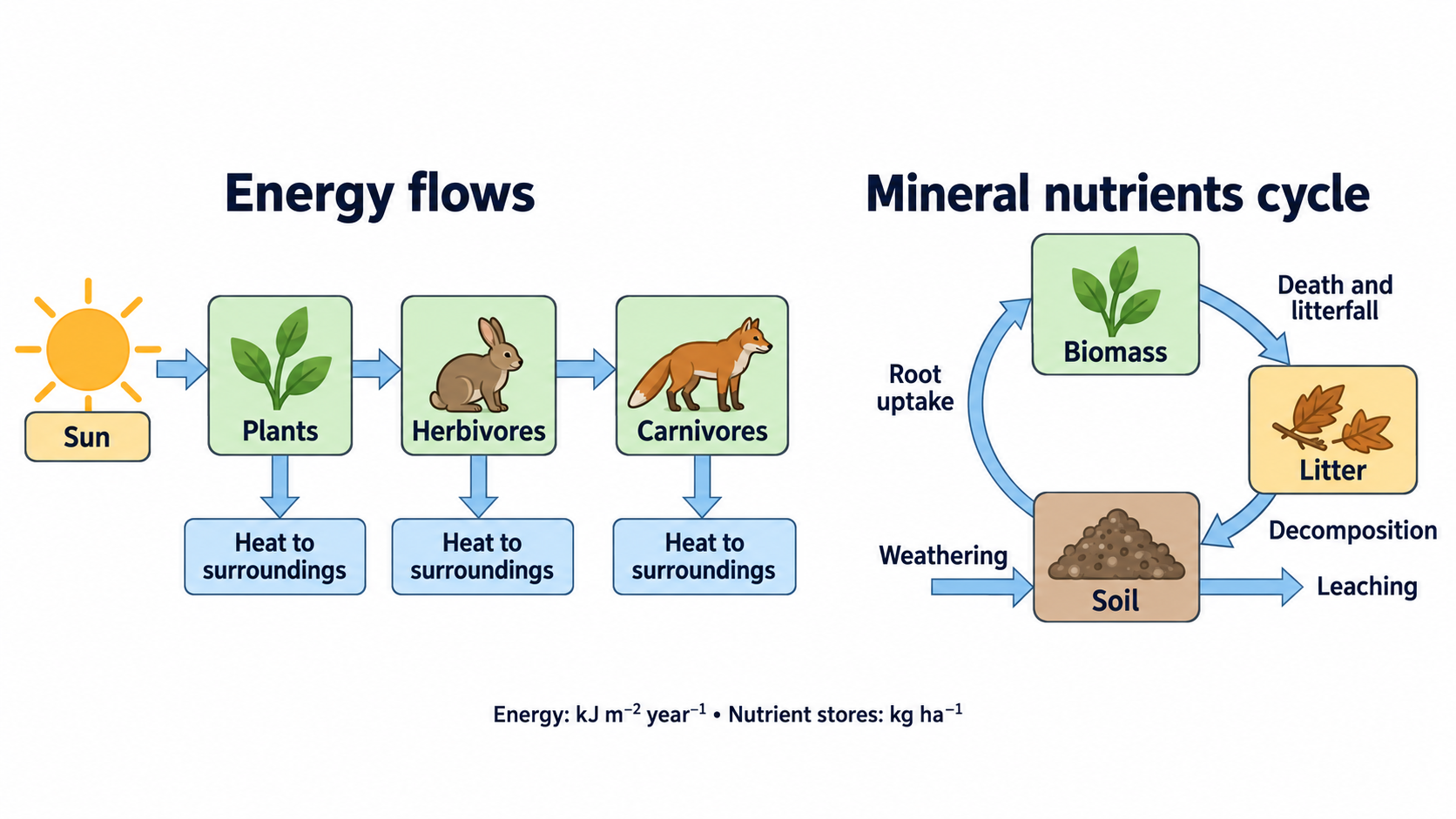
The two panels distinguish energy from minerals. Heat is an energy output; it does not return through root uptake. The mineral stores remain open to inputs and losses.
Within a defined woodland boundary, living organisms, litter and soil organic matter store materials and chemical energy. Feeding, litterfall and decomposition transfer them internally. Imported organic matter is an input; exported timber, eroded litter or water carrying dissolved minerals are outputs. A change in a store equals inputs minus outputs over the same interval. Do not count an internal transfer as a second external input.
An original illustrative annual budget has producer net production of 12,000 kJ per square metre per year, of which herbivores consume 3,000 in the same unit. Herbivore net production is 600 kJ per square metre per year. Only 5% of producer net production appears as herbivore production: 600 ÷ 12,000 × 100. The 20% ratio using 3,000 as denominator instead describes herbivore production relative to consumed energy. The question determines the correct denominator.
Continue this lesson.
You’re previewing NovaLearn without an account. Create a free account to read the rest.
Create free account