3.1.2.2, 3.1.2.3 - Wind processes and aeolian landforms
Link wind erosion, transport and deposition to distinctive landforms, using sediment supply, rock resistance and wind direction to explain contrasts.
Entrainment, transport and deposition
Deflation removes loose material from a surface. Abrasion wears exposed rock when wind-driven grains strike it. Wind itself does not sandblast rock without an abrasive load. Sparse vegetation and dry loose sediment favour entrainment, but moisture, cohesion and coarse armour can resist it.
Fine particles can remain in suspension and travel far. Sand-sized particles commonly move by saltation: short hops that strike the bed and dislodge other grains. Larger grains move by surface creep, rolling or sliding following wind force or impacts. Grain size alone is not an absolute rule because wind strength and surface conditions vary. Deposition occurs when wind loses transporting capacity or an obstacle traps grains; vegetation can both restrict initial erosion and encourage deposition.
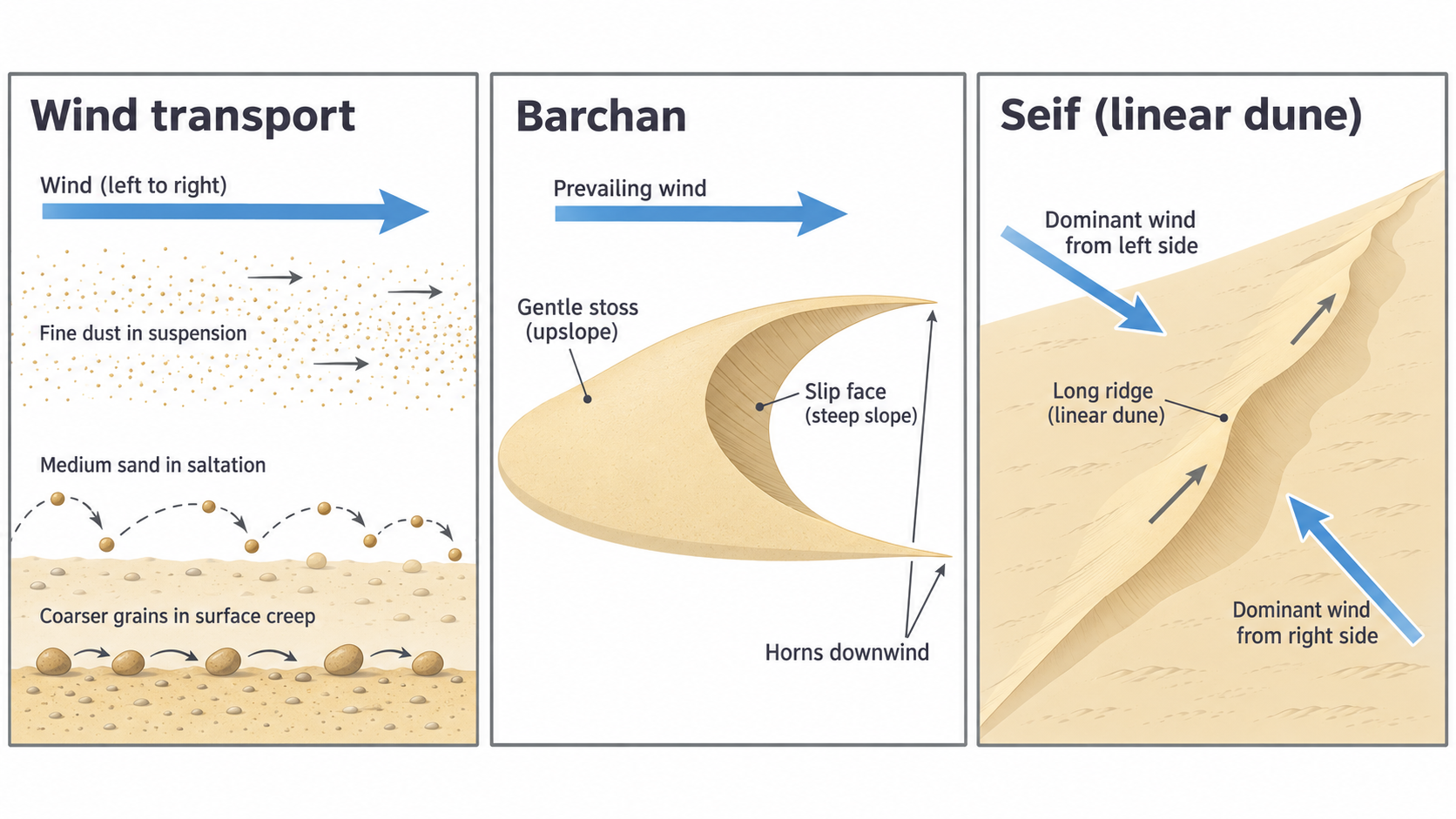
Schematic, not a measured site. Transport paths distinguish suspension, saltation and surface creep; dune geometry is explained below.
Hollows and desert pavements
A deflation hollow develops where removal exceeds replacement and the surface is lowered. Its growth may stop when coarse armour, resistant rock, moisture or vegetation limits further removal. A hollow is therefore evidence of erosion, but its present depth does not measure the current wind strength.
Desert pavement is a close surface cover of stones over finer material. Selective deflation can leave coarse clasts as a lag that protects the surface. Some pavements instead develop through dust accumulation beneath clasts and soil processes that keep stones at the surface, with little net lowering. Describe what is observed and evaluate the possible history; do not assume that all pavement formed only by removal of fines.
Continue this lesson.
You’re previewing NovaLearn without an account. Create a free account to read the rest.
Create free account