3.1.5.4 - Seismic hazards and their patterns
Earthquakes release accumulated strain suddenly, yet their distribution reflects long-term tectonic processes. This lesson distinguishes magnitude, local shaking and secondary hazards, then explains what probability maps and warnings can realistically tell us.
Fault rupture and seismic waves
An earthquake occurs when sudden fault movement releases elastic strain stored in stressed rock as seismic waves and permanent displacement.
Relative plate movement can continue while friction locks a fault segment. Rock deforms elastically until resistance is overcome and rupture spreads. The focus or hypocentre is where rupture begins within Earth; the epicentre is the surface point directly above it. A large rupture extends along a fault beyond one starting point, so distance from the entire ruptured area can matter as well as distance from the epicentre.
P waves compress and expand material and travel through solids and liquids. S waves involve transverse movement and travel through solids. Surface waves travel near the surface and can produce damaging ground motion. “Shockwaves” is often used for these seismic disturbances; they are not a literal opening crack moving through every building. Arrival times, wave types, duration and frequency content affect structures differently.
Magnitude measures event size, commonly using moment magnitude, Mw, related to fault area, slip and rock rigidity. Local intensity describes shaking/effects at a site and can vary because of distance, depth, ground and buildings. Waves lose energy as they travel, so a deeper source can give lower surface shaking despite a slightly greater magnitude; rupture direction can also affect the waves reaching a site. Soft sediments may amplify some shaking; resistant design can reduce damage at similar intensity. A larger magnitude creates potential for greater effects, but it is not a fixed casualty total.
Magnitude scales are logarithmic. For an approximate comparison of energy release, use . A one-unit increase gives about 32 times the energy; a two-unit increase gives about 1,000 times. These are ratios, not extra magnitude units or a guarantee of proportional building damage. The USGS magnitude explanation distinguishes event size, energy and intensity.
Tsunamis, liquefaction and landslides
Secondary seismic hazards require particular environmental conditions, so they do not follow every earthquake in the same way.
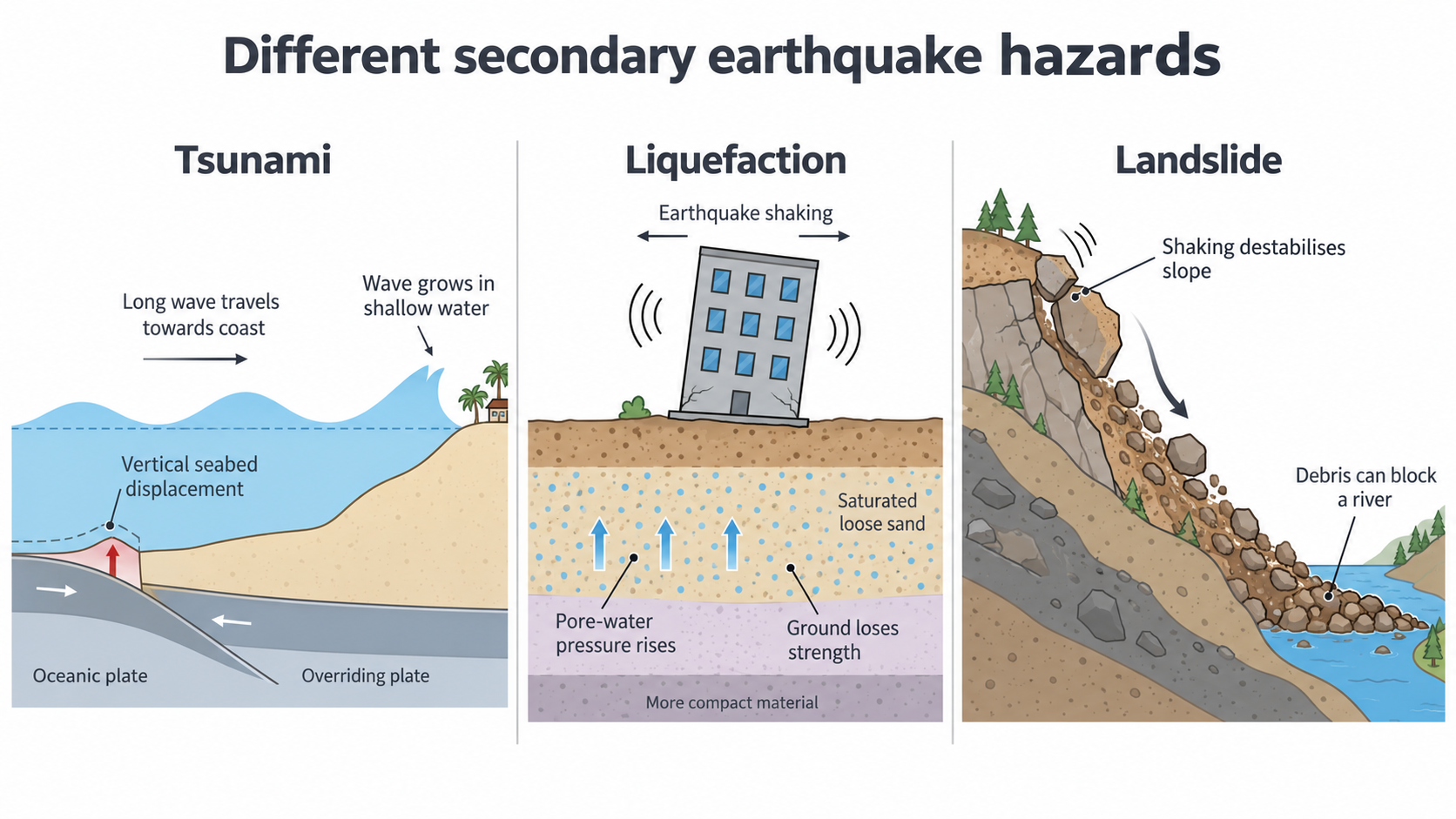
Conceptual cutaways, not a real coast or fault section. The exaggerated wave shape indicates relative shoaling, not an assessed height or prediction.
A tsunami is a series of long waves produced by displacement of water, often when a large offshore earthquake moves the seabed vertically. An earthquake dominated by horizontal movement need not displace enough water to produce a major tsunami. Waves can travel across an ocean and affect distant coasts; in shallow water they slow and can grow in height, while coastal shape and bathymetry influence inundation. A tsunami is not the same as wind-generated storm surge, and the epicentre alone does not define the exposed area.
Liquefaction can occur when shaking acts on loose, saturated sediment. Pore-water pressure rises and the effective contact forces between grains fall, reducing strength. Foundations can settle or tilt and buried infrastructure can move. The ground behaves more like a fluid mixture, but does not melt into magma. Dense or unsaturated ground behaves differently, so sediment and groundwater maps help identify where the mechanism is plausible.
Shaking can destabilise steep slopes, especially fractured, weathered or water-saturated material, causing landslides. Debris may destroy roads or settlements and dam rivers; failure of the blockage can cause later flooding. These linked effects extend disruption beyond the shaking. In a coastal mountain region, tsunami inundation and slope failure may affect different routes simultaneously. Preparedness needs both the possible physical pathways and the people dependent on them.
Continue this lesson.
You’re previewing NovaLearn without an account. Create a free account to read the rest.
Create free account