3.2.3.1 - Urbanisation, megacities and world cities
Distinguish changes in urban population from movements within urban systems, then explain why large cities and globally connected cities matter.
Urbanisation and population growth
Urbanisation changes the proportion of people living in urban places, whereas urban growth changes their absolute number.
Urbanisation
An increase in the share of a population living in urban settlements.
A city can gain people while its country's urban share falls if rural population grows faster. Conversely, the share can rise when rural population falls, even with little city growth. Rural–urban migration, natural increase among urban residents and reclassification of settlements all contribute. Reclassification changes a statistical category without necessarily moving anyone.
Concentration supports large labour markets, specialised hospitals, universities and public transport. Firms can share suppliers and knowledge, producing agglomeration economies. Congestion, expensive land, housing shortages and overloaded sanitation can offset these benefits. Thus urbanisation affects economic development, inequalities and physical systems; its percentage alone does not measure success.
As an original arithmetic example, an urban population rising from 4 to 6 million while national population rises from 10 to 15 million leaves the urban share at 40%. That is urban growth without urbanisation.
Global change since the mid-twentieth century
Global urban concentration has increased since 1945, but a defensible comparison must hold its settlement definition constant.
UN World Urbanization Prospects 2025 uses a harmonised Degree of Urbanisation classification alongside national definitions. Its cities have at least 50,000 inhabitants in dense contiguous grid clusters, broadly at least 1,500 people per square kilometre; towns and semi-dense areas are a separate category. Using this classification, cities contained 20% of world population in 1950 and 45% in 2025. The increase is 25 percentage points, or 125% relative to the starting share. The series begins in 1950, so it supplies no direct 1945 observation.
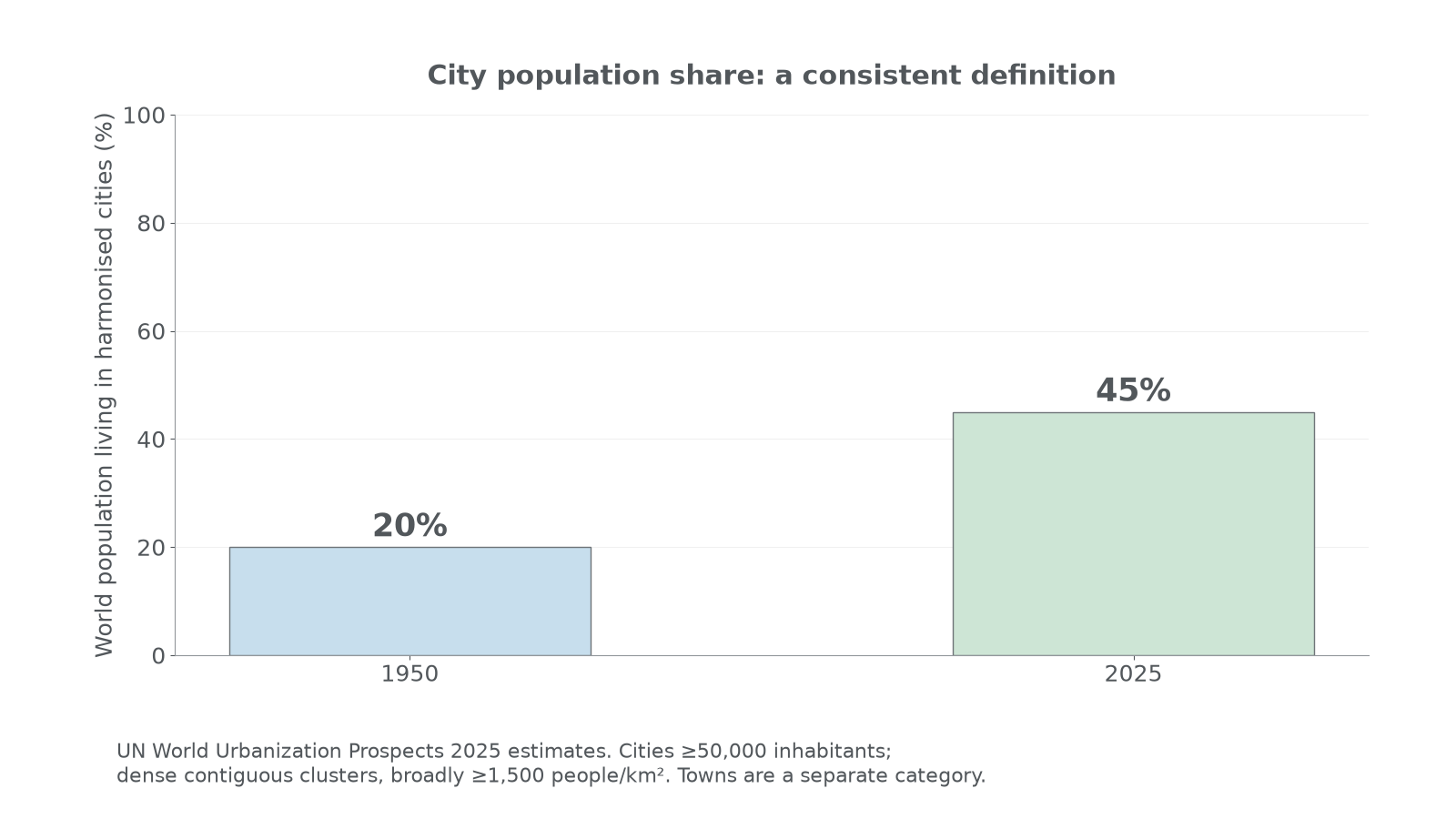
UN WUP 2025 estimates under the same city classification; these are city shares, not the broader national-definition urban share.
Industrial employment and earlier urbanisation left many high-income countries with established urban networks. Subsequent rapid growth in Asian and African cities reflects migration, youthful populations and natural increase, with differing economic and infrastructure capacity. Existing urban regions can still suburbanise or lose central-city residents. Global increase therefore coexists with local shrinkage. Population projections depend on assumptions and must be labelled as forecasts; two endpoints do not prove an uninterrupted annual rise.
The 2025 UN account identifies smaller cities as important too: among roughly 400 cities growing faster than 4% a year in 2015–2025, about one-third were in sub-Saharan Africa and one-quarter in Central and Southern Asia. Over two-thirds had fewer than 250,000 inhabitants. Rapid growth is therefore not confined to megacities, and the fastest rate is different from the largest absolute addition.
Source: UN WUP 2025 summary.
Suburbanisation, counterurbanisation and resurgence
Population movement changes the distribution of people within and beyond an urban region.
Continue this lesson.
You’re previewing NovaLearn without an account. Create a free account to read the rest.
Create free account