3.1.6.7 - Regional ecological change and community responses
Explain ecological change in the Flow Country of northern Scotland, connect it to community livelihoods and governance, and judge restoration responses using appropriately scaled evidence.
The Flow Country's blanket-bog setting
The Flow Country extends across Caithness and Sutherland in northern Scotland. Its extensive blanket bog contains peat, pools and wetland vegetation including bog mosses. Cool moist conditions and persistently wet soils can allow organic matter to accumulate faster than it decomposes. Blanket peat covers varied terrain; water movement, slopes and local substrate create a mosaic rather than one uniform surface.
Blanket bog
A peat-forming ecosystem extending over broad terrain where climate and water conditions support prolonged wetness and slow decomposition.
Bog mosses retain water and contribute to peat formation. Other plants tolerate acidic, nutrient-poor and wet conditions; wetland invertebrates and birds depend on appropriate vegetation, pools and open habitat. Lowering the water table alters oxygen supply, decomposition and rooting conditions. Environmental change therefore affects both ecosystem properties and communities of organisms.
UNESCO inscribed the Flow Country World Heritage property in 2024. The designated property consists of seven areas totalling nearly 190,000 hectares within the wider region. Forsinard Flows reserve and individual restoration plots are smaller units. Neither the UNESCO boundary nor a few monitored plots represents every condition across Caithness and Sutherland.
Forestry, drainage and ecological change
Plantation establishment on peat used drainage and altered vegetation cover. Drains can lower the water table; trees intercept precipitation and draw water through transpiration. Drier oxygenated peat can decompose more quickly, while shade and conifer litter change conditions for bog plants. Roads, extraction and disturbance can add local effects. The reasons involve land-use decisions and economic incentives as well as biophysical suitability.
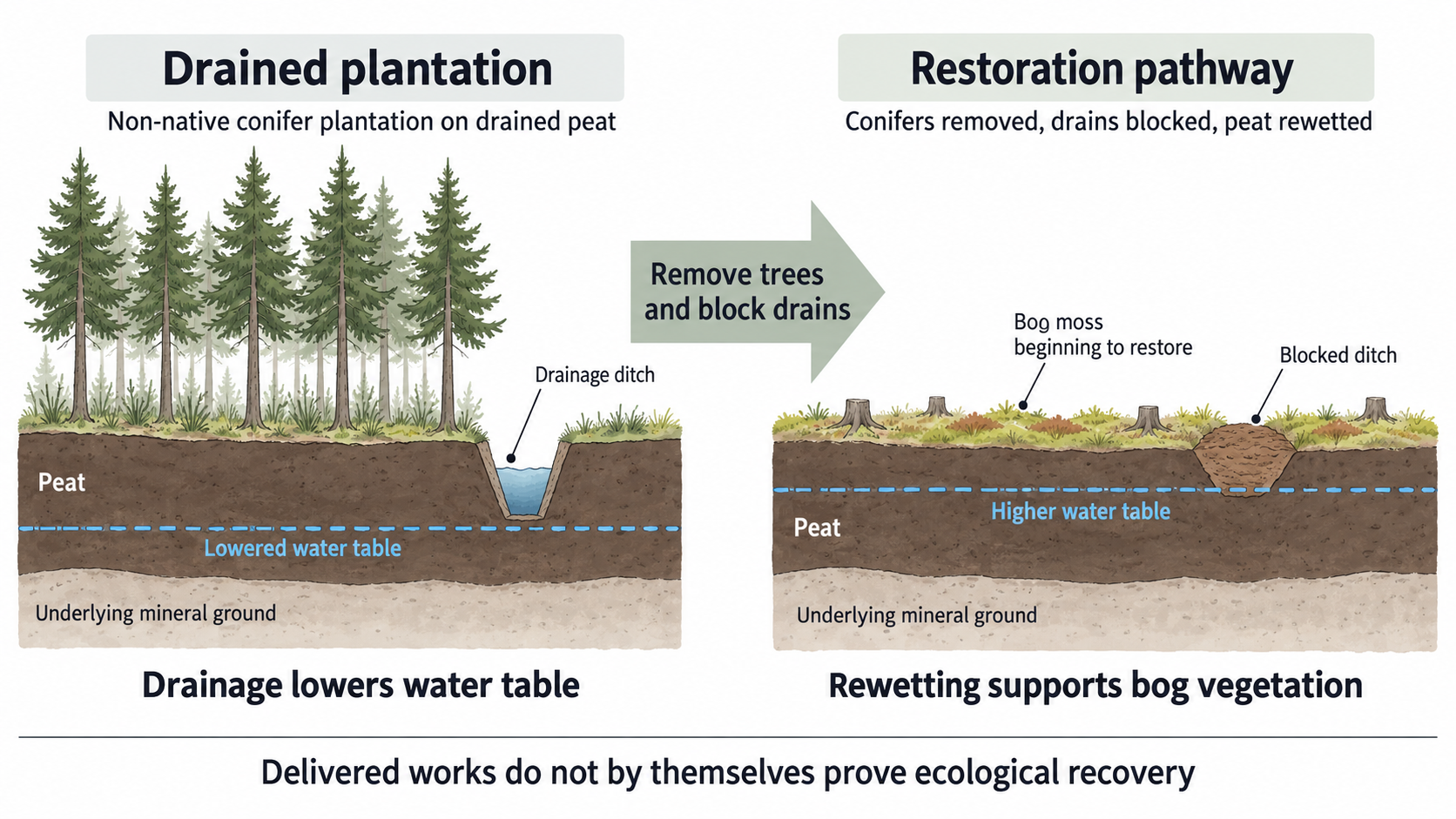
The restored panel is a pathway beginning after works, not a measured completed return to pristine bog. Higher water levels and bog vegetation require monitoring.
Forest-to-bog work removes trees, treats remaining material and blocks drains or furrows to restore wetter conditions. Rewetting can slow decomposition and favour bog species, but responses depend on peat condition, drainage connectivity, slope and previous disturbance. Vegetation may recover later than water levels; some sites may not return to an identical earlier community.
Climate-related changes in rainfall and evaporative demand can alter wetness, while drying can increase fire vulnerability. Grazing intensity also affects cover and erosion. These pressures interact with restoration, so attributing every observed change to one intervention requires an appropriate baseline, untreated comparison and records of weather and other management.
Community livelihoods, land rights and governance
The ecological setting shapes opportunities and constraints for rural communities. Crofting and common grazings, livestock production, forestry employment, tourism and conservation work connect livelihoods to land and water conditions. Sparse settlement and large land areas can make access, services and long-term monitoring demanding. These connections explain why restoration is also a development issue.
Continue this lesson.
You’re previewing NovaLearn without an account. Create a free account to read the rest.
Create free account