3.2.2.1 - Endogenous and exogenous place character
Learn how a place's physical setting, population, economy and built environment combine with connections to other places to produce its character.
Location, topography and physical setting
A place's setting creates opportunities and constraints, whose importance depends on how people use them.
Endogenous factors
Characteristics within a place that contribute to its character, including its location and physical setting, land use, built environment, infrastructure, population and economy.
Absolute location specifies a position, for example by coordinates. Relative location describes position in relation to other places, routes or markets. A town beside a navigable waterway may be accessible to cargo vessels; the significance of that position also depends on the destinations it can reach. The local site is an endogenous characteristic, while the trading relationship made possible by it is exogenous. State the mechanism rather than treating the two labels as competing explanations.
Topography is the shape of the land, including elevation, slope and relief. Gentle land may allow larger building plots and easier road construction. Steep slopes can restrict routes, raise construction costs and produce terraced settlement. This is not a rule that steep land cannot develop: engineering, wealth and planning can modify the constraint.
Physical geography also includes geology, soils, water, climate and ecosystems. Water may support transport or recreation while flooding creates a hazard. Geological resources may encourage extraction, but resources do not create employment without access, investment and demand. Climate influences heating, building design and outdoor activity. Physical factors interact, and the same feature can have several consequences for different users.
Salford City Council records that the Manchester Ship Canal opened in 1894 and that former docks were subsequently transformed into Salford Quays after closing in the 1980s. The canal and dock basins are engineered physical features and transport infrastructure, rather than an untouched natural setting. They helped support one use of the waterside and now contribute to another. An old opportunity for shipping can become a setting for recreation and housing as demand and investment change. Salford City Council, heritage, paragraph 20.4.
To explain a setting's contribution, link the feature to a process and an outcome: a sheltered waterside site can support a landing place; transport connections permit exchange; employment and buildings then give the locality a port character. A location label or a list of physical features alone does not explain character.
Land use, buildings and infrastructure
What land is used for, what has been built and how the place is connected produce different aspects of its character.
Land use is the activity occupying land, such as housing, industry, farming, retail or recreation. A large industrial area may have extensive plots, loading areas and shift-based movement. Housing with local shops may support different daily rhythms. A mixed-use area combines functions, but the mix alone does not reveal whether every group can afford or access them.
The built environment consists of human-made structures, including homes, offices and public spaces. Building height, age, architecture, condition and layout shape visual character and patterns of movement. An old warehouse may retain the appearance of an industrial past after becoming apartments: land use changes while part of the built form continues. Empty buildings can indicate disuse, but their condition cannot establish residents' attitudes without further evidence.
Infrastructure provides systems that allow the place to function: transport, water, drainage, energy, communications and public services. A railway station can widen access to employment beyond the locality; broadband may support remote work; an unreliable water supply can limit both household life and business. Infrastructure is therefore more than a collection of visible buildings. Its capacity, reliability, affordability and connections matter.
At Salford Quays, the council's area-policy account identifies residential, employment, retail, tourism and leisure functions and a creative, digital and media cluster associated with MediaCityUK. These are specific functions within a neighbourhood, not evidence that the whole City of Salford has the same economic character. Salford City Council, paragraphs 8.8–8.9.
A useful comparison separates three observations: the warehouse is still standing (built form); apartments now occupy it (land use); a frequent bus now serves it (infrastructure). Then connect them: reuse can preserve visual continuity, new residents alter demand for services, and improved access may attract further residents. These are linked contributions, not three independent lists.
When comparing land-use evidence, first check the boundary, dates, units and categories. With a fixed area, changes in one category must be accompanied by changes elsewhere. Identify the largest use, the direction and size of changes, and uses that persist. For example, housing increasing as industry contracts supports a change in the mix of functions; it does not by itself prove that every factory job was lost or that all residents welcome the change. Use the measured land-use variable to support the pattern before adding a separately evidenced explanation.
Population and economic characteristics
Who lives in a place and how people earn a living shape its needs, activities and opportunities.
Demographic characteristics describe population size, age structure, household structure and other population attributes. A larger population can increase demand for housing and transport. A higher proportion of older residents may increase demand for accessible services; many school-age children may increase demand for schools. These are reasonable mechanisms, not a prediction that every member of an age group behaves alike. Cultural identities and migration histories can contribute to languages, organisations and social networks, but do not determine a single uniform culture.
Economic characteristics include employment sectors, income, employment and unemployment, business types and the distribution of opportunities. Manufacturing is secondary-sector production; services are tertiary; research and information-intensive activity is often described as quaternary. A change from manufacturing to services can change skills required, working patterns and the buildings used. Growth in highly paid work may coexist with insecure low-paid work. An average income cannot show the full distribution.
Population and economy interact. A new employer can attract workers, increasing demand for homes and shops. A skills mismatch can leave established residents unable to enter the new jobs. Outward migration can alter the population and the customer base for businesses, but a fall in population by itself does not prove why people moved or whether every neighbourhood declined.
The units and dates matter. ONS reports that the Salford local-authority area, code E08000006, grew from about 233,900 residents in 2011 to 269,900 in 2021, an increase of 15.4%. These are rounded authority-wide counts, not counts for Salford Quays. The US Census Bureau records Detroit city, Michigan, as 713,777 residents on 1 April 2010 and 639,111 on 1 April 2020. That is the municipal city, not metropolitan Detroit. These series establish contrasting population directions over different census decades; they do not isolate migration, employment change or lived experience. ONS Salford population change, US Census Bureau QuickFacts: Detroit city.
External links and local interactions
Places develop through relationships with other places, and their internal characteristics affect which relationships develop.
Exogenous factors
External influences and relationships linking a place with other places, including flows of people, goods, money, investment and ideas.
A commuter brings labour from a home locality to a workplace. A supplier connects a factory to resource-producing places. An investor may finance a new building, while an overseas design practice can introduce ideas about its form. These connections help shape endogenous characteristics: residents, jobs, land use and buildings. Their effects depend on the locality receiving them. Available land and skills may attract investment; expensive housing or weak transport may restrict access to its benefits.
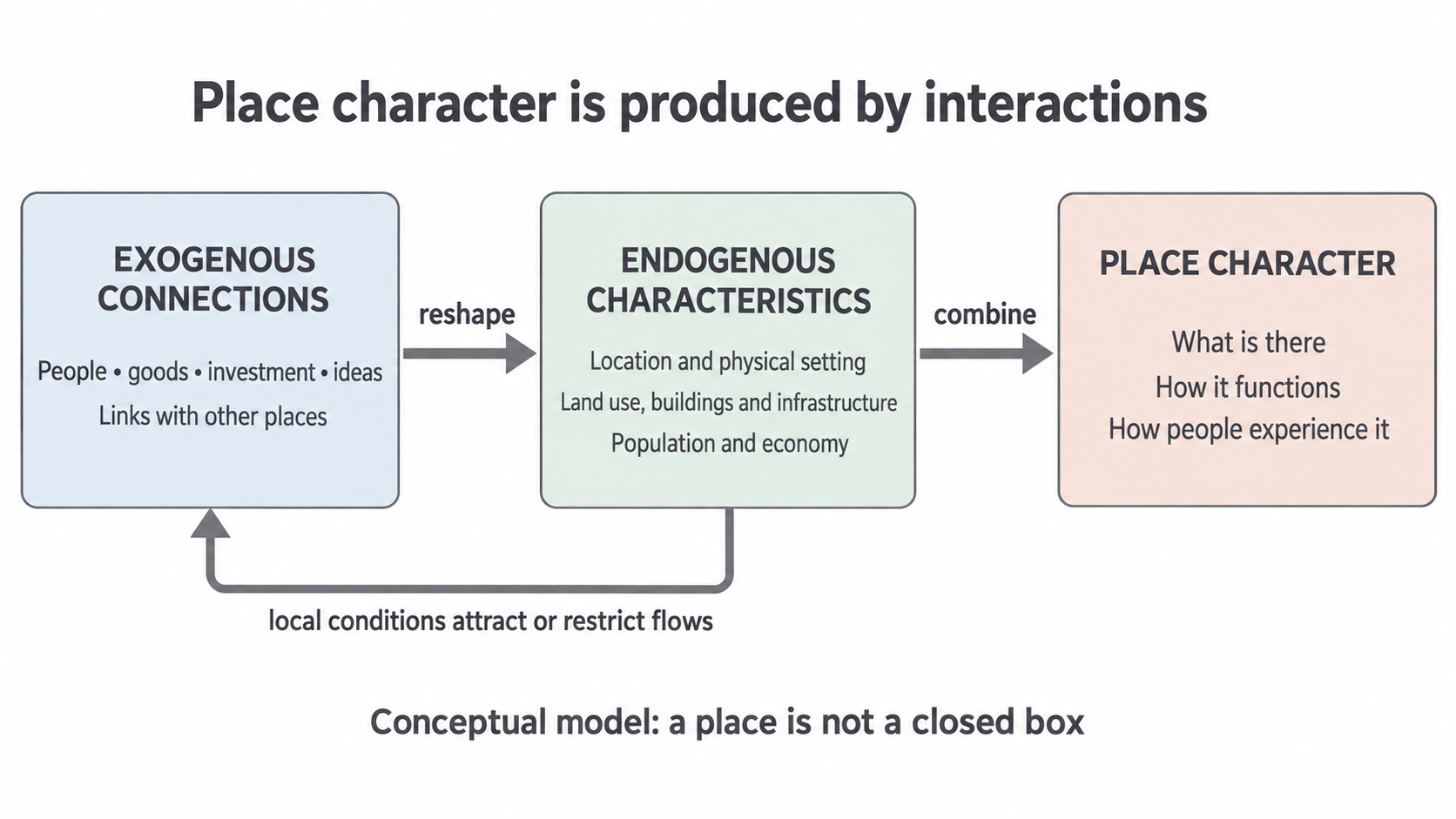
Conceptual model: external connections reshape internal characteristics, while local conditions can attract or restrict those flows. The arrows express mechanisms, not measured quantities.
The distinction depends on what is being explained. Workers living within the boundary are part of its demographic character; their earlier migration from another place is an exogenous flow that helped produce it. A station is local infrastructure; the service linking it to another city is an external connection. Avoid classifying an entire object as permanently endogenous or exogenous without specifying the aspect.
A complete explanation can connect the two. Suppose an original illustrative town has unused factory buildings beside a functioning railway. A company headquartered elsewhere rents them for distribution. The buildings and railway are internal assets; the firm's investment, incoming goods and wider customer network are external relationships. Reuse changes land use and employment, while the old buildings remain. If residents lack transport to night shifts, new employment does not benefit them equally. Thus character emerges through interaction and can differ at neighbourhood and town scales.