3.2.4.2 - Zonal soils, agricultural problems and management
Learn how two zonal soils support different agricultural systems, and trace the causes of erosion, waterlogging, salinisation and structural deterioration to appropriate management.
Soil properties and agricultural productivity
Soil supports crops through interacting physical, chemical and biological properties rather than a single label of fertility.
Mineral particles, organic matter, air and water form the soil. Texture is the proportion of sand, silt and clay; structure is how particles are grouped into aggregates. Pores between and within aggregates allow water movement, gas exchange and root growth. Organic matter improves aggregation and nutrient retention. Nutrients must be available in a form plants can use; unsuitable acidity can restrict this even when elements are present.
Zonal soil
A soil whose broad regional characteristics reflect climate and associated vegetation over long periods, while local parent material, relief, drainage and management still create variation.
Water retention must be balanced with drainage. Very rapid drainage can leave crops short of moisture; saturated pores restrict root oxygen. High clay content does not guarantee high nutrient-holding capacity because clay minerals differ. A dense forest above a soil does not prove that nutrients are stored mainly in its mineral horizons: rapid biological recycling can maintain vegetation above chemically poor soil.
To diagnose a farm problem, separate observations from explanations. Surface ponding may reflect intense rain, compaction, a high water table or clay-rich texture. Check infiltration, structure, drainage and recent management before selecting a remedy. A colour or soil name alone is insufficient.
Ferralsols and Chernozems
Ferralsols and Chernozems exemplify contrasting long-term pathways linking climate, vegetation and agricultural opportunity.
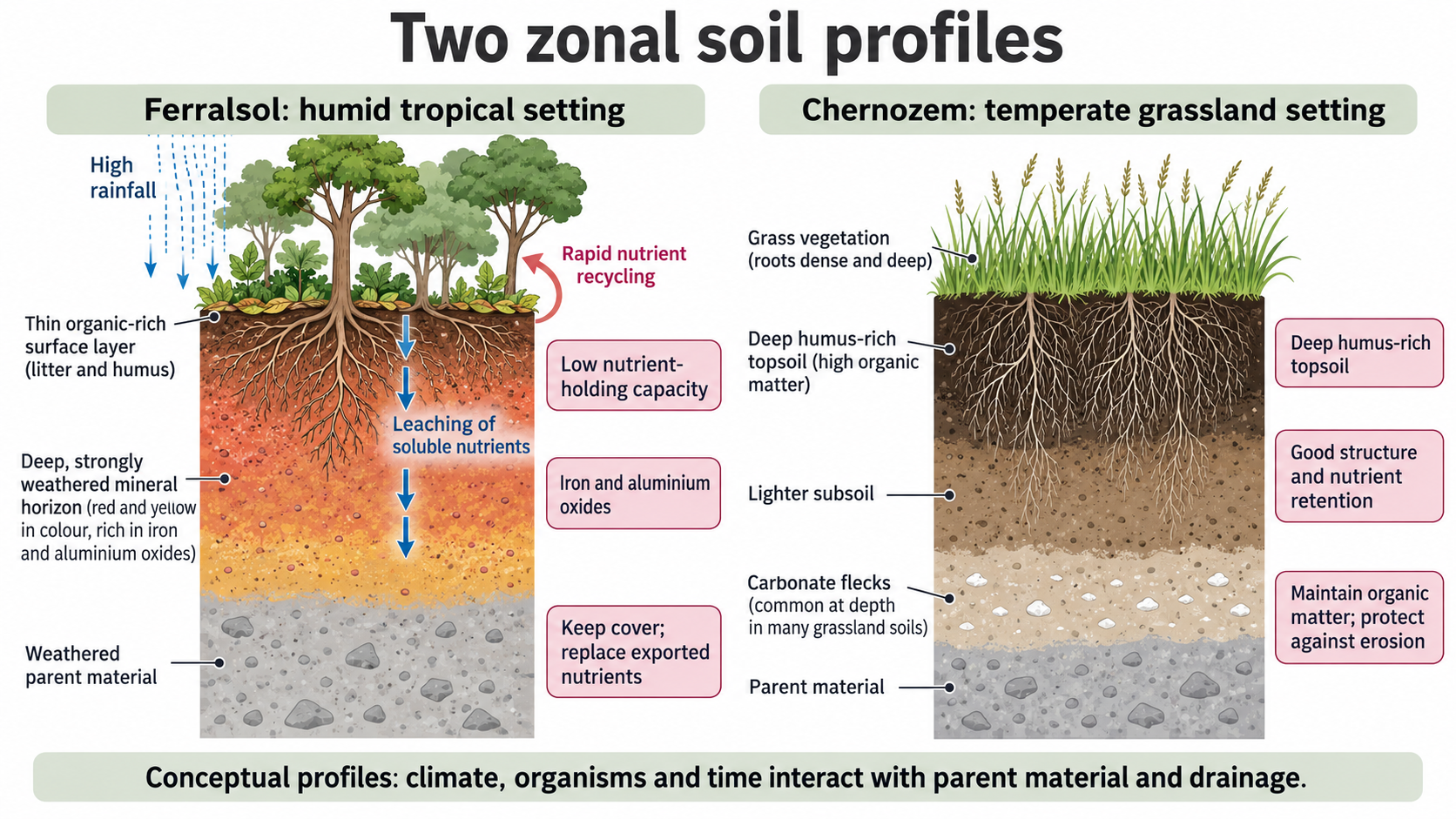
Figure 1. Original conceptual profiles, not measured field sections or a claim that every soil in either region is identical.
Ferralsols occur extensively on old, strongly weathered surfaces in tropical South America, central Africa and parts of South-East Asia. Long weathering and downward water movement remove many soluble bases. Deep red/yellow horizons contain iron and aluminium oxides and low-activity clays. These clays retain relatively few nutrient cations; phosphorus can also become strongly bound. Physical aggregation can be good even where nutrient fertility is low. Humid tropical warmth supports rapid litter decomposition and shallow nutrient recycling through living vegetation.
Forest removal interrupts that recycling; harvesting exports nutrients and exposed land becomes vulnerable to erosion. Agriculture can continue with retained cover, organic inputs, suitable fertiliser and acidity management where needed. Agroforestry helps protect the surface, but nutrient exports still need replacement. Ferralsols are not necessarily an impermeable iron hardpan, and tropical alluvial or volcanic soils can differ greatly.
Chernozems are associated with temperate continental grasslands, especially the Eurasian steppe and parts of the North American prairie. Dense grass roots add organic material; seasonal conditions permit substantial humus accumulation. Their thick, dark topsoil commonly has good structure, nutrient retention and high base status; carbonate accumulation can occur deeper down. They support cereal farming, but drought, erosion and organic-matter loss can reduce yields after cultivation.
The FAO soil descriptions show why these are regional tendencies, not a complete climate-only classification. Chernozems exemplify grassland soils; they are not the typical soil of Woodford's oceanic climate. Soil and climate comparisons need not use the same two regions.
Soil erosion and protective management
Erosion removes soil faster than it can be replaced, reducing the productive resource and transferring sediment elsewhere.
Rain splash detaches exposed particles. Overland flow transports them as sheet wash, then concentrated rills and gullies; wind can remove fine dry material from bare surfaces. Deforestation, overgrazing and cultivation along slopes reduce protection or accelerate runoff. Loss of topsoil removes humus and nutrients, while sediment can obstruct drainage or harm downstream water quality.
Continue this lesson.
You’re previewing NovaLearn without an account. Create a free account to read the rest.
Create free account