3.1.3.3 - Erosional coastal landscapes
Explain how interacting marine and sub-aerial processes produce cliffs, platforms, caves, arches and stacks, and use a coast beyond the UK to show how structure changes the sequence.
Cliffs and wave-cut platforms
Cliffs develop where erosion removes material from a relatively steep coastal slope, while rock structure and slope processes shape the resulting face.
Waves can attack joints and bedding planes near the cliff foot, using hydraulic action, quarrying and abrasion. Repeated attack can make a notch and remove support. The overlying material then fails by rockfall, slide or slump; waves remove some debris and renewed attack causes retreat. Weathering and runoff also act higher on the slope. Not every cliff has a visible notch: rapid mass movement, resistant rock or sediment cover can change the form.
Wave-cut platform
A gently sloping rock surface at a cliff's foot exposed by retreat and modified by marine erosion and weathering.
As a cliff retreats, its former base may remain as a platform, usually most visible at low tide. A wider platform can dissipate wave energy, but platform height, tidal level, joints and beach cover determine exposure. Retreat is therefore not necessarily constant. A rock platform differs from a sandy beach: its surface is bedrock, although sediment may partly cover it.
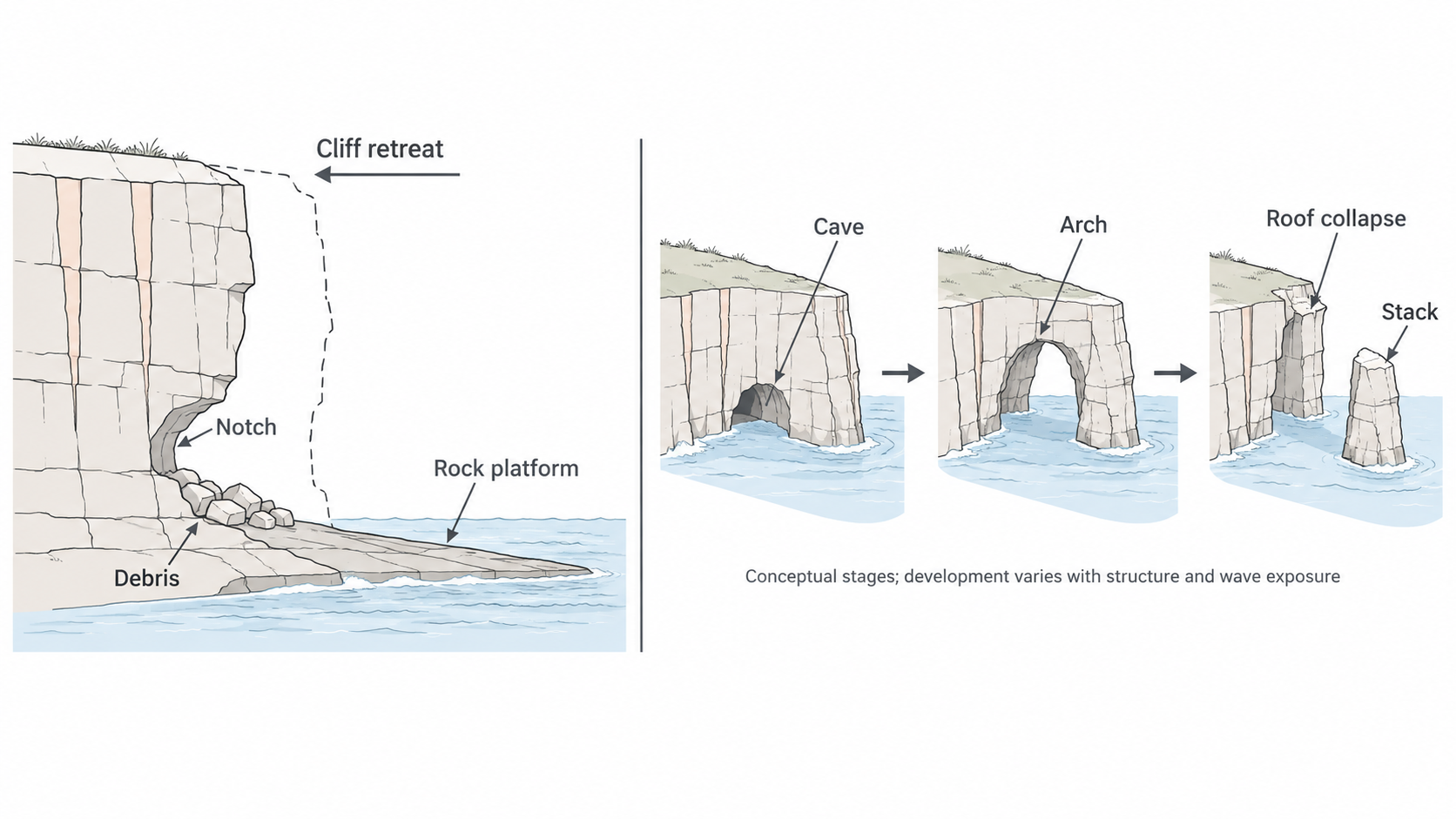
The diagram shows possible mechanisms. It does not give a timescale or imply that every rocky coast follows the same sequence.
At Aldbrough, contrasting unconsolidated tills can slump and form stepped cliff profiles. Compare this with jointed resistant basalt in Hawaiʻi: rockfalls and quarrying exploit fractures in a more coherent rock mass. Resistance alone is insufficient to predict retreat; jointing, saturation, exposure and removal of debris all matter.
Caves, arches and stacks
Weaknesses in a headland can guide erosion into a cave, but later development depends on its geometry and rock strength.
Wave refraction often directs energy onto protruding headlands. Hydraulic pressure, quarrying and abrasion enlarge a joint, fault or weaker band into a cave. A cave may extend through a narrow headland, or caves from opposite sides may join, producing an arch. Waves erode the sides and base while weathering weakens the roof. Roof collapse can isolate a stack; further erosion and failure can reduce it to a low stump. These are possible linked stages, not an inevitable timetable: an isolated block may form by other failures and some arches remain stable for long periods.
Beyond the UK, the US National Park Service describes Hōlei Sea Arch on the Puna coast of Hawaiʻi Volcanoes National Park. Lava formed basalt rock that subsequently experienced coastal erosion. The arch's form links a volcanic geological starting point with marine processes and structural weaknesses. The NPS account updated 31 March 2020 is evidence for that setting; it does not license a claim about its precise present dimensions or stability without a new survey.
Continue this lesson.
You’re previewing NovaLearn without an account. Create a free account to read the rest.
Create free account