3.1.4.3, 3.1.4.4 - Glacial erosion and landscapes
Glacial erosion reshapes rock at several scales. Learn how abrasion and plucking combine with inherited relief to produce a connected erosional landscape, including examples beyond the UK.
Abrasion, plucking and the roche moutonnée
Abrasion occurs when debris carried at the glacier base scrapes and grinds bedrock. Coarse fragments make grooves or striations; smaller debris can polish rock and produce rock flour. Its effectiveness depends on moving debris in contact with the bed, not simply on the presence of clean ice. Bed temperature, sliding, debris load and resistant rock all influence the result.
Plucking removes blocks along joints. Water enters cracks; freezing and pressure changes help loosen blocks, which moving ice entrains. On the downstream side of an obstacle, loss of contact and fluctuating water pressure can aid block removal. A well-jointed bed therefore responds differently from massive resistant rock under similar ice conditions.
A roche moutonnée is an asymmetric bedrock mound. Ice moving over it smooths its gentler upstream stoss face by abrasion; plucking leaves a steeper rougher downstream lee face. The combination can indicate former ice direction, provided the feature is correctly identified. A loose streamlined sediment hill is not a roche moutonnée. Jointing and later weathering can modify its outline, so support a direction inference with striations and the wider assemblage rather than one isolated shape.
Corries and arêtes develop together
A corrie, also called a cirque, is an armchair-shaped hollow with a steep headwall, an overdeepened floor and often a rock lip. Snow collects in a favourable hollow, compacts into ice and begins rotational movement. Abrasion deepens the floor; plucking and frost weathering contribute to headwall retreat. Less erosion near the thinner ice at the exit can leave a lip, sometimes supplemented by deposited moraine. After retreat, water may fill the basin.
Corries favour sites where snow accumulates and survives, shaped by aspect, wind redistribution and shading. Their development may span repeated glacial episodes rather than a single winter. An arête forms where adjacent corries or glacial valleys erode back towards one another, leaving a narrow sharp ridge. It is an erosional remnant between hollows, not a ridge deposited by ice.
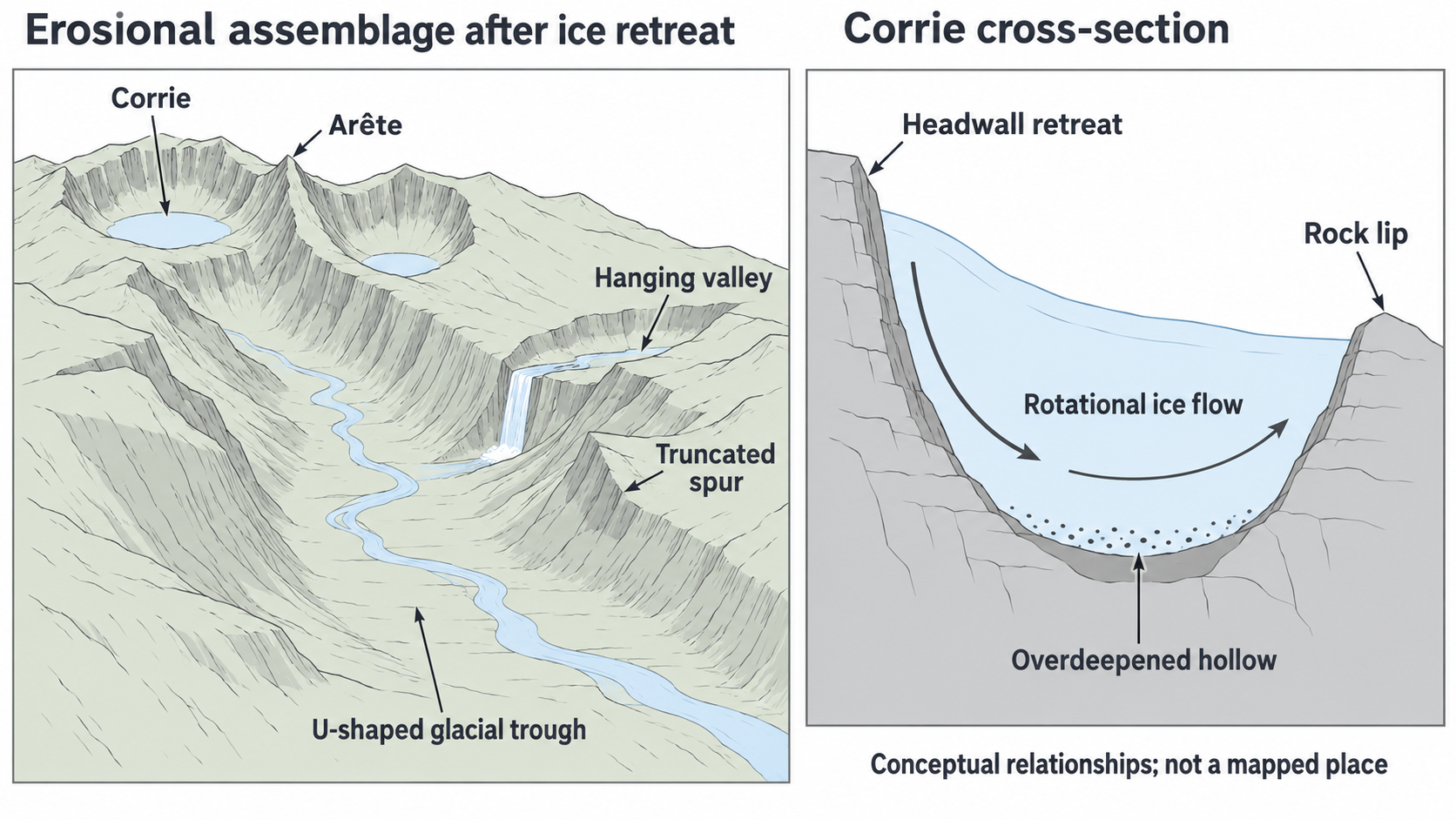
Conceptual erosional assemblage and corrie section. The left panel shows landforms after ice retreat; the right panel shows the curved flow that can contribute to corrie development. It is not a map of Cwm Idwal or Yosemite.
Continue this lesson.
You’re previewing NovaLearn without an account. Create a free account to read the rest.
Create free account