3.1.6.2 - Succession, environmental controls and change
Explain how communities change through succession, how environmental controls interact, and why climatic change and human exploitation can alter the pathway.
Succession and seral stages
Succession is change in a community's composition and structure over time. Each recognisable stage is a seral stage; a sequence is a sere. Primary succession begins where developed soil and an established community are absent, for example newly exposed rock. Secondary succession follows disturbance where soil, seeds or surviving organisms remain, so colonisation often starts differently and can proceed faster.
Pioneers tolerate the initial conditions and reach the site through dispersal. On rock, weathering and the accumulation of organic matter can create rooting material. Vegetation changes shade, shelter, moisture and nutrient availability. These changes may facilitate later arrivals, while competition can inhibit others. Taller plants may shade pioneers, but replacement is not always a simple sequence in which every species disappears.
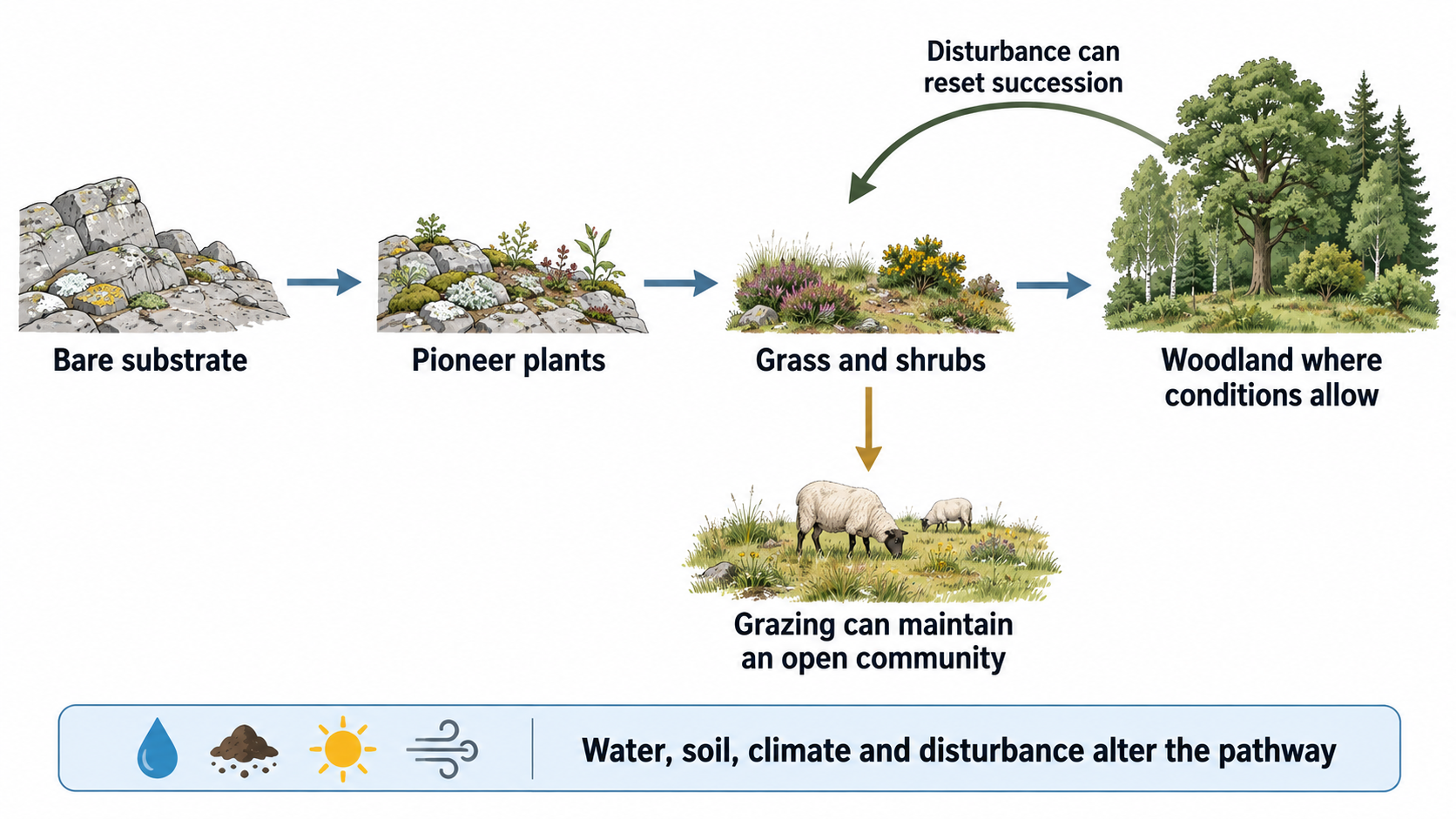
The arrows show possible pathways, not fixed durations. Seed supply, waterlogging, grazing, fire and site history can alter or reverse them. Repeated surveys provide temporal evidence; different communities along a slope only provide a spatial contrast unless their history justifies treating them as a time sequence.
Climatic climax, sub-climax and plagioclimax
The climatic-climax model describes a relatively persistent mature community compatible with regional climate where local constraints and disturbance permit it. Temperate deciduous woodland is a useful model for many sufficiently drained lowland British sites. It is not the inevitable endpoint of every peat bog, exposed mountain or saline coast, and a mature woodland still changes through treefall and regeneration.
Sub-climax and plagioclimax
A sub-climax is a community held before the modelled climatic climax by a limiting condition or repeated disturbance. A plagioclimax is a community maintained by human activity, such as grazing, cutting or burning that prevents further succession.
Waterlogged soils can constrain tree establishment even without management. By contrast, repeated mowing or livestock grazing can remove tree seedlings from land where woodland might otherwise develop. Use the causal distinction rather than assuming all open vegetation is man-made. The terms can overlap in classification; name the limiting process and show whether human intervention maintains it.
If grazing ceases, shrubs may establish where viable seeds, suitable soil and water conditions exist. Woodland is then a possibility, not a guaranteed or immediate result. Conservation may deliberately maintain an open community for species requiring short vegetation. A later successional stage is therefore not automatically the most desirable conservation outcome.
Continue this lesson.
You’re previewing NovaLearn without an account. Create a free account to read the rest.
Create free account