3.1.2.4, 3.1.2.6 - Desertification responses and local futures
Use Ranawa in Burkina Faso as a local desertification and restoration case, judge the evidence of community and landscape change, and assess conditional futures under climatic and management uncertainty.
Ranawa: a local dryland landscape
Ranawa is a village on Burkina Faso's northern Central Plateau in the Sahelian dryland margin. It is a farming landscape, not a Sahara sand sea. A 2020 study by Belemviré, Ouedraogo, Reij and Tappan describes drought-related difficulties in the 1970s and 1980s alongside expansion of cultivation onto marginal land, vegetation decline and reduced soil productivity. Water shortages added to women's work, while reduced crops, fodder and woody resources affected livelihoods.
The case illustrates sustainable-development issues at household and village scales: restoring productive soils can support food supply and income while maintaining vegetation and water functions. Yet access to labour, manure, stones and land affects who can benefit. The study's historical migration and water accounts are dated reports, not proof of current conditions in every household. Its mapped comparison uses an 820-hectare study area; do not combine that denominator with a different older study boundary.
How restoration changes soil-water processes
Farmers adapted contour stone bunds to slow runoff and retain water and sediment rather than letting them leave fields rapidly. Bunds must follow the contour and remain permeable; poor siting or maintenance can divert water and cause damage. Zaï planting pits break crusted surfaces and concentrate rainfall and organic matter near crops. Organic inputs improve nutrient supply and soil functioning, so a yield response cannot be attributed to water harvesting alone where both change.
Farmer-managed trees and regeneration provide cover, organic inputs and useful products. Together, these actions can reduce the cover-loss/runoff feedback and create recovery: improved infiltration supports plants, which further protect soil. Participation and maintenance matter as much as an initial engineering design. Top-down structures elsewhere in the region had previously failed when they were poorly suited to local practice and maintenance.
Resilience is the capacity to withstand or recover from disturbance while retaining useful functions. Restoring infiltration and diversifying tree/crop benefits can increase resilience to variable rain. Adaptation adjusts practice to climatic conditions; mitigation of land degradation reduces its causes or severity. These uses of mitigation differ from climate-change mitigation, which reduces greenhouse-gas emissions or increases carbon sinks. Tree recovery may contribute to both, but its carbon benefit needs measurement.
What the evidence supports and limits
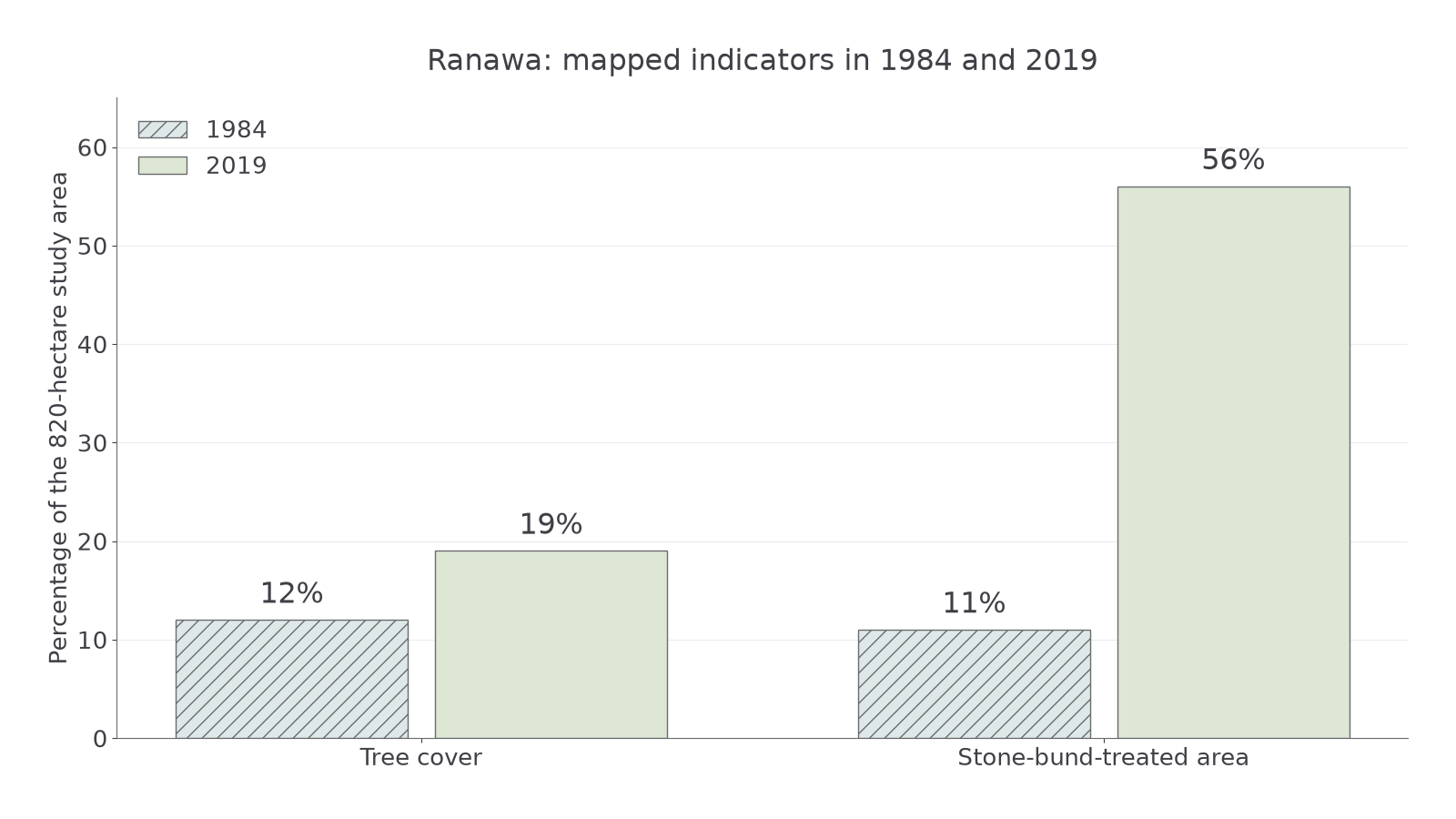
The study's dry-season image interpretation compares the same 820-hectare Ranawa area in 1984 and 2019:
| Indicator | 1984 | 2019 |
|---|---|---|
| Tree cover | 12% | 19% |
| Area treated with stone bunds | 11% | 56% |
Continue this lesson.
You’re previewing NovaLearn without an account. Create a free account to read the rest.
Create free account