3.4 4.a - Environmental costs of increasing food production
Increasing food output can improve availability while damaging the soil, water and ecosystems on which future production depends. This lesson explains salinisation, deforestation, landscape change and agrochemical pathways. The Brazilian Amazon provides a dated case linking agricultural expansion to immediate and longer-term environmental consequences.
Irrigation and salinisation
Irrigation can extend production through dry periods, but salts accumulate when inputs are not balanced by removal from the root zone.
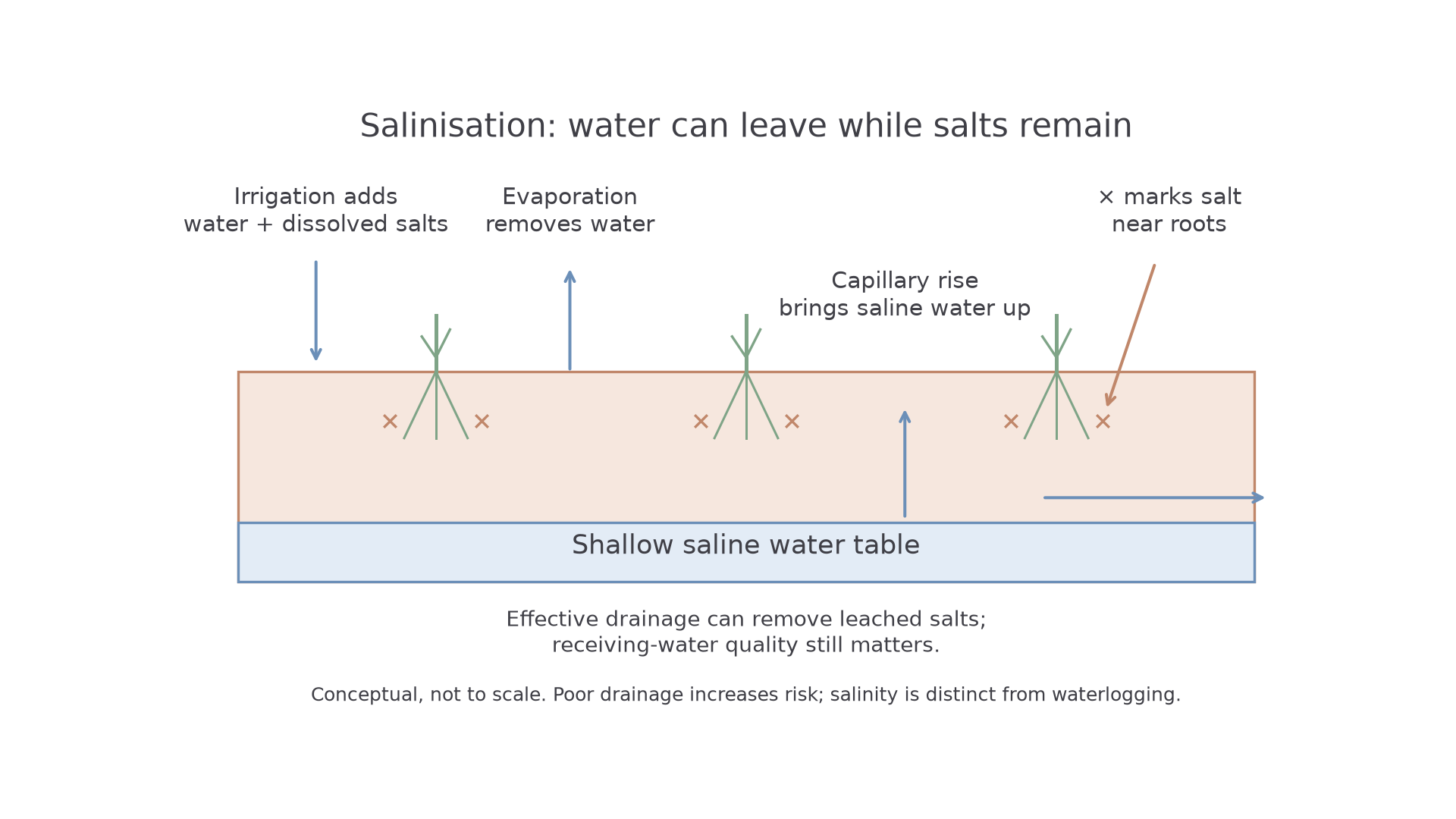
Irrigation water commonly contains dissolved salts. Evaporation and plant water uptake remove water while leaving much of the salt behind. Repeated application can therefore raise salt concentration. Poor drainage can also raise a saline water table; capillary movement brings water and salts towards the surface, where further evaporation concentrates them. The risk is particularly important where evaporative demand is high and rainfall provides little leaching.
High salt concentration makes it harder for roots to take up water and can create ion-specific toxicity. Yield can decline even in a moist soil, so simply adding more irrigation without drainage can worsen the problem. Salinisation differs from waterlogging, which concerns saturation and poor aeration, although the same badly managed scheme can produce both. FAO, salinity processes and control.
Management can include appropriate water quality, careful application, suitable crops and leaching supported by effective drainage. Leaching transfers salts below roots; the drainage water then needs an acceptable destination. Moving salt out of one field can create a downstream water-quality problem. Judging sustainability therefore requires a system boundary that includes both the field and receiving waters, as explained in FAO's drainage assessment.
[DIAGRAM: asset_name: Irrigation and salt accumulation; asset_slug: h481_d29_salts; caption: Water can leave through evaporation while salts accumulate in a poorly drained root zone.; description: An illustrative soil cross-section shows irrigation supplying dissolved salts, upward capillary movement from a shallow saline water table and water loss to the atmosphere. Salt markers remain near roots. A separate drainage arrow indicates the mechanism needed to remove leached salts, with a note about downstream disposal.]
Deforestation, biodiversity and landscapes
Expanding farmland changes habitats, land cover and the physical organisation of a landscape.
Clearing vegetation removes habitats and can fragment what remains into smaller patches. Species may lose feeding areas, shelter or routes between populations; edges can have hotter, drier and more disturbed conditions than a forest interior. Biodiversity effects depend on the species and landscape, so a count of hectares alone cannot measure every ecological consequence. Losing pollinators, predators or soil organisms can also affect agricultural functions.
Vegetation removal changes water and sediment processes. Less interception exposes soil to raindrop impact; reduced root protection and compacted surfaces can increase runoff and erosion. Draining wetlands lowers water storage and alters habitats. Removing hedges or merging fields changes connectivity, shelter and the routes along which runoff travels. On steep land, cultivation that leaves soil exposed can accelerate loss of topsoil, while terraces or contour management may reduce it.
Intensification can sometimes spare land by increasing output on existing fields, but this is not automatic. Higher profits may encourage expansion unless governance and incentives protect remaining habitat. Equally, an extensive system is not necessarily environmentally harmless if it converts large natural areas. Assess the location, management and displaced effects rather than assume one farm label determines the outcome.
Agrochemicals and water quality
Fertilisers and pesticides can support production, but losses from the target area can affect water and non-target organisms.
Fertilisers supply nutrients that crops need. When application exceeds uptake or is poorly timed, dissolved nutrients or sediment-bound material can move through runoff, drains and leaching. In a waterbody where a nutrient limits growth, enrichment can stimulate algae or other plants. Shading and the microbial decomposition of organic matter can then reduce dissolved oxygen, harming aquatic life. This eutrophication pathway is a sequence of ecological changes, not simply the assertion that all fertiliser directly poisons fish. US EPA, agricultural nonpoint pollution.
Continue this lesson.
You’re previewing NovaLearn without an account. Create a free account to read the rest.
Create free account