1.2 - Human disturbance, equilibrium and feedback
Human activities alter both the size of water and carbon stores and the pathways connecting them. This lesson explains dynamic equilibrium, contrasts urban, agricultural and forestry effects, examines water extraction and carbon sequestration, and traces positive and negative feedback as complete causal loops.
Dynamic equilibrium of stores and flows
Dynamic equilibrium means that a system's opposing flows approximately balance over a stated interval even though movement continues.
A lake can receive and lose a large volume of water while maintaining a similar store. A forest can take up carbon through photosynthesis and return it through respiration without a large net annual change. Equilibrium therefore does not mean no flow. It is also scale-dependent: a whole basin may have little net change while water shifts from groundwater into a reservoir, changing individual stores.
Balance over a stated interval
For a simplified catchment with no unmeasured transfers across its boundary:
is precipitation, evapotranspiration and discharge, expressed as volumes or equivalent depths over the same interval. Additional abstractions, imports or groundwater boundary flows must be included if present.
Worked annual accumulation
A basin receives , loses through evapotranspiration and discharges over a year. Total the outputs, then subtract:
Storage increases, so this is not exact equilibrium even though the opposing flows are large.
Worked storage depletion
A snow-fed basin receives , loses through evapotranspiration and discharges . All terms cover one year:
if the initial equivalent store was 500 millimetres. Discharge and evapotranspiration exceed current precipitation because stored water supplies the difference. Convert discharge rates into the same interval and depth units before entering them in either budget.
Natural variability creates temporary departures from balance. A wet season can increase storage and a dry season deplete it without a long-term trend. A persistent new land use can instead establish a different flow regime and shift the average store. Feedback may oppose or amplify this adjustment. The distinction between variability and sustained change requires a record long enough to include the system's relevant response time.
Measurement uncertainty matters. If an estimated imbalance is smaller than combined uncertainty in rainfall, evaporation and discharge, it is weak evidence of a real trend. A residual can reveal an omitted transfer or measurement error; it is not automatically proof that water has been created or lost from the planet.
Urban growth, farming and forestry
Different land uses modify different processes, so their effects must be traced rather than grouped as one generic human disturbance.
Urban growth often replaces vegetation and soil with roofs, roads and drains. Interception and soil storage can decline, and connected drainage routes transfer rainfall rapidly to channels. Groundwater recharge may fall beneath sealed surfaces, although leaking pipes, imported water and infiltration systems can add alternative inputs. Carbon is lost when vegetation or soil is removed, while construction, transport and energy use add emissions beyond the local biological budget. Urban trees and permeable surfaces can partly modify these changes.
Farming changes leaf area, rooting depth, soil structure and harvest exports. Irrigation imports water into a field while abstracting it elsewhere; crop transpiration then returns some to the atmosphere. Compaction can reduce infiltration, whereas retained residues, cover crops and soil structure can protect it. The Tanguro example shows why clearance can increase streamwater export mainly through reduced evapotranspiration without requiring large stormflow increases. Carbon in harvested products leaves the field, while roots and residues can replenish soil carbon. Fertiliser and machinery introduce other resource and emission pathways.
Forestry can increase biomass carbon during growth, canopy interception and transpiration. Root networks and litter can protect infiltration and reduce sediment loss. Harvest removes carbon and temporarily changes those functions; access roads can concentrate runoff even where the surrounding forest remains permeable. A plantation's high growth rate does not by itself establish a permanent sink across repeated harvest rotations and product lifetimes.
The response depends on what land use replaces, how it is managed and the boundary considered. Moving water into an irrigated field can improve its supply while reducing downstream availability. A forest can improve water quality yet lower local water yield through greater evapotranspiration. These are connected outcomes, not contradictions. Compare the full pathway and the timescale before judging an intervention.
The 2013 Tanguro synthesis by Neill and colleagues gives a dated example: soya headwater catchments exported several times more streamwater than forest catchments, with reduced evapotranspiration central to the explanation. Permeable deep soils still buffered rapid stormflow. The mechanism qualifies the assumption that clearance must increase discharge solely by making the surface impermeable.
Worked resource explanation
Illustrative urban resource: roofs, roads and connected drains expand across a former vegetated neighbourhood. Explain how urban growth affects the water cycle. Replacing leaves reduces interception storage and evaporation from the canopy. Sealing soil reduces infiltration and soil-water replenishment, while drains rapidly connect surface water to channels. More rainfall can therefore become quickflow, with an earlier discharge peak. The explanation uses the observed land-cover changes to identify altered stores and then follows the transfer to the channel; imported water and leaking pipes could partly modify recharge locally.
Water extraction, aquifers and artesian basins
Extraction removes water from a store or flow, while the resulting response depends on recharge, hydraulic connections and how the water is returned.
Surface abstraction diverts water from rivers, lakes or reservoirs for domestic, industrial or agricultural use. Lower downstream flow can reduce channel and wetland storage. Some abstracted water evaporates or is transpired; some returns through drainage or wastewater, often at a different place, time or quality. An abstraction volume is therefore not always the same as net consumptive loss.
An aquifer is a geological formation that stores and transmits usable quantities of groundwater. In an unconfined aquifer, the water table is its upper saturated boundary. Pumping lowers the water level near a well, forming a cone of depression. Continued withdrawal may deplete storage, induce additional recharge or capture water that would otherwise have discharged to a river or spring. Thus an apparently stable pumping water level does not guarantee that connected ecosystems are unaffected. The USGS groundwater-flow explanation describes these pressure-driven connections.
A confined aquifer lies below a less permeable layer. Recharge at an exposed, often higher-elevation area can create pressure within it. In an artesian basin, water in a well penetrating the confined aquifer rises towards a pressure level, called the potentiometric surface. It flows at ground level only if that pressure surface lies above the ground: not every artesian well flows freely. Pumping can reduce pressure and stop flow even before the aquifer is drained. Slow recharge and long travel times can make recovery much slower than extraction.
[DIAGRAM: asset_name: Confined aquifer and artesian pressure; asset_slug: p27-artesian-aquifer; caption: Artesian pressure raises water in a well, but free flow depends on ground elevation.; description: A schematic cross-section shows recharge entering an exposed permeable aquifer upslope, a confining layer above it, groundwater movement and a dashed potentiometric surface. One well ends below that pressure surface and can flow, while a higher-ground well rises internally without reaching the surface. A second dashed line shows pressure reduction after pumping.]
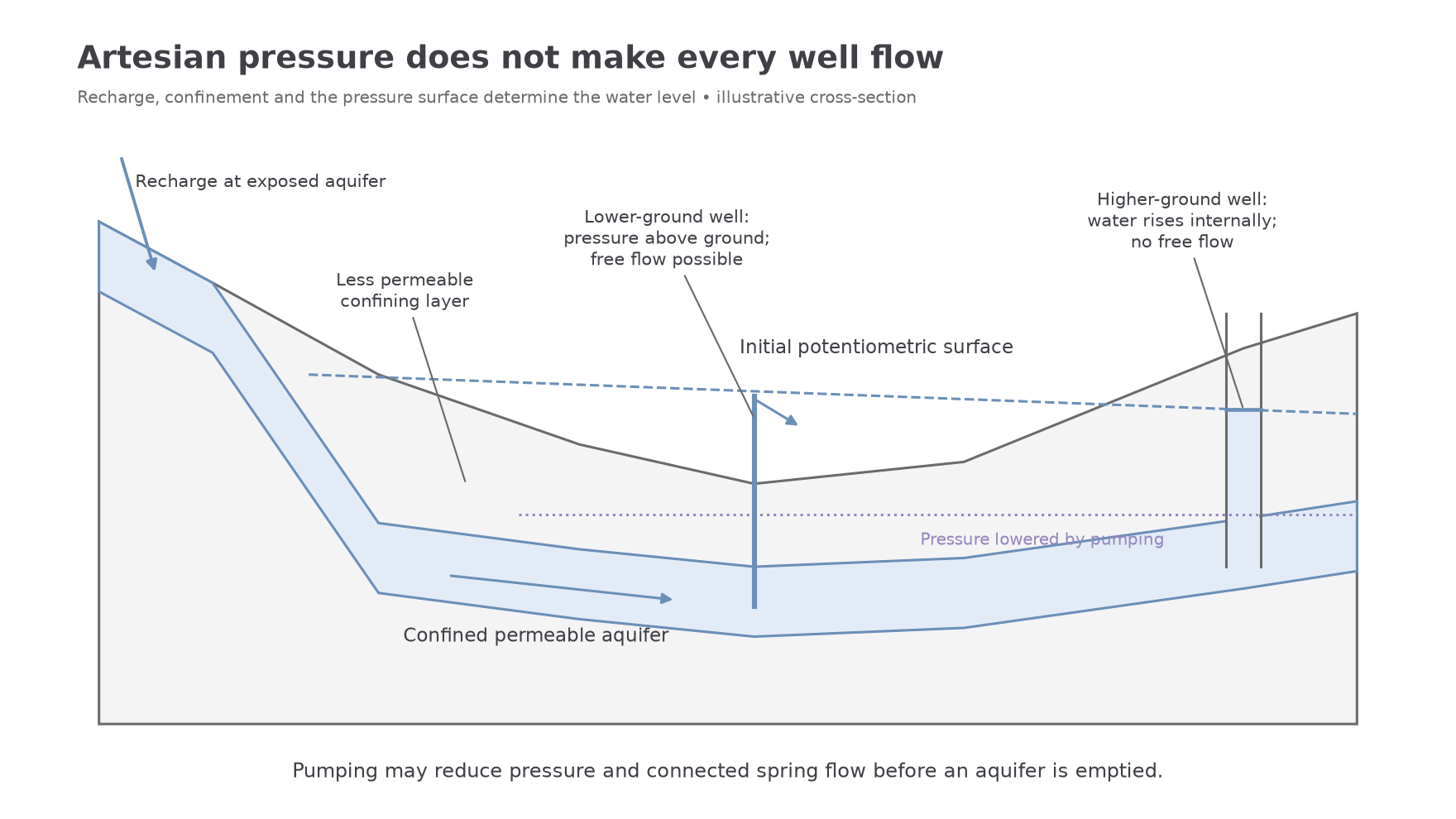
Linked carbon effects require a mechanism. Lowering groundwater beneath a wet organic soil can admit oxygen and accelerate decomposition, releasing carbon dioxide. Loss of vegetation from reduced water supply can reduce uptake, while pumping energy may create emissions depending on its source. These effects are possible where connections exist; pumping a deep aquifer does not automatically drain every surface peatland. The sustainable balance must also protect required spring and river discharge, rather than allocating all estimated recharge to pumps.
Fossil fuels and carbon sequestration
Combustion adds geological carbon to active stores, while sequestration transfers carbon into storage without destroying it.
Coal, oil and gas extraction exposes a store that exchanged slowly with the atmosphere before industrial use. Burning the fuel releases carbon dioxide rapidly. Natural land and ocean sinks remove some of this addition, but if total emissions exceed removal, atmospheric storage rises. A large existing natural sink does not establish that extra emissions have been fully offset.
Biological sequestration increases carbon in growing vegetation, soils or restored wetlands. The gain is net of respiration, disturbance, harvest and any displaced emissions. Forest fire or drainage can reverse it. Storage capacity and growth rates also change over time, so a fixed parcel cannot indefinitely absorb the same amount while its stock increases without limit.
Carbon capture and storage can separate carbon dioxide from an industrial gas stream and place it in a geological store. Suitable formations, impermeable cap rock, monitoring and management of wells are needed to retain it. Capturing an emission before release avoids some addition relative to an uncaptured baseline; it does not necessarily remove carbon dioxide already in the atmosphere. Direct air capture followed by durable storage does remove atmospheric carbon, but the energy and full life-cycle emissions must be included in the net balance.
The IPCC's 2022 mitigation assessment treats emissions reduction and carbon dioxide removal as related but distinct contributions. Their effectiveness depends on additionality, duration and accounting. Additionality means that the claimed benefit exceeds what would have occurred without the intervention. Avoid counting the same carbon both as a prevented emission and as a new atmospheric removal.
Positive and negative feedback loops
A feedback loop returns an effect to its original variable, amplifying or opposing the initial change.
Positive feedback reinforces change; negative feedback opposes it. The labels do not mean beneficial and harmful. “Clearance reduces interception” is a one-direction effect. To become feedback, the chain must return to a variable that alters the original clearance or forest condition.
Within water–climate interactions, initial warming can increase atmospheric water vapour where moisture is available. Water vapour strengthens the greenhouse effect, causing further warming. This is a positive loop; it does not mean human emissions of water vapour are the same initiating forcing as accumulated carbon dioxide. Conversely, wetter soil can support more actual evapotranspiration, removing water and opposing the initial increase in soil moisture. That is a negative water-storage feedback under conditions allowing evaporation or transpiration.
Within carbon cycling, increased atmospheric carbon dioxide can stimulate photosynthesis where water and nutrients permit growth. Greater uptake then removes carbon dioxide, opposing the original rise: a negative feedback. Its strength is constrained by resources and competing losses. Warming can also increase decomposition of accessible organic matter, releasing more carbon dioxide and causing further warming: a positive carbon–climate loop. It depends on moisture and substrate and need not have the same strength everywhere.
A cross-cycle positive feedback connects permafrost and carbon. Warming increases thaw, making formerly frozen organic material accessible. Microbial breakdown releases carbon dioxide or methane, strengthening warming and causing further thaw. Drainage determines the gas mixture and rate. Another cross-cycle loop can follow forest loss: reduced transpiration may decrease downwind moisture recycling, intensify water stress and fire risk, and cause further forest loss. Both trace a return to the initial change.
[DIAGRAM: asset_name: Amplifying and opposing feedback; asset_slug: p27-cycle-feedback; caption: Feedback is identified by a complete return pathway to the initial variable.; description: Two labelled loops compare an amplifying warming–thaw–carbon-release–warming chain with an opposing carbon-dioxide-rise–plant-uptake–reduction-in-carbon-dioxide-rise chain. Each arrow states the direction of change. Notes identify moisture and nutrient limits and explain that a one-direction effect is not a complete feedback loop.]
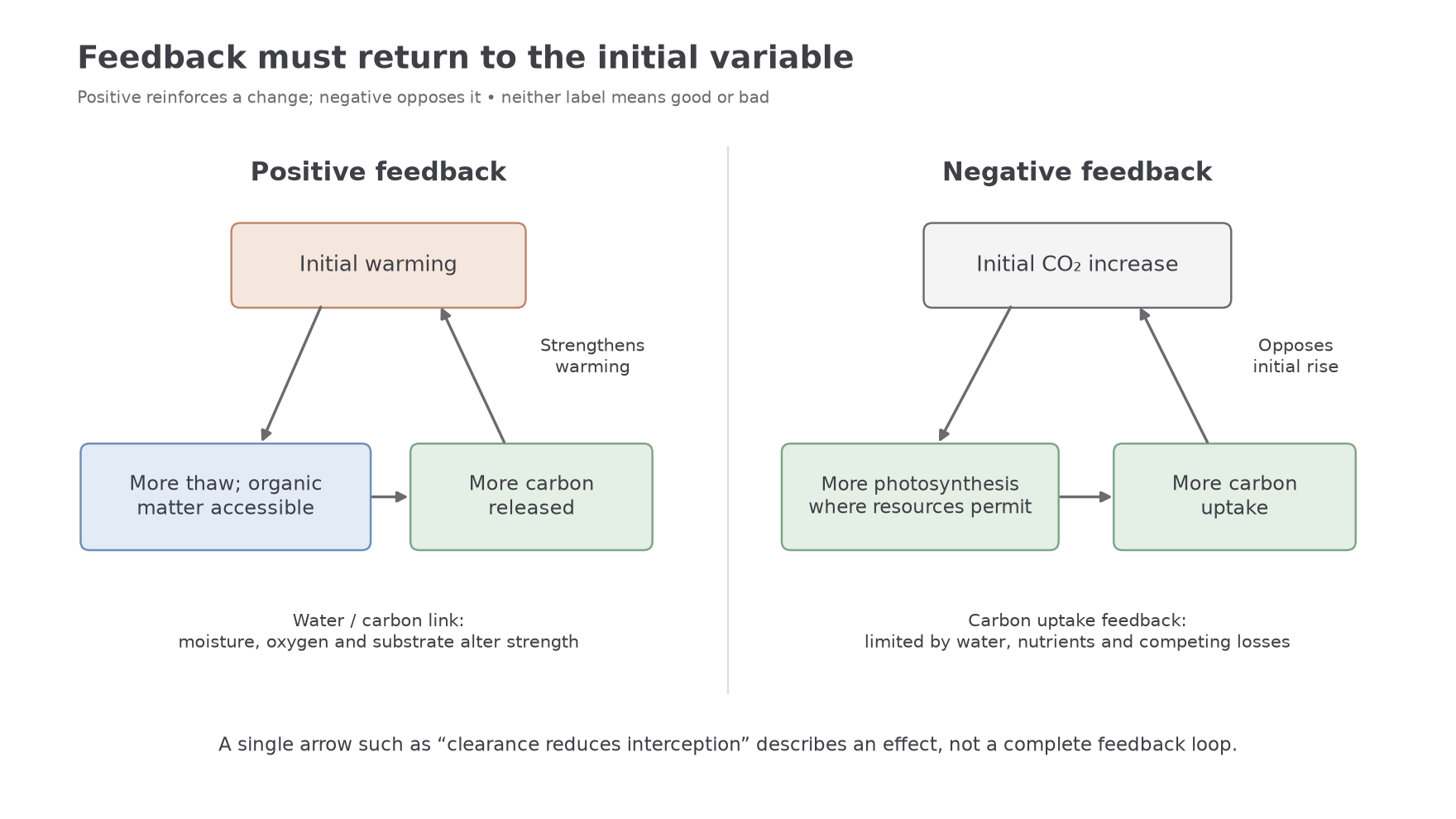
Cross-cycle negative feedback is also possible. Where modest initial warming increases plant growth in a water- and nutrient-sufficient environment, greater transpiration can produce evaporative cooling. Cooling can limit temperature-driven soil respiration and carbon dioxide release, weakening greenhouse warming and opposing part of the initial temperature rise. This is a conditional local pathway, not proof that planting trees always cools every climate. To evaluate a loop, identify the initial variable, every mechanism, the return effect, resource limits and the spatial and temporal scale.