3.2 2.a - Development, epidemiological transition and air pollution
Economic development changes disease risks through living conditions, age structures and the environments in which people work and live. This lesson explains the epidemiological transition and its limits, then examines air pollution and cancer in India and the national and international responses to that risk.
Living standards and susceptibility
Living standards affect both exposure to disease and the capacity to resist or recover from it. Income matters because it can support better housing, food and services, but it does not act automatically: public investment, distribution and the reliability of infrastructure determine what households can actually access.
Safe drinking water and sanitation interrupt faecal–oral transmission. Separating human waste from water sources reduces the opportunity for pathogens to reach new hosts. A pipe or toilet is not sufficient if water is intermittent, waste treatment fails or the poorest settlements remain unserved. Household storage can become important where supplies are unreliable, creating different contamination or vector risks depending on how it is managed.
Adequate food supports growth and immune function. Undernutrition can increase susceptibility to infection, while illness can reduce appetite, nutrient absorption and the ability to earn an income. This creates a reinforcing cycle between disease and poverty. Food availability at national scale does not guarantee access to a varied diet for every household. WHO explains the health consequences and unequal distribution of malnutrition.
Housing can reduce crowding, improve ventilation and limit vector entry. Education can improve access to information, but information alone cannot supply clean water or paid leave. Accessible healthcare adds vaccination, diagnosis, treatment and continuing care. These measures act at different points in a causal chain: they reduce transmission, reduce susceptibility or reduce the consequences once illness occurs.
Rising average income can coexist with unequal services and exposure. An informal settlement near a growing city may remain poorly drained and crowded even while the national economy expands. Disease geography therefore asks who benefits from development, where improvements occur and whether those improvements are sustained.
The epidemiological transition
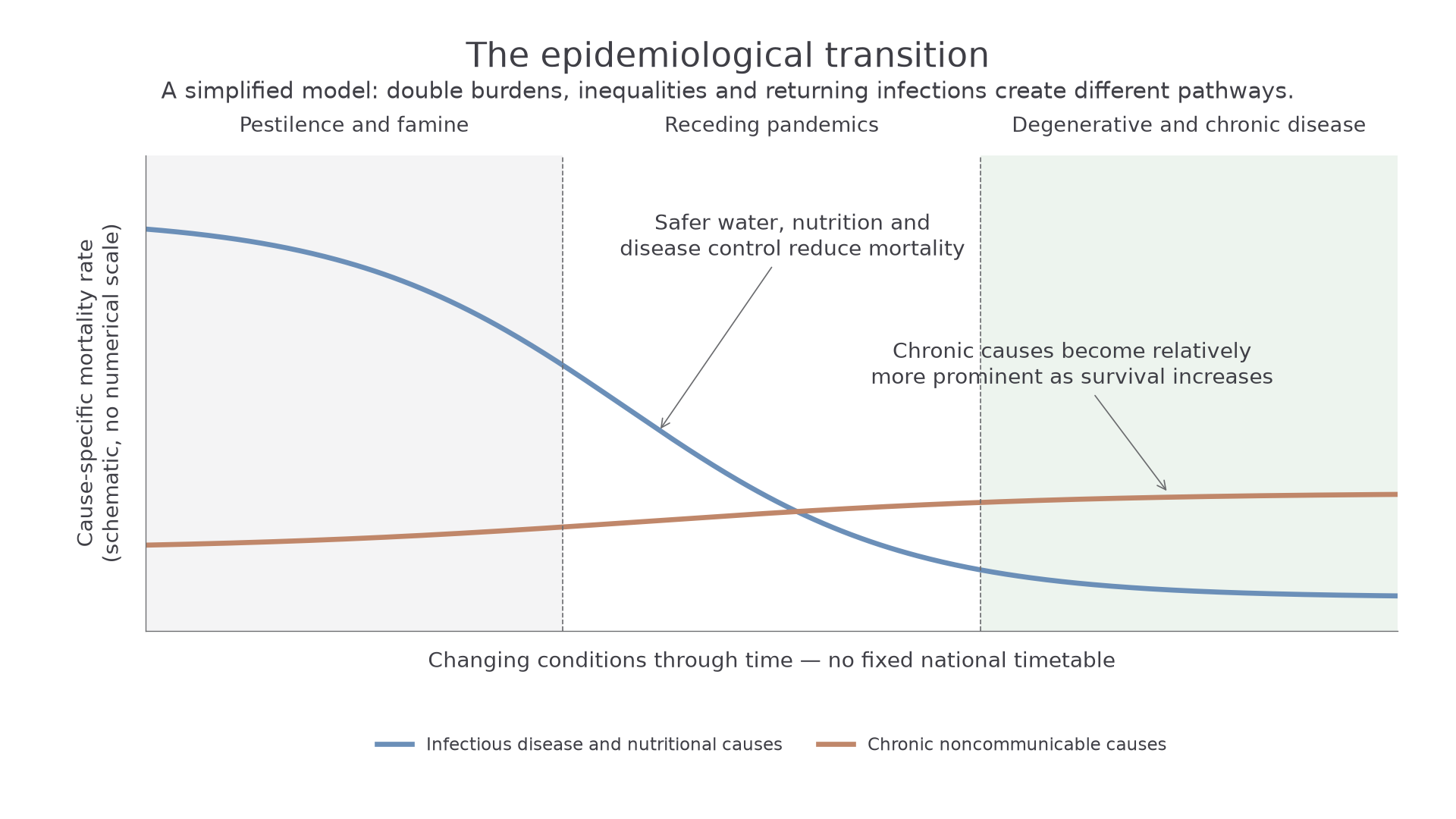
The epidemiological transition describes a long-term change in patterns of disease and death, commonly from a high burden of infections and early mortality towards greater prominence of chronic noncommunicable conditions. It is associated with development, but is a model of interacting changes rather than an unavoidable national timetable.
In the classic model, an age of pestilence and famine involves high, unstable mortality. Receding pandemics follow as nutrition, sanitation, services and disease control improve. Degenerative and other chronic conditions then become more prominent as more people survive into older age and exposures change. Later extensions discuss delayed chronic mortality and emerging or returning infections. These additions show that one simple sequence cannot capture every country.
Communicable disease often remains important in low-income developing countries where unsafe water, undernutrition, vector exposure and limited care persist. In advanced countries, longer survival and ageing increase the share of people living with cardiovascular disease, cancer or diabetes. Industrial pollution, tobacco, food environments and inactivity can also raise chronic risk. A rising share of deaths from one category can partly reflect falling deaths from another, rather than an absolute increase in every chronic disease.
However, “diseases of poverty” and “diseases of affluence” are shorthand, not exclusive categories. Many lower-income countries face a double burden of infections and chronic disease, while advanced countries still experience infections and health inequalities. WHO's 2025 cardiovascular assessment reports that more than three-quarters of cardiovascular deaths occur in low- and middle-income countries. Those income groups are not identical to OCR's development categories, but the evidence challenges an affluence-only explanation. WHO cardiovascular assessment, 2025.
Within countries, poorer groups can face greater chronic as well as infectious risk through housing, work, food access and care barriers. Economic growth may also increase traffic, industrial emissions or marketed unhealthy products before regulation catches up. The transition must therefore be interpreted through institutions, inequality, age and changing exposure, not national income alone.
[DIAGRAM: asset_name: The epidemiological transition; asset_slug: repair_d11_transition; caption: A schematic transition shows declining infectious mortality and the increasing relative prominence of chronic causes.; description: Three stages are labelled pestilence and famine, receding pandemics, and degenerative and chronic disease. A falling infectious and nutritional mortality curve crosses a gently increasing chronic noncommunicable mortality curve. The axes have no numerical scale or fixed dates because this is a conceptual model; double burdens, inequalities and returning infections create different national pathways.]
Air pollution and cancer in India
India is a large South Asian country with rapidly changing cities, industries, transport systems and household energy use. Its air-pollution exposure is uneven across places, seasons and social groups. Emissions sources include transport, coal-based power, industry and household solid-fuel combustion; agriculture, dust and atmospheric conditions also affect local mixtures. People living or working close to sources can experience exposures different from a city-wide average. WHO India air-pollution overview.
Continue this lesson.
You’re previewing NovaLearn without an account. Create a free account to read the rest.
Create free account