1.2 - Carbon-cycle pathways and sequestration
Carbon moves through living organisms, soils, air, water and geological reservoirs by biological, chemical and physical processes. This lesson explains those mechanisms, distinguishes rapid exchanges from long-term sequestration, and shows why combustion, weathering and ocean uptake cannot each be treated as a single uniform transfer.
Photosynthesis and respiration
Photosynthesis moves inorganic carbon into organic compounds, while respiration releases energy from organic compounds and returns carbon to inorganic forms.
Plants and other photosynthetic organisms use light energy to convert carbon dioxide and water into organic matter, releasing oxygen. On land, carbon dioxide enters leaves through stomata. Roots supply water, and leaf area determines the surface capable of intercepting light. Temperature, sunlight, nutrients and moisture constrain uptake: more carbon dioxide alone does not guarantee unlimited growth. In water, algae and phytoplankton use dissolved inorganic carbon.
Carbon fixed into sugars is used to build tissues or is transferred through food webs when organisms feed. Leaves, wood and roots have different turnover times, so the same annual uptake can be associated with different amounts of standing biomass. A mature tree stores carbon while continuing to take up and release it; the existing store is not identical to that year's new production.
Respiration by plants, animals and microbes releases energy needed for life. Aerobic respiration uses oxygen and releases carbon dioxide and water. Plants respire both by day and at night, whereas photosynthesis requires light. Soil respiration includes roots as well as decomposers, so it must not be counted twice in an ecosystem budget.
Gross and net primary production
Gross primary production is total carbon fixed by photosynthesis. Net primary production is the carbon remaining after the plants' own respiration. It supports new tissue and transfers to consumers and litter; it is not automatically the net increase of the entire ecosystem's carbon store.
Worked forest production balance
A forest has gross uptake of , plant respiration of 70 and other organisms' respiration of 40 in the same units. Subtract plant respiration to find net primary production, then the remaining respiratory output:
This assumes no other transfers. The IPCC's 2021 carbon assessment separates gross biological exchanges from net land uptake.
Worked harvested-grassland balance
A grassland fixes 240 tonnes C per year; plant respiration is 110, other respiration 100 and harvest exports 35. Calculate production first, then include the remaining outputs:
The system has substantial new plant production but loses carbon overall. NPP and total-system storage change therefore require different sets of transfers.
Decomposition and soil carbon
Dead organic matter is both a carbon store and a resource for decomposers.
Leaves fall, roots die and organisms produce waste, transferring carbon from living biomass to litter and soil. Microbes and soil animals break complex compounds into simpler material. Some carbon becomes microbial biomass or more persistent soil organic matter; some is released through respiration. Dissolved organic carbon can also be carried through soil and into streams. Decomposition therefore redistributes carbon as well as releasing it.
Temperature influences the rate of biochemical reactions, while water is needed for microbial activity. Warm, moist and aerated conditions commonly support rapid decomposition. Very dry soil restricts biological activity; frozen soil greatly slows access and reactions. Waterlogging limits oxygen supply. Anaerobic pathways can then generate methane as well as carbon dioxide, but rates depend on substrate, temperature and microbial conditions. “Wet” is not synonymous with “fast aerobic decomposition”.
Soil carbon accumulates when organic inputs exceed decomposition and other losses over time. In a productive warm forest, large litter inputs can coexist with rapid turnover and a relatively thin surface litter layer. In cold or waterlogged environments, slower decomposition can allow organic material to accumulate despite lower plant production. Mineral surfaces and soil aggregates can protect some organic material from rapid microbial access, giving different residence times within the same soil.
Residence time is the average time material remains in a specified store under the conditions of the model. Dividing a stock by an appropriate annual output gives a simple turnover estimate, but a soil is not a perfectly mixed tank: recently fallen leaves and mineral-associated carbon behave differently. If warming, drainage or disturbance changes outputs, a previously accumulating store may begin to lose carbon. The store's historical formation rate cannot simply be applied to its future.
Worked turnover estimates
A peat store contains 600 tonnes C and loses 30 tonnes C per year. Divide stock by annual output and cancel the mass units:
A second soil contains 900 tonnes C but loses 90 tonnes C per year:
The larger store has the shorter estimated turnover time because its output is proportionately larger. Both estimates assume the measured output represents continuing conditions; neither gives the age of every carbon atom.
Natural and fossil-fuel combustion
Combustion transfers carbon from a fuel store into gases and particles while releasing chemical energy.
In sufficiently oxygenated burning, carbon-rich material is oxidised mainly to carbon dioxide. Incomplete combustion also produces carbon monoxide, particles and char. A vegetation fire therefore does not instantly convert every carbon atom into atmospheric carbon dioxide: some remains in char or unburned material, and some is redistributed. However, loss of living biomass and later decomposition can substantially reduce ecosystem storage.
Lightning can ignite fires where fuel and weather allow them. Such fires are part of the natural dynamics of some ecosystems. Subsequent regrowth can draw carbon back into vegetation, but recovery takes time and may be incomplete if repeated fire, drought, erosion or land-use change prevents it. Even a fire followed by full regrowth temporarily changes atmospheric carbon. Calling all biomass burning immediately “carbon neutral” ignores timing and possible soil losses.
Fossil-fuel combustion uses coal, oil or gas formed from organic material and stored geologically over very long periods. Extraction and burning move this old carbon rapidly into the active atmosphere–ocean–biosphere system. Ocean uptake or new plant growth removes part, but does not automatically offset the added flux. The source-store residence time is therefore fundamentally different from a leaf or branch growing and decaying within a recent biological cycle.
NASA's carbon-cycle account, published in 2011, distinguishes slow geological storage from faster biological cycling. The relevant comparison is not simply natural versus human ignition. It is the store disturbed, the rate of release, the other changes caused and the time required for removal or replacement. A human-lit fire followed by forest clearance can create a lasting carbon loss; a fossil-fuel emission adds geological carbon regardless of whether the combustion is efficient.
Chemical weathering and carbon transfers
Water connects atmospheric carbon with rock minerals through dissolved gases and chemical reactions.
Rain absorbs carbon dioxide, forming a weak carbonic-acid solution. In soil, respiration can increase carbon dioxide concentrations and strengthen this pathway. Precipitation thus transports dissolved carbon and supplies water for weathering; it is not itself photosynthesis or another biological carbon-fixation process.
Carbonation involves reaction with carbonic acid. For limestone, a simplified reaction is:
Carbon in the dissolved products comes partly from the carbonate rock and partly from carbon dioxide. Streams and groundwater can carry these products to the ocean. If calcium carbonate is later precipitated, the simplified reverse reaction releases carbon dioxide. Carbonate dissolution followed by reprecipitation therefore does not necessarily provide a permanent net removal of atmospheric carbon dioxide over the complete cycle.
Hydrolysis alters minerals through reactions with water and hydrogen ions, often producing dissolved ions and clay minerals. Carbonic acid can drive silicate weathering. When its dissolved products reach the sea and contribute to carbonate burial, the full silicate-weathering pathway can remove carbon dioxide over long timescales. A simplified net expression after carbonate formation is:
The equation summarises the net pathway, not a single reaction occurring instantly on a rock surface. Uplift exposing fresh silicate material and a supply of water influence its rate. Kasting and Catling's 2003 review, hosted by NASA, explains this long-term carbonate–silicate connection.
Solution is dissolution of soluble minerals in water. Dissolving a salt such as halite does not by itself consume carbon dioxide. Oxidation transfers electrons to an oxidising agent, commonly oxygen: iron-bearing minerals can form iron oxides without taking carbon from the atmosphere. Oxidation of organic carbon can instead release carbon dioxide. These distinctions matter because “chemical weathering” describes several reactions, not a universal carbon sink.
The net effect depends on the mineral, acid source, transport and eventual fate of dissolved products. Weathering can transfer carbon to groundwater or rivers before any long-term burial occurs. A change at one reaction step must not be confused with the balance of the entire geological pathway.
Ocean and sediment sequestration
Sequestration transfers carbon into a store where it remains for a meaningful period, but storage duration and the possibility of re-release vary.
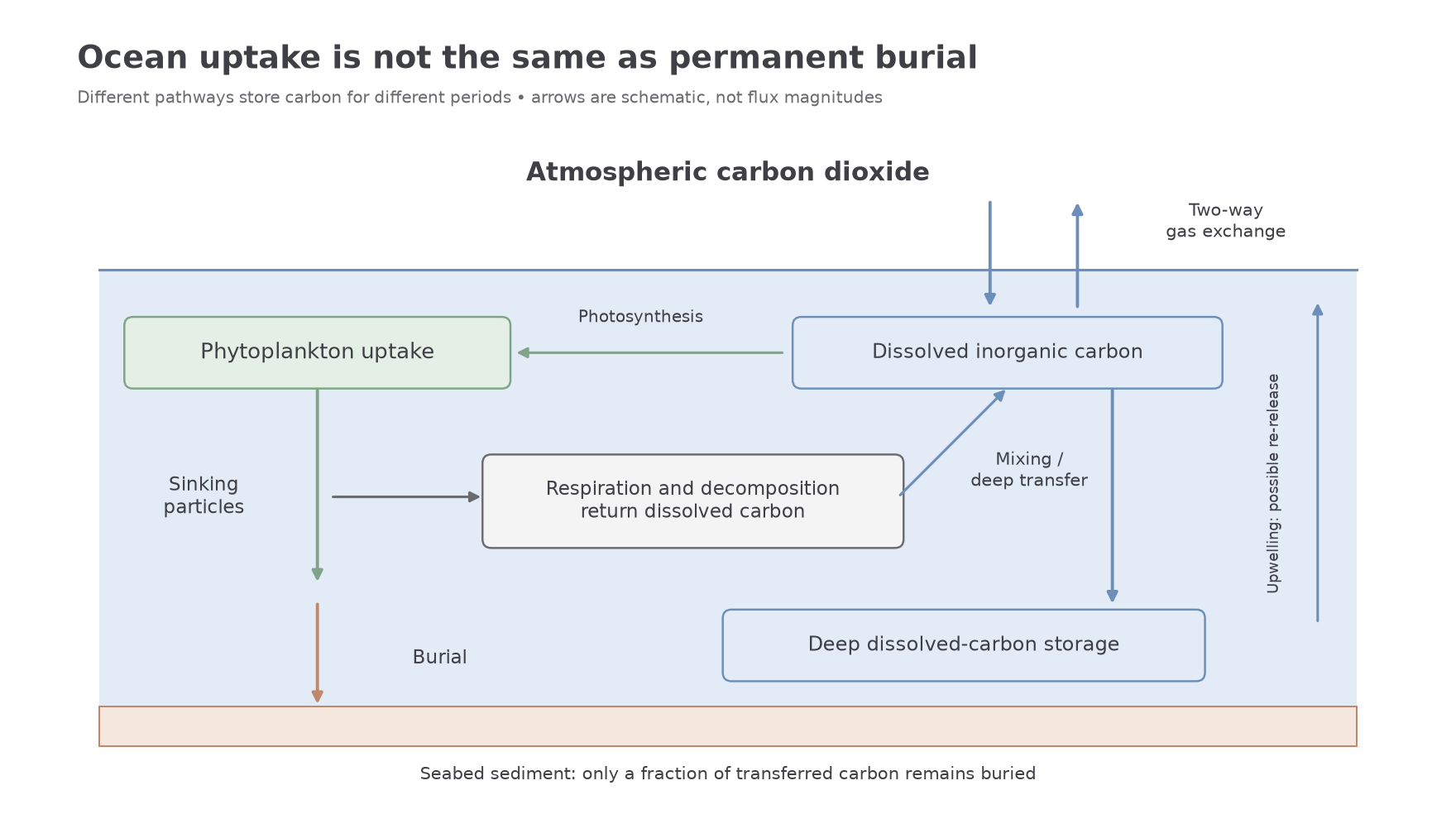
Carbon dioxide exchanges in both directions across the sea surface. A difference in partial pressure drives net transfer: uptake occurs when the atmosphere–surface-water conditions favour dissolution. Colder water can generally hold more dissolved carbon dioxide than warmer water, while circulation and chemistry influence the actual flux. Much dissolved inorganic carbon is present as bicarbonate, rather than as free carbon dioxide molecules.
The solubility pump includes dissolution and the physical transfer of carbon-rich water into the ocean interior through circulation and mixing. Deep storage can delay return to the atmosphere, but upwelling can eventually bring carbon-rich water back towards the surface. Warming and stratification may alter this exchange. A large deep-ocean stock is not proof that any extra surface emission is instantly absorbed.
The biological pump begins when marine organisms fix carbon through photosynthesis. Feeding and death transfer organic material through the food web. Some particles sink, but much is respired or decomposed before reaching the seabed, returning carbon to dissolved forms. Only a fraction is buried in sediments. Organisms also form carbonate shells, which can dissolve or accumulate; shell formation itself is not equivalent to the complete net carbon balance of biological uptake and burial.
[DIAGRAM: asset_name: Ocean carbon pathways; asset_slug: p24-ocean-carbon-pumps; caption: Ocean uptake, transfer to depth and burial occur along distinct pathways.; description: A schematic ocean cross-section shows two-way atmosphere–surface exchange, biological uptake by phytoplankton, sinking particles, decomposition and dissolved-carbon return, deep-water transfer and a small burial pathway to seabed sediment. The diagram separates temporary storage from longer-term burial and labels possible re-release through upwelling.]
On land, vegetation stores carbon during growth and transfers it to soils. In oceans and wetlands, burial can isolate organic material from rapid oxidation. Over geological time, heating, metamorphism and volcanism can return some stored carbon. The climate-regulating value of a sink therefore depends on net uptake, duration, additional storage and vulnerability to disturbance, rather than the mere existence of an uptake process.
People can also transfer captured carbon dioxide directly into geological storage. At Sleipner in the Norwegian North Sea, separation from produced natural gas and injection beneath the seabed began in 1996. Equinor's June 2019 account reported about one million tonnes stored annually at that time. This is a different pathway from natural biological uptake and sediment burial: it intercepts a production emission and moves carbon into a subsurface reservoir. Retention, monitoring and the emissions associated with the wider fuel system determine the net climate benefit.