2.2.2 3.a - Germany and power in the migration system
Germany shows how a powerful destination influences migration while remaining dependent on people and decisions elsewhere. This lesson explains dated migration evidence, labour and protection policies, opportunities and uneven local challenges.
Germany and influence over migration
Germany lies at the centre of the European Union and is an advanced economy in OCR's AC framework. Its large labour market, institutions, infrastructure and political influence help it attract migrants and shape rules affecting their movement. This influence is substantial but not unlimited: migrants make choices, employers depend on skills and other states control parts of a corridor.
Economic power operates through demand and access. German employers can recruit internationally, while the state determines which non-EU applicants can enter particular work routes. Recognising qualifications, setting entry conditions and funding integration can make some skills more mobile than others. An origin country may have invested in training workers but exert much less control over the destination's recruitment decisions.
Political influence also operates beyond a single border. Germany participates in EU rule-making and cooperation on mobility, protection and external-border management. EU free movement differs from entry conditions for most non-EU nationals, so “Germany's migration policy” is not one rule applied equally to everyone. National choices interact with European obligations, neighbouring states and agreements with origins.
Ageing and workforce change create reasons to seek labour, illustrated by the Destatis sixteenth population projection, published in 2026. Projections are conditional on fertility, mortality and migration assumptions; they do not guarantee a particular future labour shortage or migration total. Recruitment can address some needs, but training, productivity, retirement patterns and participation also matter.
The power relationship is therefore interdependent. Germany can select routes and negotiate cooperation, but it cannot simply command people to arrive with the required skills or make every worker remain. Poor recognition, housing barriers or exclusion can reduce its attractiveness. Origin communities and diaspora networks also shape movement independently of an official recruitment objective.
Patterns, policies and interdependence
Germany experiences both immigration and emigration. Destatis records 1,479,944 arrivals and 1,244,944 departures across its borders in 2025, giving net immigration of 235,000. The net balance was about 1.462 million in 2022, 663,000 in 2023 and 430,000 in 2024. These are annual registered movements, not the foreign-born population stock; they include a variety of citizenships and reasons for moving. Destatis migration table, 2022–2025, checked 14 October 2026.
[DIAGRAM: asset_name: Germany’s changing annual migration balance; asset_slug: h481_h17_net_migration; caption: Destatis records a positive but declining net migration balance from the 2022 peak to 2025.; description: An exact bar chart plots Germany’s registered net international migration as 1462089 in 2022, 662964 in 2023, 430183 in 2024 and 235000 in 2025. The axis states people per year and the title distinguishes net flow from migrant stock.]
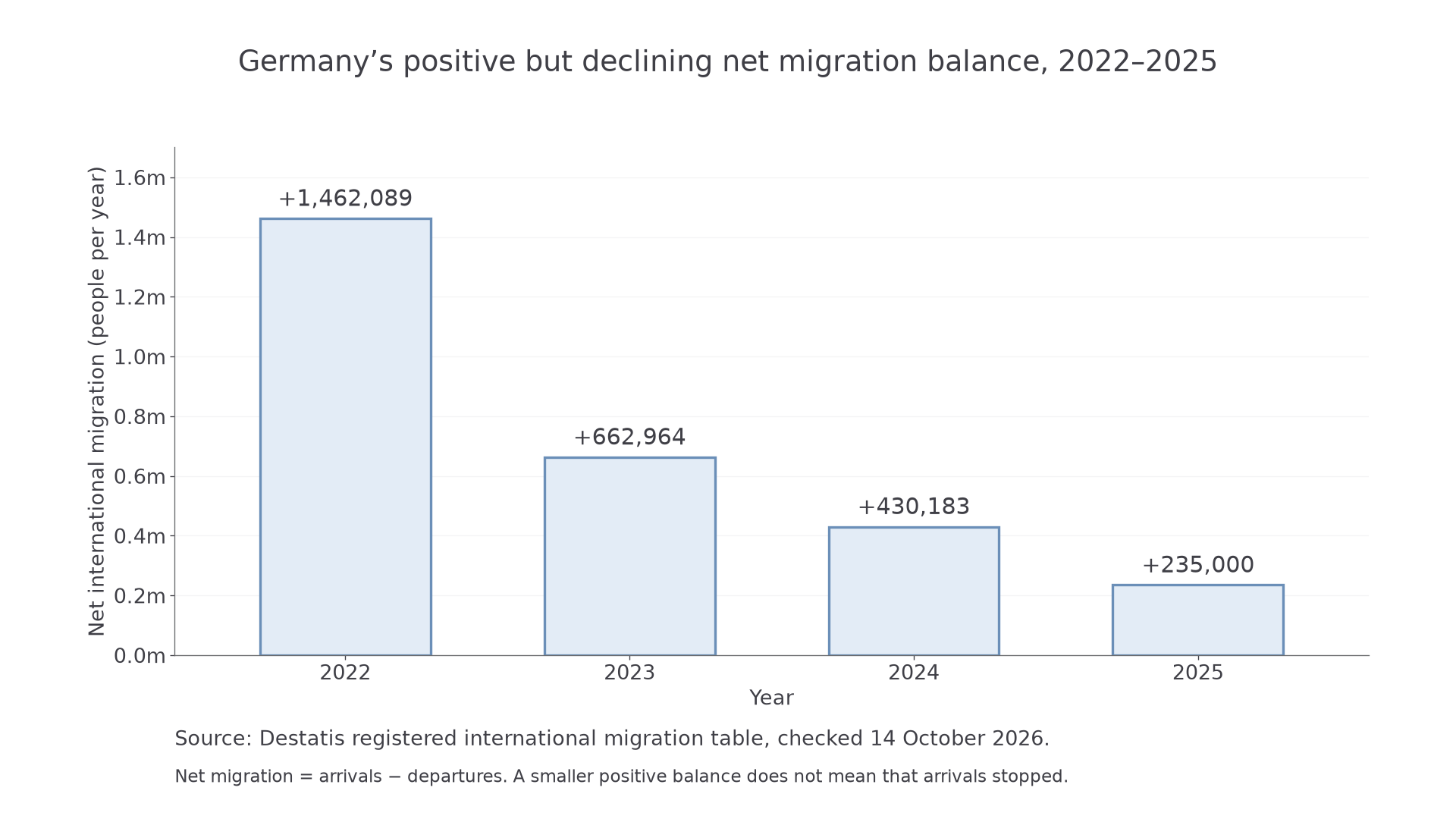
Origins and reasons are diverse. European labour and family links coexist with protection movements from conflict-affected countries and skilled recruitment from beyond Europe. The exceptional 2022 balance includes the context of displacement from Ukraine, while later lower net totals do not imply that all immigration ceased. Emigration includes return, onward migration and German citizens moving abroad. A net total cannot identify any one of those components without disaggregated evidence.
A dated policy example is the phased expansion of skilled immigration legislation in 2023–2024 and the opportunity card introduced in June 2024. The aim was to widen routes through which qualified people could seek or take work, with recognition procedures remaining important. This illustrates selective facilitation rather than an unrestricted border. German Government account of the legislation and opportunity-card introduction.
Protection, family and work routes have different purposes and conditions. Do not treat a refugee as simply a worker recruited to fill a vacancy or assume every EU mover uses a non-EU permit. Established Turkish, European and other diaspora links can sustain family and business connections, while changes in origin conditions or destination policy alter the same corridors over time.
Interdependence includes money sent to relatives, employers' reliance on workers, origin-country skill losses or diaspora gains, and cooperation over documentation and return. A German policy change can affect recruitment and family plans elsewhere; a conflict or recession outside Germany can alter arrivals and departures. These relationships explain why national control and cross-border dependence coexist.
Worked examples: calculating a migration balance
Example 1. Illustrative dataset: during one year, 1,850 people move into a rural district and 2,420 move out. Match the area and period, then subtract departures from arrivals.
The negative balance means net emigration of 570 people. Gross immigration remains 1,850; the net figure does not count everyone who moved.
Continue this lesson.
You’re previewing NovaLearn without an account. Create a free account to read the rest.
Create free account