2.2.3 4.a - Human rights governance and development in South Sudan
South Sudan is a low-income developing-country case of the relationship between human rights governance and development. Using a dated post-independence evidence window, this lesson compares immediate protection and relief with longer-term legal and institutional change. It assesses opportunities for recovery alongside continuing violence, unequal access and impunity.
Short- and long-term governance consequences
Governance can change immediate survival conditions before it changes the institutions that shape long-term development.
In the short term, an NGO clinic can treat injuries, a food distribution can reduce hunger and a protected route can allow people to reach water or shelter. These are substantive benefits for rights and wellbeing, even if they do not solve the conflict. They depend on safe access, supplies, staff and funding. A temporary service can disappear when any of those connections breaks.
Longer-term consequences can include stronger courts, laws protecting rights, more accountable public finance and institutions capable of delivering services without permanent emergency substitution. The pathway is conditional: a new law needs implementing rules, trained staff, resources and public trust before it can change everyday access. If external aid bypasses national services indefinitely, it may save lives while leaving a weak public system. If it withdraws before capacity exists, people may lose essential care. The relevant judgement concerns sequencing and coordination rather than a simple choice between relief and development.
In South Sudan, the 2024 Commission for Truth, Reconciliation and Healing Act and Compensation and Reparation Authority Act created legal foundations for transitional justice. The UN's 2025 country results report describes preparatory work, while noting continuing implementation requirements and a pending Hybrid Court. Legal enactment is a real institutional step; it is not evidence that every survivor has already received a remedy. UN South Sudan, country results report 2025.
Rights issues in South Sudan
South Sudan is a landlocked country in East-Central Africa, with Juba as its capital and extensive rural areas within the Nile basin. It became independent in July 2011, but renewed conflict from 2013 and subsequent violence have repeatedly undermined civilian protection and development. Long distances and seasonal access difficulties make the location of protection and services particularly important.
The 2018 Revitalized Peace Agreement established a framework for political transition and reform. Its existence does not mean that all parties consistently complied or that local violence ended. The country is distinct from Sudan, its northern neighbour, although cross-border conflict and displacement can affect South Sudan's resources and services.
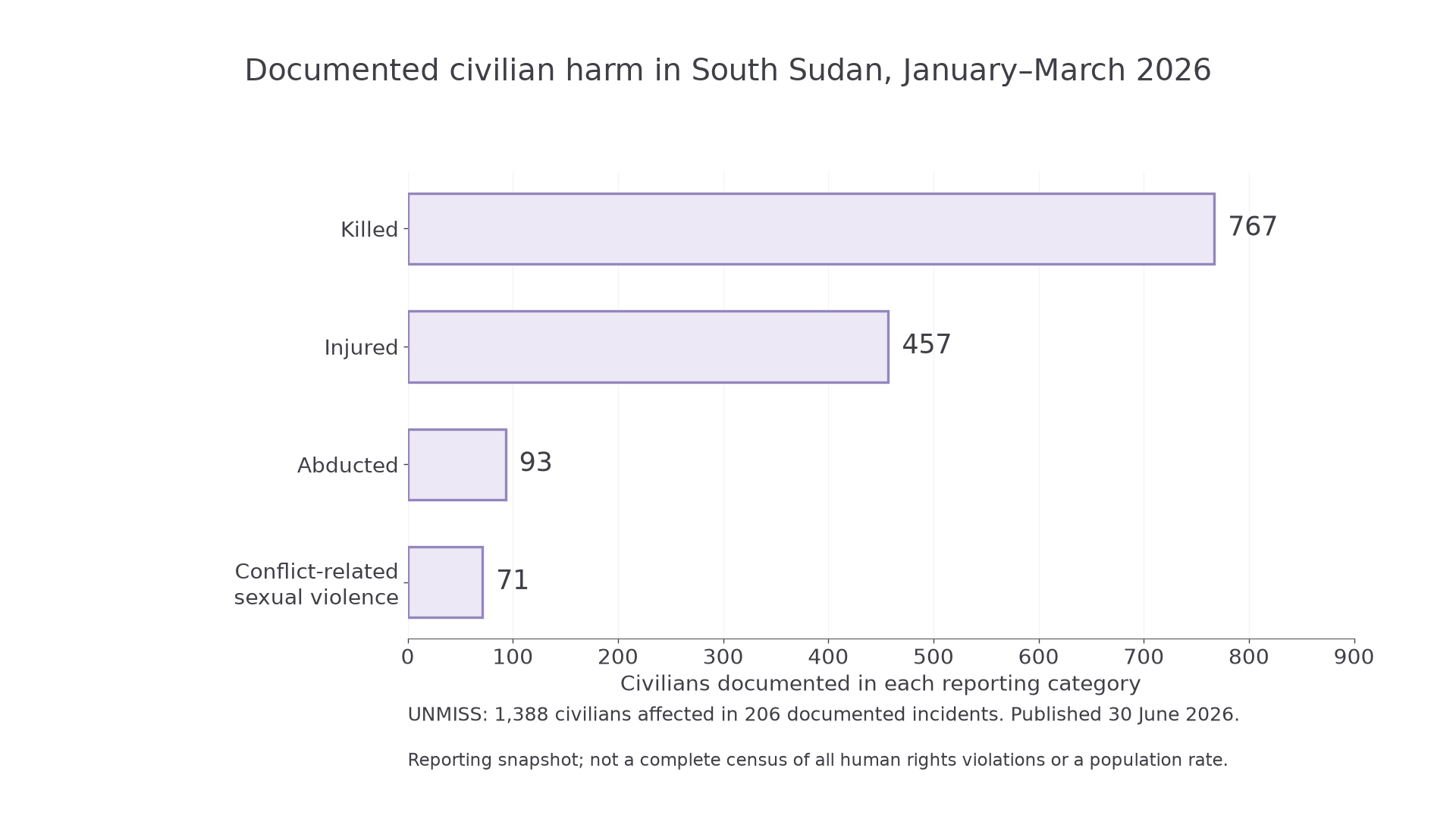
UNMISS's June 2026 summary documents 206 incidents of conflict-related violence affecting 1,388 civilians in January–March 2026: 767 killed, 457 injured, 93 abducted and 71 subjected to conflict-related sexual violence. These are documented categories in a defined reporting period, not all rights violations or the complete national human cost. Insecurity and reporting access affect what can be verified. UNMISS, first-quarter 2026 monitoring.
[DIAGRAM: asset_name: Documented civilian harm in South Sudan; asset_slug: h481_h23_civilian_harm; caption: UNMISS documented several forms of civilian harm in January–March 2026.; description: A horizontal bar chart shows 767 killed, 457 injured, 93 abducted and 71 subjected to conflict-related sexual violence among 1,388 civilians documented by UNMISS in 206 incidents during January–March 2026. Counts are a reporting snapshot, not a complete census of all human rights violations.]
Displacement can remove access to land, income, schooling and healthcare. Women and children can face particular risks, but harms differ by age, location and circumstances rather than affecting every member of a group identically. A household that returns may encounter damaged services or contested property. The absence of active fighting in its village would therefore not establish the restoration of all rights.
Worked examples: a category's share of a recorded total
Example 1. Illustrative dataset: a district monitoring team verifies 250 land-rights complaints, of which 82 concern access to communal grazing. Use the category count as the numerator and the complete recorded total as the denominator.
Grazing-access complaints make up 32.8% of these verified complaints. The denominator is complaints, rather than every resident or every rights violation in the district.
Example 2. Illustrative dataset: a community survey finds that 47 of 180 responding households cannot obtain the land documents they need.
The result describes 26.1% of the responding households. It does not establish the proportion of individual people affected or automatically represent households that did not respond.
Global governance strategies for human rights
South Sudan's governance response combines protection, humanitarian assistance, monitoring, diplomacy and attempts to secure accountability.
UNMISS was established in 2011. Its mandate under Security Council Resolution 2820 of 2026 includes civilian protection, conditions for safe humanitarian delivery, support through good offices and monitoring and reporting on rights and the peace process. These roles combine uniformed and civilian work. A mandate authorises activity; actual reach depends on access, personnel, resources and cooperation. The government retains primary responsibility for protecting people. UNMISS's 2026 mandate.
Humanitarian agencies and NGOs provide services that keep people alive. Médecins Sans Frontières' account of the 3 May 2025 attack on its Old Fangak hospital describes the destruction of its pharmacy and disruption of medical supplies. This is direct operational evidence from the affected NGO, which also calls for protection of health facilities. It shows why medical assistance depends on security and respect for civilian infrastructure; it cannot be judged only by how many supplies donors purchase. MSF, 4 May 2025.
Regional diplomacy involving the African Union and the Intergovernmental Authority on Development supports negotiation and implementation of the peace framework. Monitoring bodies can identify violations and preserve evidence. Transitional justice initiatives include truth telling, reparations and proposals for a hybrid court involving national and international elements. These are distinct mechanisms: a monitoring commission does not itself convict defendants, and an intended court must not be described as already delivering trials without evidence.
Continue this lesson.
You’re previewing NovaLearn without an account. Create a free account to read the rest.
Create free account