1.1.2 - Glacier ice, types and movement
Glaciers form from persistent snow and move because ice deforms and, under suitable conditions, slides over its bed. This lesson compares valley glaciers with ice sheets and warm-based with cold-based ice. It explains how temperature, thickness, meltwater and friction affect movement, providing the basis for understanding glacial erosion and deposition.
From snow to glacier ice
A glacier can begin where some snow survives successive melt seasons and later snowfall buries it. Accumulation must be sufficient to build a persistent mass; one exceptional snowstorm does not by itself produce glacier ice.
Fresh snow contains much air between delicate crystals. Burial adds weight, compacting the snow and reducing its pore space. Crystals change shape and grow through recrystallisation, producing denser granular material called firn. With further compaction and recrystallisation, the connected air spaces close and the material becomes glacier ice containing trapped bubbles. The transition is gradual and its rate varies with accumulation and temperature; there is no universal number of years for every glacier.
Meltwater can percolate into snow and refreeze, adding ice layers and transferring heat as latent heat is released. This pathway is important in some settings but is not required for all glacier formation. A glacier does not normally begin as a lake freezing solid: it develops mainly through the transformation of accumulated snow. NSIDC's glacier overview, checked 14 October 2026, explains this sequence.
Once the mass is thick enough, its weight creates stresses that allow it to deform and spread. The exact threshold depends on slope, temperature and geometry. Ice moving out of its accumulation area can extend into lower, warmer locations where it loses mass. The lower tongue's existence therefore does not imply that snowfall there exceeds melt; it can be maintained by a supply of flowing ice from above.
Valley glaciers and ice sheets
Valley glaciers and ice sheets contain the same material but have different geometries and relationships with the underlying relief. A valley glacier is a body of ice channelled through a mountain valley, often supplied by snowfields or smaller tributary glaciers higher up. Its flow is strongly constrained by the valley's sides and overall gradient.
Ice enters the lower tongue from upstream and is removed by ablation. Tributary glaciers can merge, joining debris bands and changing flow width. Contact with valley walls and bed creates resistance, so surface movement is commonly fastest towards the centre and slower near the sides. A bend, narrowing or steepening can change speed and stress. Surface cracks, called crevasses, develop where brittle near-surface ice is stretched beyond its capacity to deform smoothly.
An ice sheet is a much larger, dome-like ice mass that spreads over a broad region and is thick enough to bury much of the underlying relief. Ice flows outward from high parts of its surface towards its margins. It is not everywhere a uniform slow slab: fast-flowing ice streams and outlet glaciers can concentrate discharge. Greenland and Antarctica contain the present-day ice sheets, as identified by NSIDC, checked 14 October 2026.
In both forms, gravity drives flow down the ice-surface gradient. Bed topography influences the route and resistance, but ice can cross a local bedrock rise if the wider pressure and surface-slope conditions drive it onwards. A simple statement that ice always follows the steepest exposed ground is therefore inadequate for a thick ice sheet.
A valley glacier often produces an assemblage organised along one trough, whereas an ice sheet can generate widespread streamlined bedforms and deposits across several drainage basins. These are broad tendencies: an outlet from an ice sheet can itself occupy a valley, so the categories connect rather than describing completely separate processes.
The distinction matters in Greenland's 2025 balance year, 1 September 2024–31 August 2025. NOAA's Arctic Report Card estimated a net ice-sheet loss of billion tonnes, despite above-average snowfall. Ice flowing towards the ocean and leaving through its outlet glaciers contributed to the loss alongside surface runoff. An ice sheet therefore remains a moving system of connected interiors and outlets, rather than a static store classified only by its size. NOAA Arctic Report Card 2025.
Warm-based and cold-based glaciers
A glacier's basal temperature determines whether ice can remain frozen to its bed or whether liquid water can support substantial sliding. The classification concerns conditions at the base, not simply summer air temperature.
A warm-based glacier has basal ice at the local pressure-melting point, so liquid water can occur at the bed. That melting point can be below the normal atmospheric-pressure value of , because pressure increases beneath thick ice. Geothermal heat, frictional heating, insulation by overlying ice and the arrival of surface meltwater all influence whether the base reaches it. Pressure alone does not provide an unlimited source of heat for melting.
A cold-based glacier has basal ice below its local pressure-melting point and is largely frozen to the bed. Substantial basal sliding is strongly restricted, but the ice can still move through internal deformation. Cold-based ice may preserve older landforms beneath it more effectively than debris-rich sliding ice, although local erosion and entrainment are not necessarily zero.
Real glaciers can be polythermal, containing zones with different thermal conditions. A cold surface in winter can overlie a warm bed, and a thick central area can behave differently from a thin margin. Consequently, latitude and air temperature alone cannot establish the basal regime.
Thermal differences influence landscape development through movement and contact with the bed. Sliding ice containing debris can abrade rock, and changing basal water pressure can help detach blocks. A cold, frozen bed offers fewer opportunities for these mechanisms. Yet erosion still depends on rock structure, debris supply and how strongly the moving ice presses against the surface. “Warm-based” does not automatically mean equally rapid erosion everywhere.
Basal sliding and internal deformation
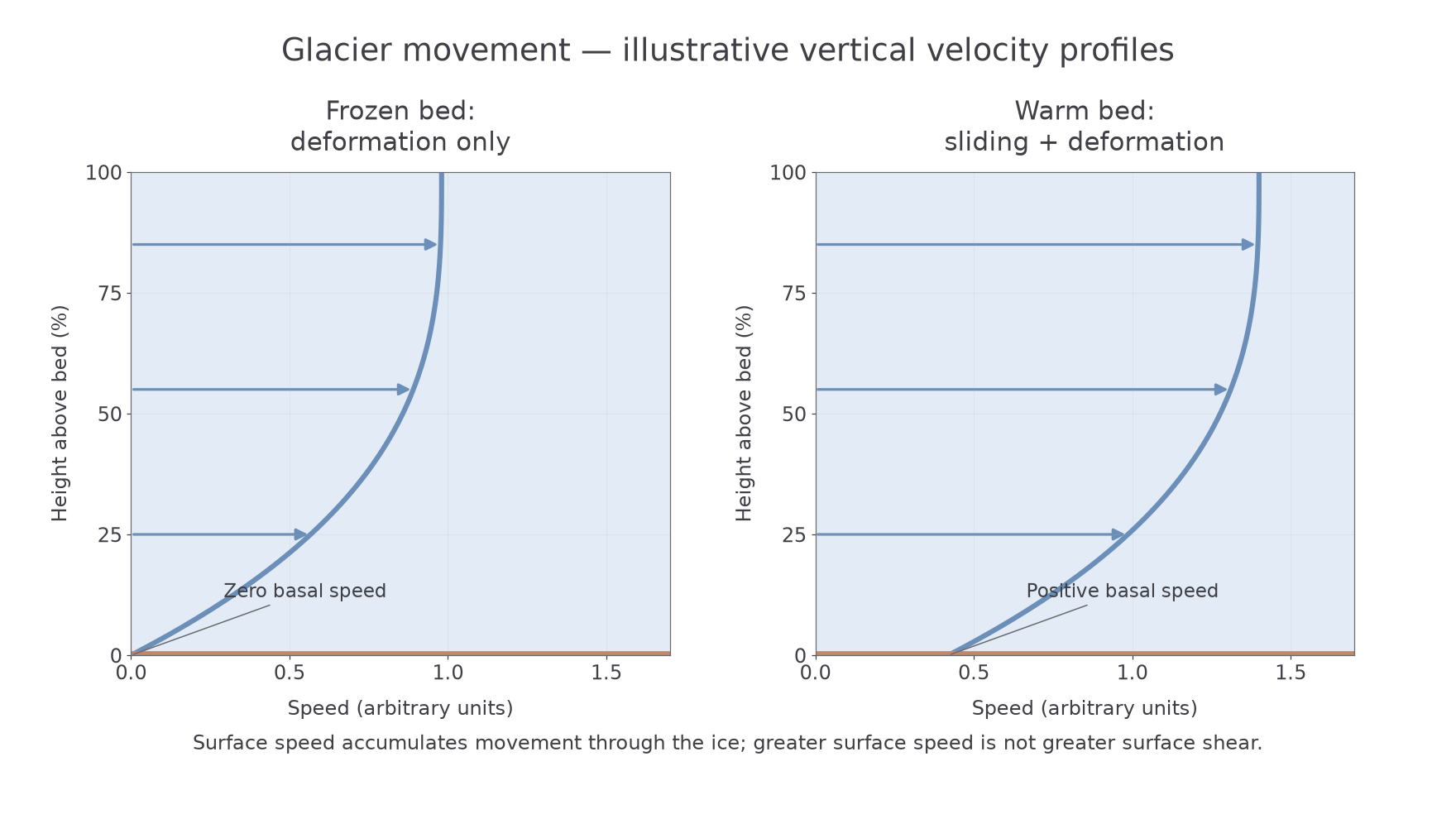
Glacier movement combines deformation within the ice with movement at or beneath its base. Their relative contributions vary between glaciers and through time, so they should be explained as interacting mechanisms rather than two fixed speeds.
Internal deformation, or creep, occurs when sustained stress makes ice crystals deform and move relative to one another. Greater ice thickness and surface slope generally increase driving stress. Warmer ice, still below or at its melting point, usually deforms more readily than colder ice under comparable stress. Ice can therefore flow while its base remains fixed.
A vertical velocity profile helps explain an apparent puzzle. Resistance at the bed slows basal ice, while the movement produced by deformation through the layers accumulates upwards. Surface velocity can consequently be greater than basal velocity. This does not mean that the greatest shear deformation must occur at the surface. Deeper ice can deform strongly while the overlying column moves faster overall.
Basal sliding is movement of ice relative to its bed. Liquid water can reduce effective contact and resistance, while ice deforms around obstacles and local melting and refreezing can help it pass small irregularities. Where the bed contains wet sediment, deformation of that sediment can add to basal motion. These mechanisms depend on the bed's roughness, sediment properties and water pressure.
[DIAGRAM: asset_name: Sliding and deformation velocity profiles; asset_slug: p09-glacier-velocity; caption: Surface motion can combine basal sliding with accumulated internal deformation; description: Two illustrative vertical velocity profiles compare a frozen-bed glacier with zero basal sliding and a warm-bed glacier with positive basal velocity. Both gain additional velocity towards the surface through deformation. Axes show height above bed and speed in arbitrary units; they are explanatory profiles, not glacier observations.]
More meltwater does not always produce a proportional speed increase. Water pressure may initially rise and reduce resistance, but an efficient drainage network can later remove water and lower pressure. Ice thickness, temperature and bed conditions must therefore be considered alongside supply. NSIDC's movement explanation, checked 14 October 2026, distinguishes sliding, deformation and terminus change.