3.2 5.a - Medicines from nature and sustainable plant trade
Nature supplies compounds that can become medicines, linking human health to soils, climate, biodiversity and international trade. This lesson uses Artemisia annua to explain medicinal-plant growing conditions and pharmaceutical supply chains, then examines how conservation and fair production can sustain both ecosystems and livelihoods.
Medicinal plants and their habitats
Plants produce chemical compounds involved in functions such as growth and defence, and some compounds have useful effects when developed into medicines. Finding a biologically active substance is an early stage: effectiveness, safety, manufacturing quality and suitable use still require investigation. “Natural” describes an origin, not a guarantee of a safe or effective treatment. Plant material, a purified compound and a regulated medicine are different products.
A habitat is the environment in which an organism lives. Its climate influences the energy and water available for growth. Temperature affects rates of biological processes; extremes can damage tissues. Rainfall and evaporation determine water availability, while sunlight supports photosynthesis. Day length can influence flowering, so moving a crop between latitudes can alter its development even where annual rainfall appears similar.
Soils also matter. Texture and structure influence drainage and water storage; deep soils can provide a larger rooting volume. Soil acidity, measured by pH, affects nutrient availability, while fertility affects the nutrients available for growth. A waterlogged soil can deprive roots of oxygen even if a crop needs abundant water. Hence “wet climate” and “well-watered roots” do not imply that permanent saturation is beneficial.
The harvestable medicinal yield depends on more than total plant mass. A vigorous crop may contain a different concentration of the useful compound from another variety or harvest. Altitude is often an indirect influence through temperature, rainfall and seasonality, rather than a universal altitude requirement for a species. Farmers must therefore match a suitable variety, planting calendar and management system to local conditions. This is a geographical connection between an ecosystem's physical processes and a global health resource.
Growing Artemisia annua
Artemisia annua, also called sweet wormwood, is an annual plant whose leaves provide artemisinin, a compound used to manufacture important antimalarial medicines. It is a useful named case because its production depends on both agroecology and the organisation of cultivation. Annual crops complete their life cycle within a growing season, so planting and harvesting decisions must fit that cycle.
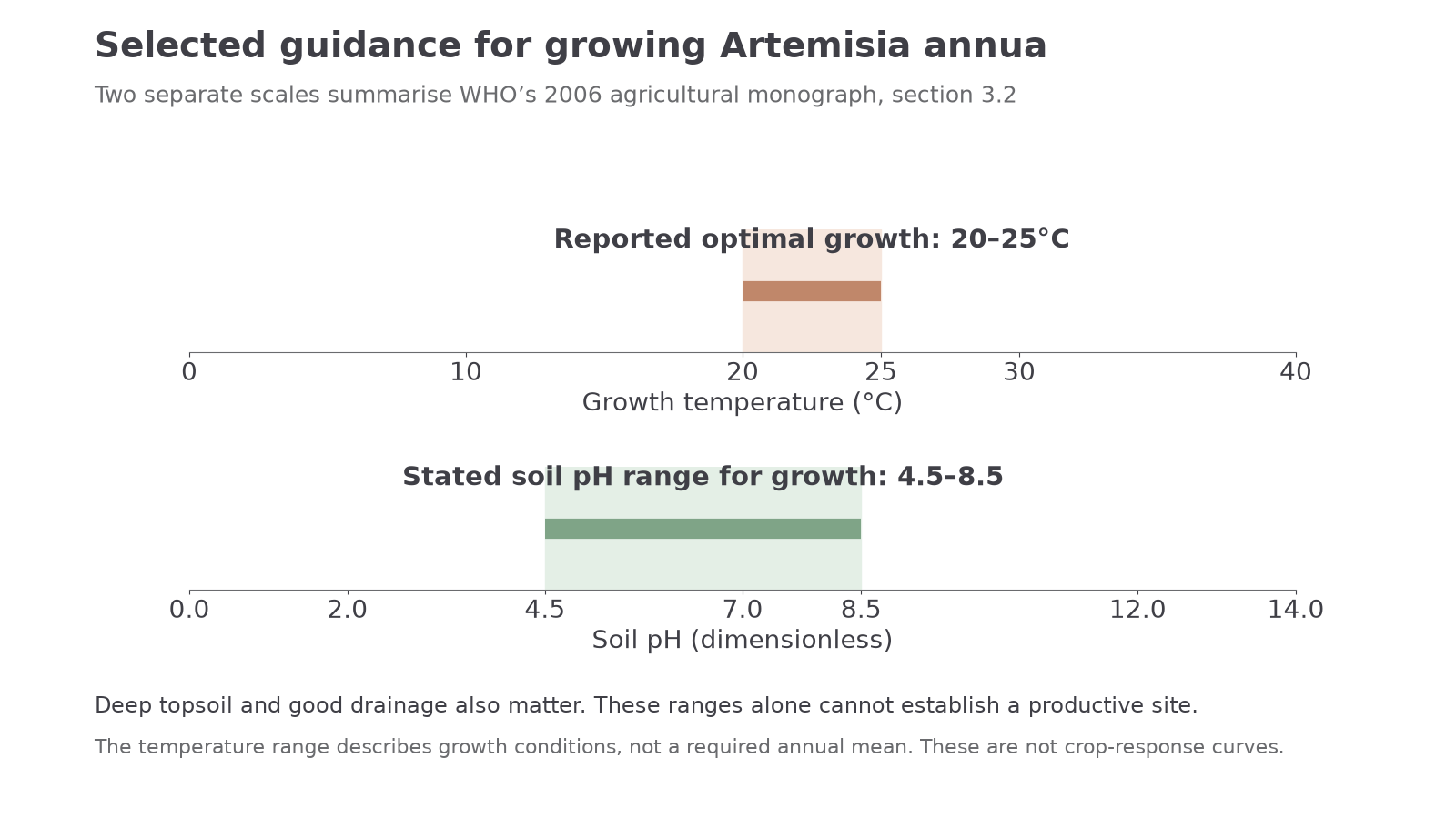
The WHO agricultural monograph published in 2006, especially section 3.2, describes a preference for sunny conditions and reports an optimal growth temperature of about from experience in several countries. This is a growth-temperature range, not a claim that the annual mean must be . It identifies deep topsoil and good drainage, with growth possible across soil pH 4.5–8.5. These broad guidance ranges do not make every site within them equally productive.
[DIAGRAM: asset_name: Artemisia growing guidance; asset_slug: d15-artemisia-conditions; caption: Two separate ranges summarise selected WHO 2006 guidance, not a universal crop response curve; description: The first horizontal scale highlights 20–25 degrees Celsius as the reported optimal growth-temperature range. A separate pH scale highlights 4.5–8.5 as the stated soil pH range for growth. Deep topsoil and good drainage are also required; suitable temperature or pH alone does not establish a productive site.]
Successful cultivation also needs reliable moisture during establishment, weed control and a planting calendar suited to local day length. Premature flowering can reduce the period available to build useful leaf biomass. The WHO 2006 consultation on artemisinin supply emphasises suitable labour, land and access to processing as well as physical conditions. Nursery work, transplanting, weeding and harvesting create labour demands that can coincide with other farming tasks.
Thus a proposed farm should be assessed as a system. A warm, sunny site may still be unsuitable if it waterlogs, lacks labour at harvest or is too far from a reliable buyer and processor. Local trials can establish how varieties and timing perform before large commitments are made. Agricultural guidance supports that assessment; it is not a promise of a fixed yield for every country or season.
Continue this lesson.
You’re previewing NovaLearn without an account. Create a free account to read the rest.
Create free account