3.3 5.c - Piracy, migration and hazardous ocean crossings
Oceans provide routes for commercial movement and for people seeking safety or opportunity, but journeys can expose people to serious danger. This lesson examines the changing geography and management of piracy, then explains why people cross the Mediterranean from North Africa and how hazards, borders and humanitarian responses shape those journeys.
Twenty-first-century piracy patterns
Piracy and armed robbery against ships threaten crews, cargo and maritime connections, but their legal definitions and geographical patterns differ. The IMO's definitions, drawing on UNCLOS, identify piracy as specified private acts of violence, detention or depredation against another ship on the high seas or in a place outside state jurisdiction. The relevant piracy provisions also apply in exclusive economic zones: piracy is not limited to locations more than 200 nautical miles from land. Armed robbery against ships refers to relevant private acts within internal waters, archipelagic waters or the territorial sea. These categories should not be used indiscriminately for every naval confrontation or politically motivated attack.
Important twenty-first-century concentrations have included the Gulf of Aden and western Indian Ocean off Somalia, the Gulf of Guinea in West Africa, and Southeast Asian waters including the Straits of Malacca and Singapore. They combine valuable maritime movement with different opportunities and enforcement conditions. Dense shipping and anchorage areas provide potential targets; long coastlines, jurisdictional boundaries, criminal networks and limited effective enforcement can complicate prevention. Geography creates opportunities, but does not make coastal communities inherently criminal.
The IMO's December 2024 meeting account records 72 reported actual or attempted incidents worldwide in January–June 2024. Its regional categories include 37 in the Straits of Malacca and Singapore, 13 in the Indian Ocean, 10 in West Africa, seven in the Arabian Sea, four in the South China Sea and one in Atlantic South America. These are counts for that reporting period, not a ranking fixed for all years.
[DIAGRAM: asset_name: Reported piracy and armed robbery in early 2024; asset_slug: d24-piracy-counts; caption: IMO regional counts cover actual and attempted incidents during January–June 2024; description: A horizontal bar chart shows Straits of Malacca and Singapore 37, Indian Ocean 13, West Africa 10, Arabian Sea 7, South China Sea 4 and South America Atlantic 1, totalling 72. The chart explicitly combines reported piracy and armed robbery, labels the six-month period, and warns that counts are not risks per vessel transit.]
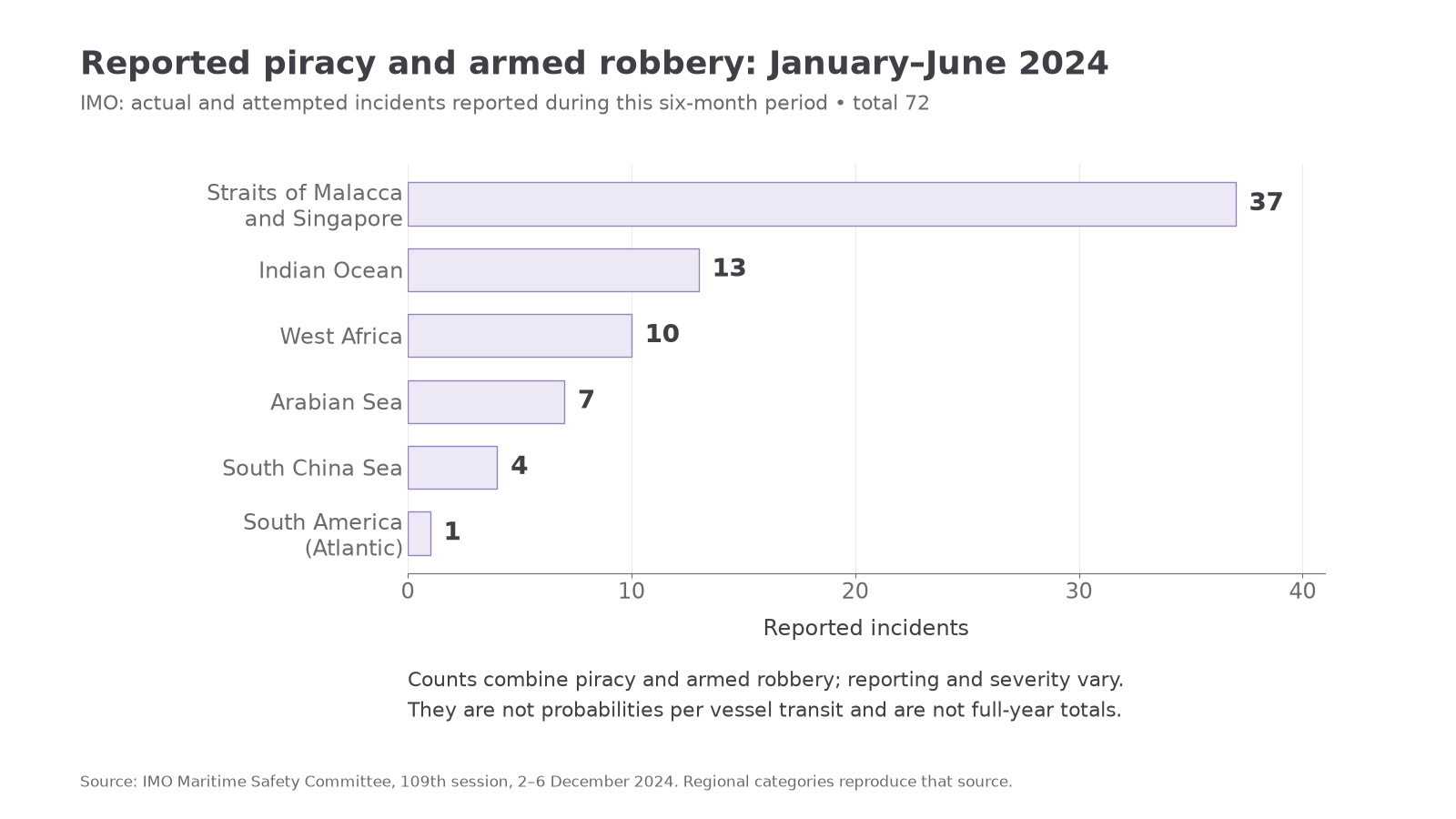
A count is not automatically a probability of attack. A busy region may record more incidents partly because more ships pass through it; comparing risk would require a suitable exposure measure such as vessel transits, alongside comparable definitions. Reporting can be incomplete, and a report can distinguish attempted from successful attacks, hijackings and crew harm. Do not infer equal severity from equal counts or add totals from different organisations as if they were separate events.
Worked example — standardising incident exposure
Illustrative dataset: a route records five incidents during 10,000 vessel transits.
Worked example — another route with a different denominator
Illustrative dataset: a second route records eight incidents during 4,000 transits.
The rate standardises exposure. It is not a complete probability of harm because reporting, repeated incidents and severity still require investigation.
Patterns also change. A February 2012 EU NAVFOR briefing described reduced successful Somali hijackings during 2011 alongside continuing criminal incentives and insecurity ashore. A May 2024 account of the attack on the Basilisk, approximately 380 nautical miles east of Mogadishu, demonstrates a continuing offshore threat and naval response. Successful suppression for a period does not establish permanent elimination.
Managing maritime piracy
Managing piracy requires measures at sea and action against the conditions sustaining criminal activity ashore. Patrols can deter attacks, respond to incidents and protect vulnerable shipping, but the operating area may be much larger than the area a particular ship or aircraft can monitor. Security cannot be assessed by counting deployed vessels alone.
Operation Atalanta was established in 2008 to help deter, prevent and repress piracy and armed robbery off Somalia. Its mission account includes protecting World Food Programme shipping and contributing to maritime security. Sharing information and coordinating deployments can reduce duplication and direct assistance where it is needed. Ship operators also use applicable protection guidance, trained crews and incident reporting. These measures can make an attack harder or improve response, but involve costs and responsibilities and do not guarantee safety in every incident.
Arrest is only one stage in a legal response. Evidence must be collected, jurisdiction established and suspects brought before competent authorities with due process. Cooperation over transfer and prosecution matters because a naval force cannot simply substitute for every national court. Atalanta's May 2024 newsletter records the transfer of six alleged pirates to Seychelles authorities after the Chrystal Arctic incident. An allegation or transfer is not itself a conviction. The case illustrates how patrol activity and a judicial pathway must connect.
Continue this lesson.
You’re previewing NovaLearn without an account. Create a free account to read the rest.
Create free account