2.2.1 3.a - Ethiopia and unequal access to world markets
Ethiopia is an LIDC whose exporters participate in global markets while facing limited bargaining power, infrastructure constraints and a concentrated export base. This lesson examines dated trade patterns, explains barriers and diversification opportunities, and compares Ethiopia's responses with the wider policy options available to a core economy such as the United States.
Ethiopia and peripheral trade patterns
Ethiopia is a landlocked country in the Horn of Africa and is studied as a low-income developing country, or LIDC, in OCR's framework. Its peripheral position concerns limited control over some markets and valuable activities, not an absence of economic initiative or a claim that all its firms and regions are alike.
The WTO Tariff and Trade Data profile reports 2024 merchandise exports of US$3,650.1 million and imports of US$16,770.0 million. The European Union received 28.0% of exports, Saudi Arabia 11.4%, the United States 8.4% and the United Arab Emirates 7.6%. China supplied 32.6% of imports. These are goods-trade figures for a specified calendar year, not all services or a fiscal-year national total.
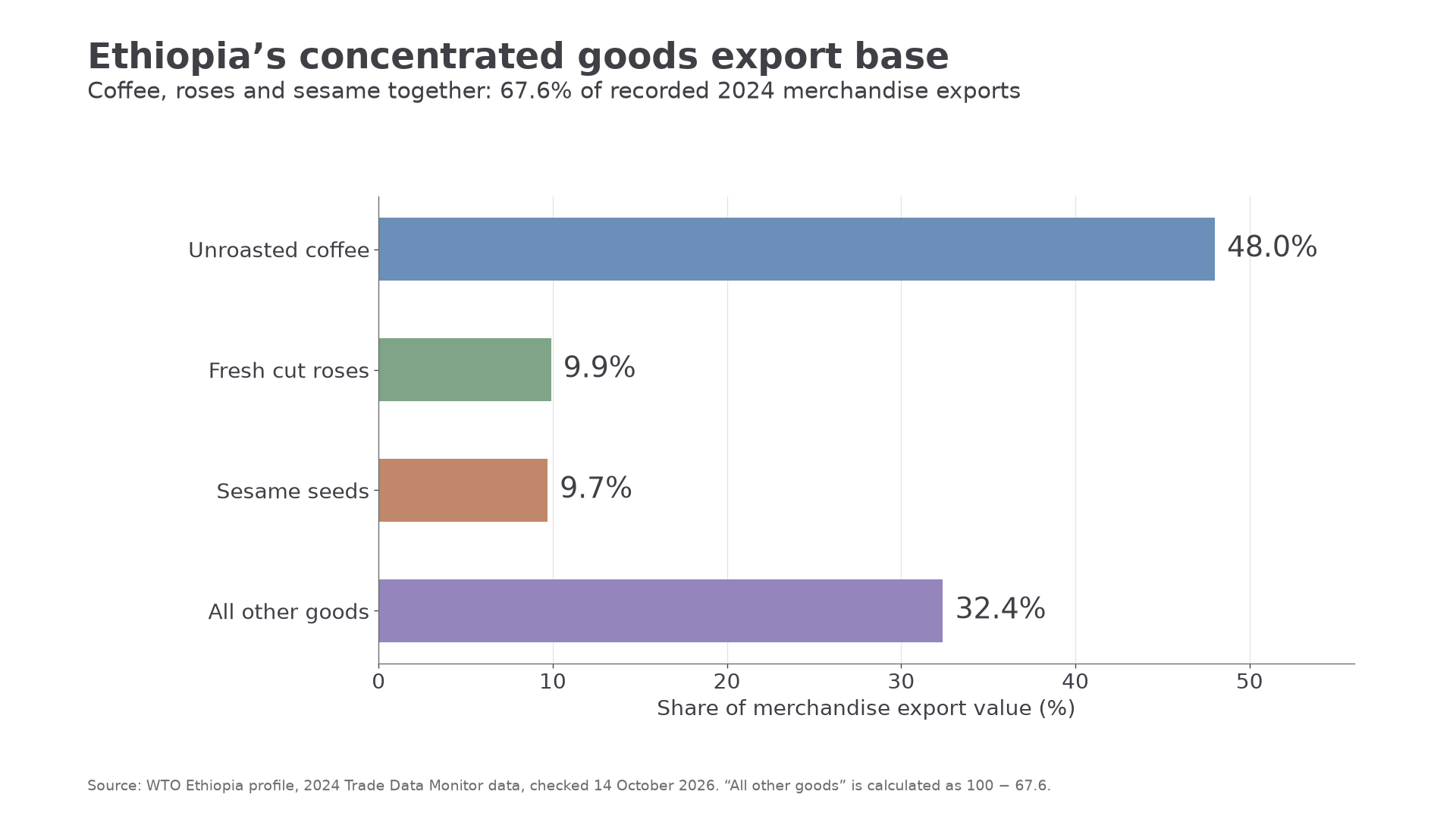
The same profile records unroasted, non-decaffeinated coffee at 48.0% of merchandise exports, fresh cut roses at 9.9% and sesame seeds at 9.7%. Together, these three product categories accounted for 67.6%. Imports included fuel, fertilisers, aircraft-related goods, machinery and medicines. This structure connects agricultural producers with distant demand while creating needs for imported inputs and equipment.
[DIAGRAM: asset_name: Concentration of Ethiopia’s merchandise exports; asset_slug: h481_h13_export_concentration; caption: Three product categories accounted for 67.6% of the recorded 2024 goods export value.; description: Horizontal bars show unroasted coffee at 48.0 per cent, fresh cut roses at 9.9, sesame seeds at 9.7 and all other goods at a derived 32.4. Source is the WTO Ethiopia 2024 trade profile checked October 2026.]
Economic factors include productive capacity, commodity prices and foreign-exchange needs. Social factors include skills, access to finance and opportunities within rural and urban labour markets. Political factors shape preferences, standards and negotiations. Ethiopia deposited its AfCFTA ratification in April 2019, while the WTO documented renewed accession negotiations in March 2025. These demonstrate attempts to influence access. Signing or negotiating does not mean every tariff, border delay or practical barrier has already disappeared.
Worked examples: combining export shares
Example 1. Illustrative dataset: clothing, footwear and electrical goods account for 17.2%, 12.6% and 10.8% of one economy's merchandise export value. The categories are separate and use the same total export value as their denominator.
Together they represent 40.6% of merchandise export value. Adding shares is valid because the categories do not overlap.
Example 2. Illustrative dataset: an island economy's processed fish, medical instruments and machinery represent 32.0%, 15.5% and 6.3% of merchandise export value.
These categories supply more than half of export earnings. Their value share measures concentration in earnings, rather than their share of exported weight or employment.
Constraints on access to global markets
Formal permission to sell into a market is only one part of access. Ethiopian producers also need goods to reach buyers reliably, meet standards and compete after transport, finance and compliance costs.
Landlocked geography makes connections through neighbouring countries and ports particularly important. Infrastructure, border procedures and coordination can add cost and uncertainty, especially for perishable products. A delayed shipment of flowers can lose value even where the nominal tariff is low. Non-tariff barriers and requirements include documentation, technical rules and health or quality standards; some protect legitimate public interests while still imposing costs that smaller exporters find difficult to meet.
The World Bank's May 2026 account of Modjo Dry Port describes improvements in storage, handling and coordination intended to support outward as well as inward flows. The importance of this work shows that a route to the sea is an organised system of services and institutions, not simply a line on a map.
Finance and foreign-exchange constraints can reinforce physical barriers. An exporter may need imported packaging, fertiliser or equipment before receiving payment from a buyer. If credit or foreign currency is difficult to obtain, it cannot readily expand or meet a contract. Skills, reliable energy and information about overseas standards also affect the ability to use market access.
Unequal power adds another constraint. A small supplier with few alternative buyers may have to accept prices and delivery conditions set by a lead firm. The US termination of Ethiopia's AGOA preferences from 1 January 2022, justified by the US government on human-rights grounds during conflict, is a dated example of access conditions decided by a larger market. It is not a ban on all Ethiopian exports, and the 2022 decision should not be used as an undated statement of every later trade rule.
Diversification and trade opportunities
Diversification expands the range of products, activities or markets generating income, reducing dependence on a narrow set of earnings. Ethiopia has opportunities to develop new activities and capture more value from existing ones, but each requires capabilities and access.
Continue this lesson.
You’re previewing NovaLearn without an account. Create a free account to read the rest.
Create free account