2.2.2 2.b - Mexico and migration interdependence
Mexico is simultaneously an origin, destination, transit and return country, connecting North America with Latin America and the Caribbean. This lesson explains dated migration patterns and changes, four forms of interdependence, and uneven consequences for development, political stability and social equality.
Mexico as an origin, destination and transit country
Mexico lies between the United States to the north and Guatemala and Belize to the south. It is an emerging and developing country in OCR's framework, with a large, varied economy and substantial differences between regions. Its location, labour markets and established networks make it important to several overlapping migration systems rather than only one northbound flow.
Emigration remains strongly connected to the United States. The OECD's International Migration Outlook 2025 records 217,000 Mexican citizens emigrating to OECD countries in 2023, with about 88% going to the United States, 4% to Spain and 3% to Canada. This is a specified annual flow to OECD destinations, not the total Mexican-born population abroad or every emigration route. The large established US connection also supports family and return movement. OECD Mexico country note, published 3 November 2025.
Mexico also receives immigrants. Its 2020 census recorded 1,212,252 foreign-born residents, including 797,266 born in the United States, 56,810 in Guatemala and 52,948 in Venezuela. Birthplace does not establish citizenship or migration motive: US-born residents can include children of Mexican families. These figures describe resident stock in 2020, not arrivals during that year. INEGI 2020 census results.
Protection movements have increased Mexico's destination role. UNHCR reports more than 800,000 refugees, asylum seekers, stateless people and others in its relevant protection population by the end of 2024, principally connected to Venezuela, Honduras, Haiti and Cuba. This combined protection population is not a count of all foreign-born residents and should not be added directly to the census stock. UNHCR Mexico operational account, end-2024 evidence.
Transit describes people passing through towards another intended destination; return describes people going back to a former country of residence. Intentions may change when policies, work or family conditions change. Someone initially transiting can seek protection or settle in Mexico. A border encounter records an event under a particular administrative system and may include repeated encounters, so it is not automatically a count of unique migrants or permanent residents.
Changing immigration and emigration
Mexico's migration system has changed during the twenty-first century as economic conditions, networks, security and policies interacted. An established history of movement to the United States created family and employment connections that continued to influence later migration. Changes in either country's labour market can alter incentives, but a wage gap alone does not determine a corridor's scale because costs, rights and networks also matter.
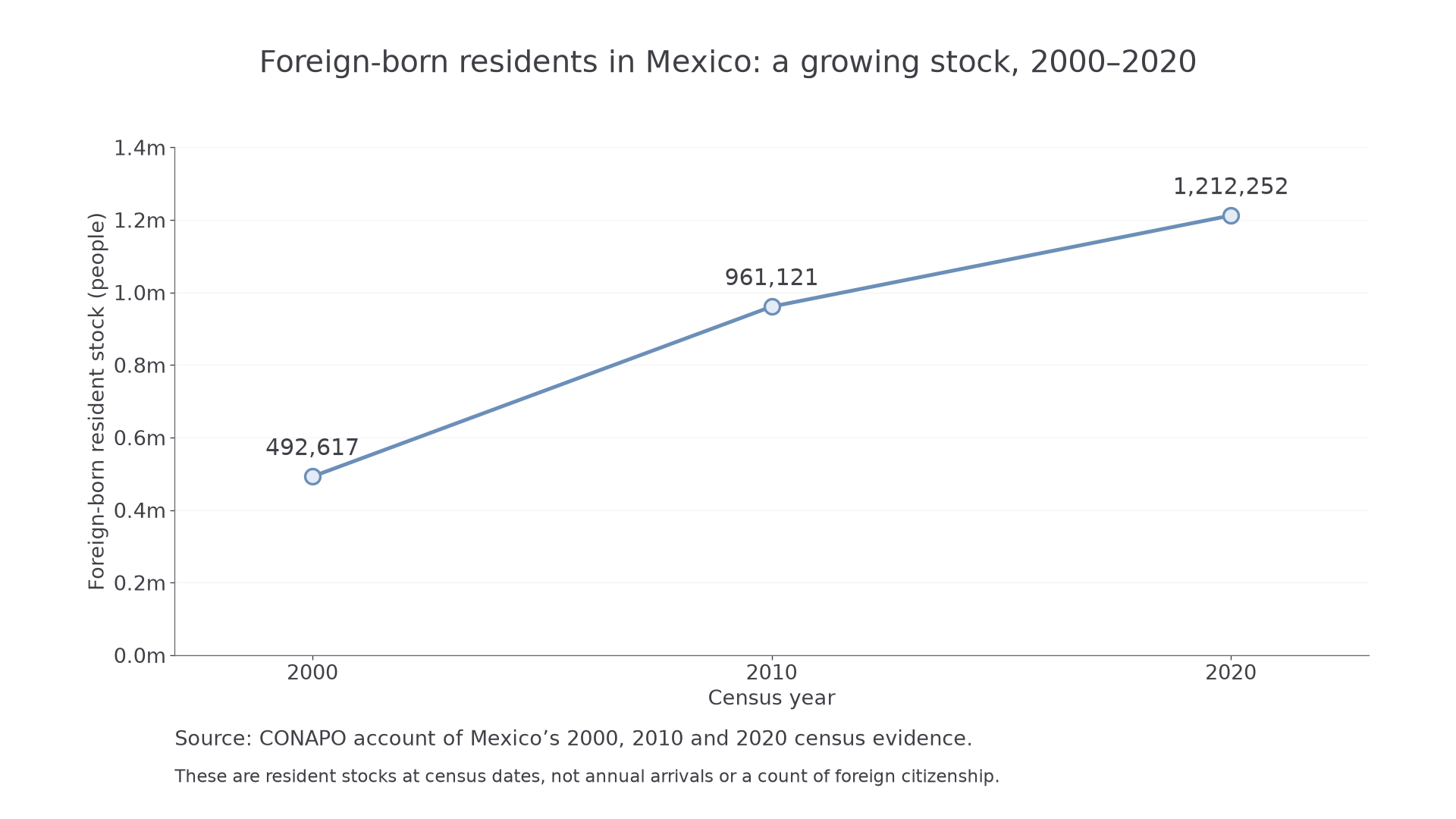
Foreign-born residence within Mexico expanded. CONAPO's account of census evidence records 492,617 foreign-born residents in 2000, 961,121 in 2010 and 1,212,252 in 2020. The increase demonstrates a growing resident stock over two decades, though changes in births, deaths, movement and measurement affect the relationship between a stock and annual flows. It does not show that every foreign-born resident is a non-Mexican citizen. CONAPO census analysis, 2021.
[DIAGRAM: asset_name: Foreign-born residence in Mexico over two decades; asset_slug: h481_h16_foreign_born; caption: Census-based foreign-born resident stocks rose between 2000, 2010 and 2020.; description: An exact three-point chart shows Mexico’s foreign-born residents at 492617 in 2000, 961121 in 2010 and 1212252 in 2020, from CONAPO’s census account. The axis states resident stock, not annual arrivals, and the date ends explicitly in 2020.]
Mexico's role in protection and transit also became more prominent as people moved from Central America, the Caribbean and elsewhere. UNHCR identifies Tapachula near the Guatemala border as a major entry and processing location and describes the concentration of asylum applications in southern states in 2023. Geographic concentration creates different conditions from national averages: people can remain in a border city while procedures or onward options are unresolved. UNHCR Mexico country account, using its stated 2023 evidence.
Policy can redirect or prolong movement. The OECD records Mexico's February 2024 Comprehensive Human Mobility Strategy, which combined humanitarian assistance, border management, regular pathways, diaspora support and regional development cooperation. The strategy illustrates multiple objectives rather than proving every intended outcome. Changes in US policy can also affect waiting, return and onward plans in Mexico; assess the actual dates and evidence rather than treating one historical rule as permanently current.
The main change is therefore diversification of roles and connections. Mexico remains an important origin but also contains longer-term immigrant communities, people seeking protection, internal displacement, returnees and people intending to move onwards. Those categories require different measures and explanations. A single national net figure cannot communicate the complete system.
Migration corridors and interdependence
Interdependence means that connected places affect one another through continuing relationships. Mexico's corridors demonstrate economic, political, social and environmental dimensions, which often interact. They do not imply equal power: the United States' much larger labour market and control over its entry rules give it leverage that Mexican households and authorities cannot simply match.
Continue this lesson.
You’re previewing NovaLearn without an account. Create a free account to read the rest.
Create free account