2.2.2 2.a - Why migration patterns have become more complex
Twenty-first-century migration is shaped by interacting labour markets, family networks, conflicts and state policies. This lesson explains new origins and destinations, changing composition and bilateral corridors, while using dated evidence to evaluate broad comparisons such as South–South and South–North migration.
Globalisation and new origins and destinations
Economic globalisation connects labour demand and household aspirations across borders. Investment, trade and new industries create employment in some places while restructuring work elsewhere. Workers do not simply move from the poorest country to the richest: job access, language, recruitment, costs, family ties and policy create selective links. A destination can also become an origin, and a transit country can develop a longer-term resident migrant population.
Transport and communications reduce some barriers. Recruitment information can travel quickly, migrants can maintain family contact and employers can coordinate cross-border hiring. Digital communication also spreads accounts of destination opportunities, although information can be incomplete or misleading. The capacity to communicate does not remove visa restrictions, finance a journey or guarantee safe work.
New labour-demand centres can produce South–South connections, such as movement between neighbouring developing economies or towards Gulf labour markets. Regional integration can encourage intra-regional mobility, while multinational supply chains link employment prospects to demand elsewhere. A factory opening may attract workers; its closure or relocation may prompt onward or return movement. Migration therefore responds to changing networks rather than a permanently fixed origin–destination map.
Family and social connections can sustain a corridor after the original recruitment condition changes. Earlier migrants provide information, accommodation or introductions, reducing uncertainty for later arrivals. This cumulative process can create concentrations of people from particular origin communities at particular destinations. Yet networks may also exclude outsiders or expose newcomers to debts and dependence, so their effects are not uniformly beneficial.
Complexity includes different intentions and durations. Study can lead to employment, a temporary job can become long-term residence, and an intended transit stay can lengthen when a border closes. The resulting pattern cannot be understood from a simple push-and-pull list alone; explain how economic changes, networks and policy interact through time.
Young workers and female migration
Migration is selective by life stage, skills and social position. Many labour corridors concentrate working-age people because employment prospects, physical mobility and the expected years of earnings affect decisions. Students may move before entering full-time employment; family reunion includes children and older relatives; retirement produces a different age profile. A statement about labour migration must not be applied automatically to every international migrant.
Young adults can have more expected working years over which to recover a move's cost and may be establishing careers before other commitments become fixed. Recruitment can therefore concentrate young workers, while family, student and retirement routes create different compositions. These mechanisms explain selectivity without assuming that all migrants are young or that every corridor follows one age profile.
Women are significant migrants in their own right, including as workers, students and family members. Demand for care, health, domestic, manufacturing and professional work can create gendered recruitment patterns. Changes in education, household strategies and social expectations can alter who moves and who controls income. Do not assume that every female migrant is a dependent or that every corridor has the same sex balance.
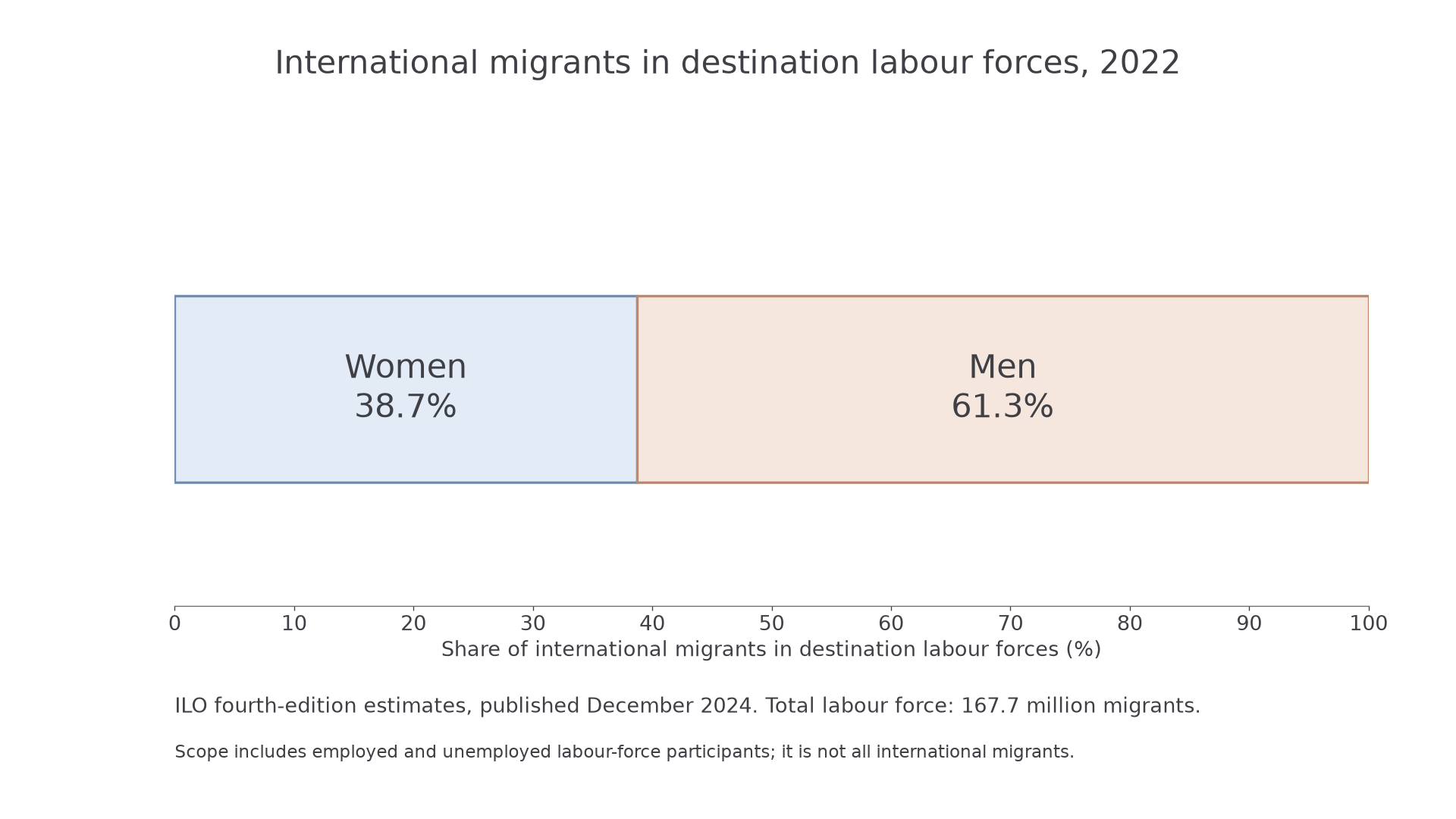
The ILO's fourth-edition estimates, published in December 2024, counted 167.7 million international migrants in destination labour forces in 2022. About 38.7% were women and 61.3% men. These figures concern migrants in the labour force, including unemployed people, not all migrants and not only those with jobs. The report also identifies gendered barriers to employment, including recognition, care responsibilities and discrimination. ILO report and release, 16 December 2024.
[DIAGRAM: asset_name: Sex composition of international migrants in destination labour forces; asset_slug: h481_h15_labour_composition; caption: The ILO estimated women at 38.7% and men at 61.3% of international migrants in destination labour forces in 2022.; description: An exact horizontal percentage bar uses ILO fourth-edition 2024 estimates for reference year 2022: women 38.7%, men 61.3%. The title states labour-force scope so it cannot be mistaken for all international migrants or annual migration flows.]
Gendered migration can redistribute care across borders. A person employed in paid care abroad may rely on relatives to provide unpaid care at home. Remittances can support that household while separation changes responsibilities and relationships. The consequences depend on working conditions, rights, access to childcare and household power. A global percentage therefore needs corridor-specific and qualitative evidence to explain its lived geography.
Refugees and changing state policies
Conflict and persecution can compel people to move, often towards nearby places of safety rather than the highest-income destination. A refugee is outside their country and meets an applicable refugee definition; under the 1951 Convention this includes a well-founded fear of persecution on specified grounds and inability or unwillingness to seek that country's protection. Regional definitions can be broader. An asylum seeker is seeking protection and awaits determination of the claim. An internally displaced person remains within their own country. These categories overlap with migration debates but are not interchangeable counts. UNHCR master glossary.
Continue this lesson.
You’re previewing NovaLearn without an account. Create a free account to read the rest.
Create free account