3.1 1.a - Reconstructing climate and explaining natural change
Earth has experienced climates much warmer and colder than today, but those changes must be reconstructed from evidence rather than assumed. This lesson explains how natural records reveal past climates, how greenhouse and icehouse states differ, and how tectonic, orbital, solar and atmospheric processes can change climate over different timescales.
Reconstructing past climates
A climate reconstruction estimates conditions before reliable instrumental measurements were available. A proxy is a measurable property that responds to climate: scientists establish its relationship with temperature or rainfall, date the record, and use it to infer earlier conditions. A proxy therefore needs both a climate interpretation and a chronology.
Marine and lake sediments accumulate in layers. Pollen preserved in lake mud identifies past vegetation; a shift towards cold-tolerant plants suggests cooling, although local land clearance can also change pollen. Marine microfossil assemblages indicate water conditions, while oxygen isotopes in shells reflect both temperature and the amount of water stored in ice. These signals must be separated before interpreting a marine isotope curve as temperature alone. Sediments can preserve very long records, but mixing by organisms and variable accumulation rates blur their timing.
Ice cores preserve successive snowfall layers. The isotopic composition of the ice helps reconstruct local temperature, while bubbles contain samples of past atmosphere, including carbon dioxide. The bubble gas is not exactly the same age as the surrounding ice: air becomes sealed only after snow compacts. Dust and sulphate layers can help identify dry conditions and volcanic events. Ice flow can thin or disturb older layers.
Tree rings can provide annual resolution. Where temperature limits growth, warmer growing seasons may produce wider rings; where moisture is limiting, drought may produce narrower rings instead. Comparing overlapping ring sequences establishes dates. Disease, competition and changing growth conditions mean one tree is insufficient. Fossils also reveal environmental tolerances: plants adapted to warmth found at high latitudes suggest a different past climate, but continental movement must be considered.
The strongest reconstruction compares several independently dated records. Agreement between ice, sediment and biological evidence is more convincing than treating one local record as a global thermometer. NOAA explains these proxy archives and their interpretation (2016).
Greenhouse and icehouse Earth
A greenhouse Earth has little or no large, permanent continental ice, whereas an icehouse Earth supports major ice sheets. These terms describe long-lived global states rather than whether one particular summer feels hot. An icehouse can contain both colder glacials and warmer interglacials.
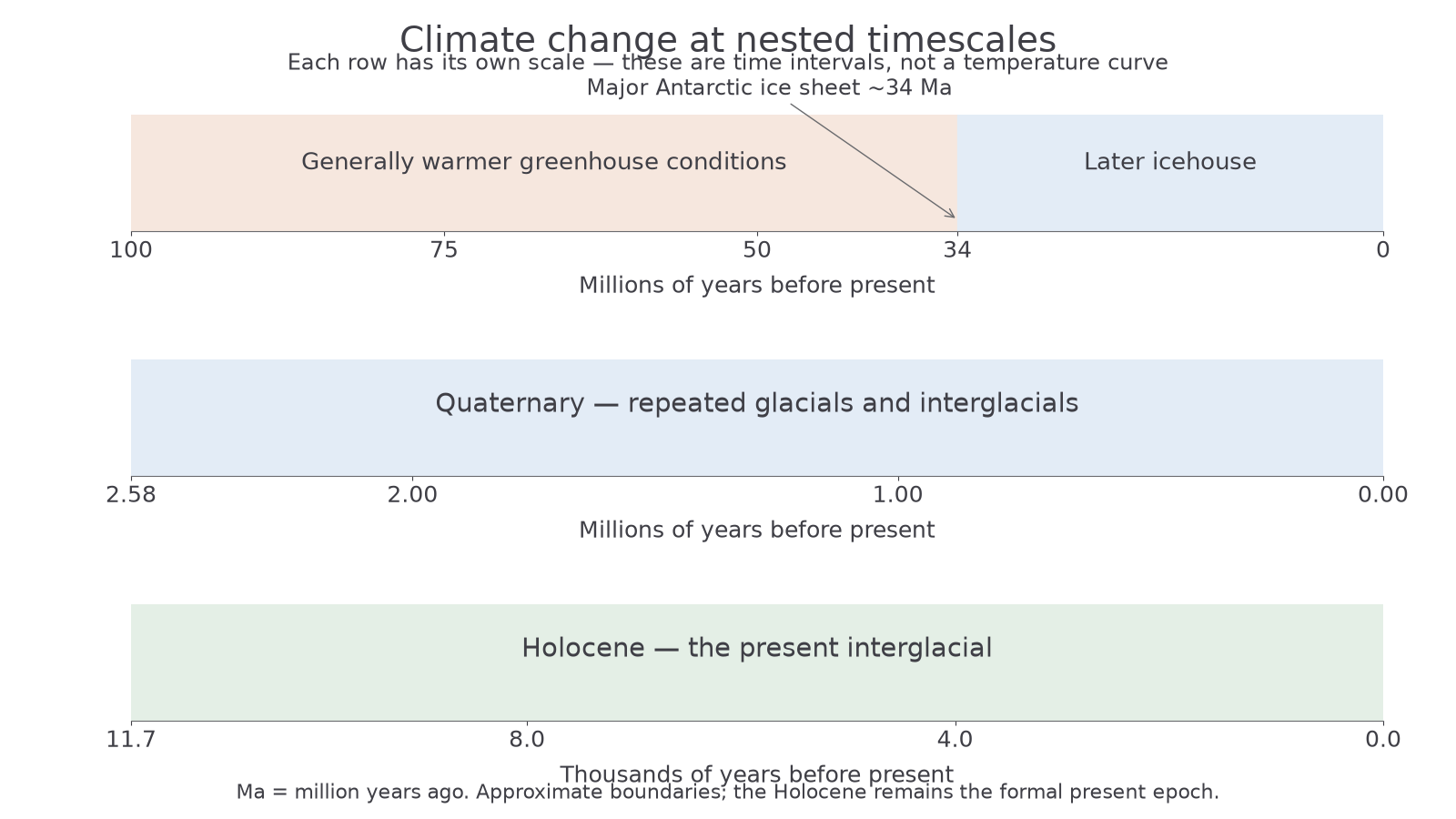
Over roughly the last 100 million years, Earth moved from generally warmer Cretaceous greenhouse conditions towards the cooler late-Cenozoic icehouse. This was not a steady decline: warmer episodes and abrupt transitions interrupted the longer trend. A major Antarctic ice sheet developed around 34 million years ago, approximately 35 million years ago when rounded more broadly. Falling atmospheric carbon dioxide and changes in ocean circulation helped conditions cross the threshold for persistent Antarctic glaciation; no single mechanism explains every detail.
The Quaternary, beginning about 2.58 million years ago, contains repeated glacial–interglacial cycles. During glacials, continental ice expanded, sea level fell and climatic zones shifted. During interglacials, ice retreated and sea level rose. These cycles operated within an icehouse world because Antarctic and, for much of the time, Northern Hemisphere ice persisted.
The Holocene began about 11,700 years ago and is the present interglacial epoch. Calling it an interglacial does not mean human-driven warming is insignificant: it locates recent change within a longer geological sequence. Nor does a past warm climate demonstrate that current warming is natural. Causes must be established from forcing, timing and evidence for the particular interval. NASA's account links the geological record with modern evidence.
[DIAGRAM: asset_name: Climate timescales and nested states; asset_slug: d01-climate-timescales; caption: Greenhouse-to-icehouse cooling, Quaternary cycles and the Holocene operate at nested timescales; description: Three separate labelled horizontal time axes show the approximate 100 million year cooling transition, Antarctic glaciation near 34 million years ago, the Quaternary beginning 2.58 million years ago, and the Holocene beginning 11700 years ago. They are schematic time intervals, not a measured temperature curve.]
Tectonics and long-term climate forcing
Plate tectonics changes the boundary conditions of the climate system over millions of years. Continental drift changes the positions of land, the width of seaways and the routes available to ocean currents. Moving a continent towards a pole can make persistent snow and ice more likely, but latitude alone is insufficient: ocean heat supply and atmospheric greenhouse gases also matter.
Continue this lesson.
You’re previewing NovaLearn without an account. Create a free account to read the rest.
Create free account