3.1 4.c - Adaptation and contrasting climate responses
Adaptation changes how people and environments cope with actual or expected climate effects. This lesson explains retreat, accommodation and protection, considers future settlements and economies, and compares the opportunities, impacts and response challenges facing the United Kingdom and Bangladesh.
Retreat, accommodate and protect
Adaptation reduces exposure, sensitivity or the consequences of climate hazards. It differs from mitigation, which addresses greenhouse-gas emissions and removals. Both are needed: adaptation responds to changes already occurring or committed, while mitigation limits the scale of future change. Adaptation does not necessarily reduce the hazard itself.
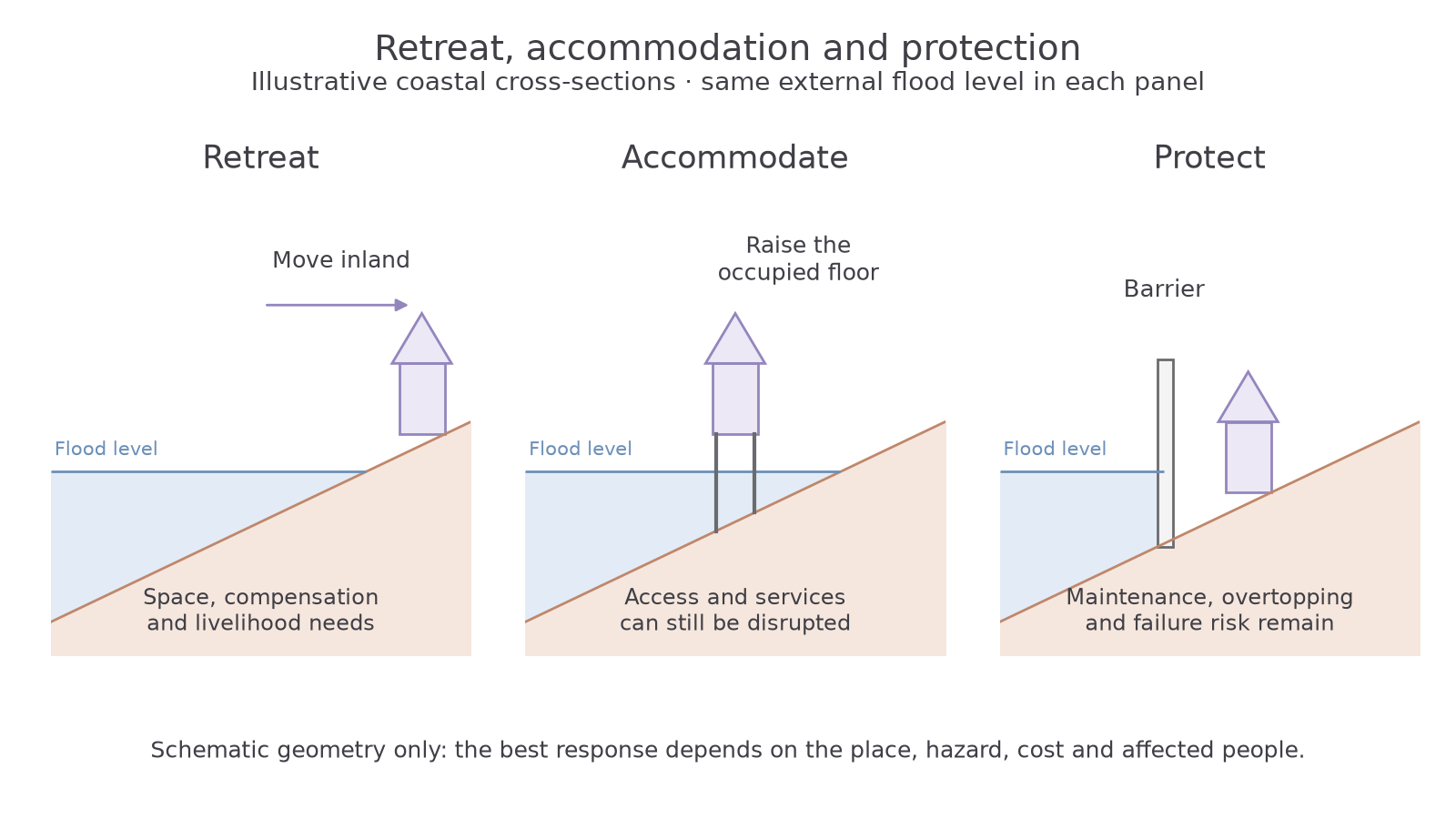
Retreat moves people, assets or activities away from an exposed location. It can include avoiding new development, relocating infrastructure or managed realignment of a coast. Moving a defence inland can create space for intertidal habitat and reduce repeated maintenance, but land, attachment, compensation and livelihoods make relocation politically difficult. Retreat planned with affected communities differs from displacement after protection fails.
Accommodation allows activity to continue while reducing damage. Raised floor levels, flood-resilient materials, early warning, changing crop calendars and safe water storage are examples. It can be flexible and relatively affordable, but repeated events, lack of access or hazards beyond the design limit can overwhelm it. A warning has little value without a safe place to go and the means to reach it.
Protection uses measures such as sea walls, surge barriers, embankments or restored buffers to reduce the hazard reaching assets. It can defend valuable infrastructure but requires maintenance and may transfer erosion or flood risk. Hard protection can also encourage development behind it, increasing the consequences if a defence fails. Ecosystem approaches may provide several benefits, but they need space and suitable conditions.
[DIAGRAM: asset_name: Three approaches to coastal adaptation; asset_slug: d07-adaptation-cross-sections; caption: Illustrative coastal cross-sections distinguish moving assets, raising them and defending them; description: Three schematic cross-sections show retreat with a building relocated inland, accommodation with a building raised above an illustrative flood level, and protection with a coastal barrier. The same flood level is used for comparison; positions are illustrative and the barrier retains residual overtopping and failure risk.]
The framework applies across development levels. Wealth can widen the available choices but does not remove conflict; a lower-cost community warning system can be highly effective when locally trusted. A strategy should be judged by who benefits, who pays, how long it works and whether it preserves future choices. IPCC AR6 Working Group II Chapter 6 assesses settlements and adaptation, 2022.
Adapting economies and the built environment
Future adaptation concerns the everyday systems on which people depend, not only dramatic coastal defences. Buildings last for decades, so decisions now can lock people into future risks. A design suitable for the past climate may become uncomfortable or unsafe as temperatures, rainfall and extremes change.
Homes and offices can use external shading, appropriate glazing, ventilation and insulation to control heat. Insulation reduces unwanted heat transfer, but overheating also requires control of solar gain and the ability to release heat. Mechanical cooling can protect health where necessary, yet increases electricity demand and can add emissions if supplied by fossil energy. Passive measures, efficient equipment and low-carbon supply therefore need coordination. Flood-resilient layouts can keep electrical systems above likely water levels and allow materials to dry without extensive replacement.
At city scale, trees and green space provide shade and cooling through evapotranspiration; permeable surfaces and storage slow runoff. Their success depends on water supply, species choice and maintenance. A city can also protect residents through heat-health plans, accessible cool spaces and support for isolated people. Upgrading a visible central district while leaving insecure neighbourhoods exposed would be an unequal adaptation outcome.
Transport adaptation includes drainage sized for changing rainfall, heat-resilient rail and road materials, slope stabilisation, and contingency routes. These are linked networks: protecting one road may achieve little if electricity, a bridge or the destination fails. Economic adaptation includes crop changes, water-efficient production, diversified livelihoods, supply-chain planning and finance for recovery. Insurance transfers some financial loss but does not physically prevent damage and may become unaffordable.
An adaptation pathway sequences choices as evidence develops. The Thames Estuary 2100 approach, updated in 2023, combines present defence maintenance with monitoring and future decisions as conditions change. It illustrates why a flexible plan can be preferable to treating one sea-level forecast as certain. Environment Agency adaptive approach, 2023.
United Kingdom climate impacts and responses
The United Kingdom is an advanced country with substantial technical and financial resources, but its population, infrastructure and ecosystems remain exposed. In its 2025 adaptation progress assessment, the Climate Change Committee highlighted recent heat, heavy rainfall, flooding and drought pressures and judged preparation inadequate. This is evidence about delivery at that time, not proof that every UK adaptation measure fails. CCC adaptation progress report, 30 April 2025.
Continue this lesson.
You’re previewing NovaLearn without an account. Create a free account to read the rest.
Create free account