3.3 1.c, 2.a - Ocean ecosystems and Antarctic krill management
Marine ecosystems depend on the interaction of light, temperature, nutrients and food-web relationships. This lesson compares inter-tidal and deep-water environments, then uses Antarctic krill to explain renewable-resource use, stakeholder interests, ecological resilience and the limits of international management.
Controls on marine ecosystems
Marine primary producers make organic material that supports consumers. In sunlit waters, phytoplankton and larger algae use photosynthesis, requiring light and nutrients as well as suitable physical conditions. Productivity measures the rate of biological production; biodiversity concerns the variety of life. A productive system is not automatically the most species-rich one.
Light decreases with depth because water and suspended material absorb and scatter it. The depth supporting useful photosynthesis varies with water clarity, so there is no single universal boundary. Below the sunlit zone, organisms generally rely on organic material transported from elsewhere or on a different energy source. Temperature affects metabolic rates and species' tolerances; warming beyond a tolerance can cause stress rather than unlimited faster growth.
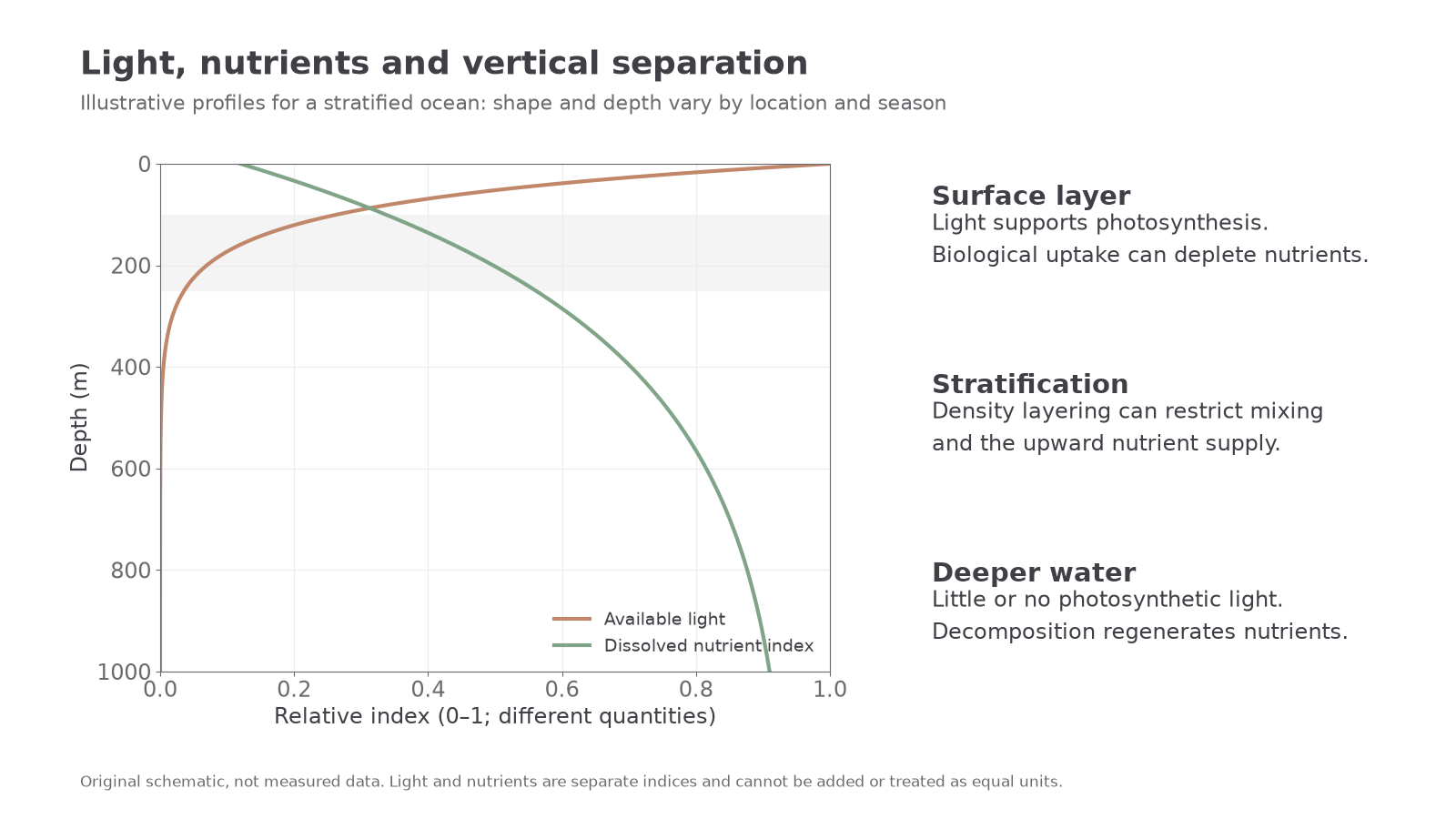
Nutrients such as nitrate and phosphate are used by producers near the surface. Decomposition releases nutrients at depth, while stable stratification can restrict their return to sunlit water. This creates a potential separation between light above and nutrients below. Mixing and upwelling bring them together. NOAA's 2017 productivity research summary explains these interacting controls, while its upwelling account describes the return of nutrient-rich deeper water.
[DIAGRAM: asset_name: Light and nutrient separation with depth; asset_slug: d18-light-nutrients; caption: Illustrative profiles show why surface sunlight and deeper nutrient supply need a connecting process; description: Two separate relative indices plot declining light and increasing nutrients against depth. Values are schematic rather than measurements. A shaded stratified layer indicates a possible restriction on exchange; mixing and upwelling can supply nutrients to lit water, and actual profile depths vary.]
Latitude changes the seasonal balance. Tropical surface water receives strong sunlight, but persistent stratification can leave open-ocean surface waters nutrient-poor. Temperate winter mixing can replenish nutrients; increasing spring light then supports a bloom until nutrients or grazing constrain it. Polar oceans have long dark winters and highly seasonal summer production; sea ice can restrict light while also supporting specialised communities. Coastal upwelling can create high productivity even where surface water is relatively cool. These contrasts show why “warmer water means more marine life” is an inadequate explanation.
Inter-tidal and deep-water ecosystems
The inter-tidal zone lies between high- and low-tide levels. Organisms alternate between immersion and exposure, facing changing temperature, salinity, drying and wave forces. A rocky shore can therefore show zonation: species tolerant of exposure occupy different levels from those needing longer immersion. Rock pools, crevices and different substrates add habitats. NOAA's inter-tidal overview describes this connection between tides and feeding opportunities.
A food chain traces one feeding pathway, such as seaweed to limpet to shorebird. A food web combines multiple pathways: phytoplankton can feed mussels; mussels can be eaten by crabs and birds; predators may use several prey species. Arrows conventionally point from food to consumer, showing the transfer of material and energy. A more connected web may provide alternative prey when one resource declines, but it does not guarantee immunity to a large disturbance.
Deep-water ecosystems generally have little or no sunlight, cold water, high pressure and sparse food arriving from above as sinking particles, carcasses or transported material. Detritus supports microbes and animals feeding on or within sediments, which in turn support predators. Low food supply often limits biomass and growth, but does not mean the deep sea lacks biodiversity. Habitat variety, evolutionary history and very large area can support many species. A comparison must distinguish low biomass from low species richness.
Hydrothermal vents and cold seeps provide important exceptions to dependence on surface photosynthesis. Microorganisms can use energy from chemical reactions involving compounds such as hydrogen sulphide or methane to build organic material: chemosynthesis. Some animals host these microbes in symbiosis; others feed within the resulting community. The energy source is chemical, not sunlight or heat alone. NOAA's chemosynthesis explanation describes this alternative base of a food web.
Inter-tidal webs therefore often have a local photosynthetic base and tolerate rapid exposure cycles, whereas much deep-water life depends on imported food and adaptations to persistent darkness and pressure. Vent communities add locally concentrated chemical production. Neither ecosystem can be described adequately by one universal chain, and both can be vulnerable when a habitat-forming species or energy source is removed.
Continue this lesson.
You’re previewing NovaLearn without an account. Create a free account to read the rest.
Create free account