1.2 - Amazon rainforest water and carbon cycles
The Amazon rainforest links large vegetation stores with rapid exchanges of water and carbon. This lesson moves from individual trees to the forest and the Upper Xingu drainage basin, explaining physical controls, evidence from Tanguro catchments, the effects of clearance and farming, and management that can protect both cycles.
Rainforest stores and rapid cycling
The Amazon is a large South American rainforest region containing varied climates, soils and land uses rather than one uniform ecosystem.
An individual tree intercepts rain on leaves and branches, absorbs soil water through roots and releases vapour through transpiration. Light supports photosynthesis, transferring atmospheric carbon into leaves, roots and wood. Respiration returns some carbon dioxide, while litterfall transfers carbon and nutrients to the soil. Scaling up to the forest adds canopy layers, extensive root systems, exchanges with streams and regional movement of moist air. Evapotranspiration can supply moisture for rainfall farther downwind, but a local evaporation molecule need not fall again within the same basin.
Warm conditions and abundant moisture support rapid plant growth and decomposition where light, nutrients and oxygen are sufficient. Living biomass is a major carbon store. Litter may turn over quickly, so a thin litter layer can coexist with high annual litter inputs. Soil water, deep groundwater and rivers are important water stores, while canopy and atmospheric water turn over rapidly. High gross biological fluxes do not by themselves establish whether the whole Amazon is a net sink in a particular year.
A climate graph connects seasonal conditions with these processes. The following official WMO/INMET Manaus climatology uses the 1961–1990 period. Manaus represents a central Amazon location, not Tanguro in the more seasonal south-east.
| Month | Rainfall, mm | Mean daily minimum, °C | Mean daily maximum, °C |
|---|---|---|---|
| Jan | 260.1 | 23.1 | 30.5 |
| Feb | 288.3 | 23.1 | 30.4 |
| Mar | 313.5 | 23.2 | 30.6 |
| Apr | 300.1 | 23.3 | 30.7 |
| May | 256.3 | 23.3 | 30.8 |
| Jun | 113.6 | 23.0 | 31.0 |
| Jul | 87.5 | 22.7 | 31.3 |
| Aug | 57.9 | 23.0 | 32.6 |
| Sep | 83.3 | 23.5 | 32.9 |
| Oct | 125.7 | 23.7 | 32.8 |
| Nov | 183.0 | 23.7 | 32.1 |
| Dec | 216.9 | 23.5 | 31.3 |
[DIAGRAM: asset_name: Manaus climate graph; asset_slug: p25-manaus-climate; caption: Manaus remains warm throughout the year but has a marked rainfall minimum in this reference period.; description: A climate graph uses WMO/INMET 1961–1990 monthly rainfall totals as blue bars on the left axis and mean daily minimum and maximum temperatures as two clay-coloured lines on the right axis. Months, units, temperature statistics and period are labelled. These are central Amazon station normals, not Upper Xingu measurements or a current-year record.]
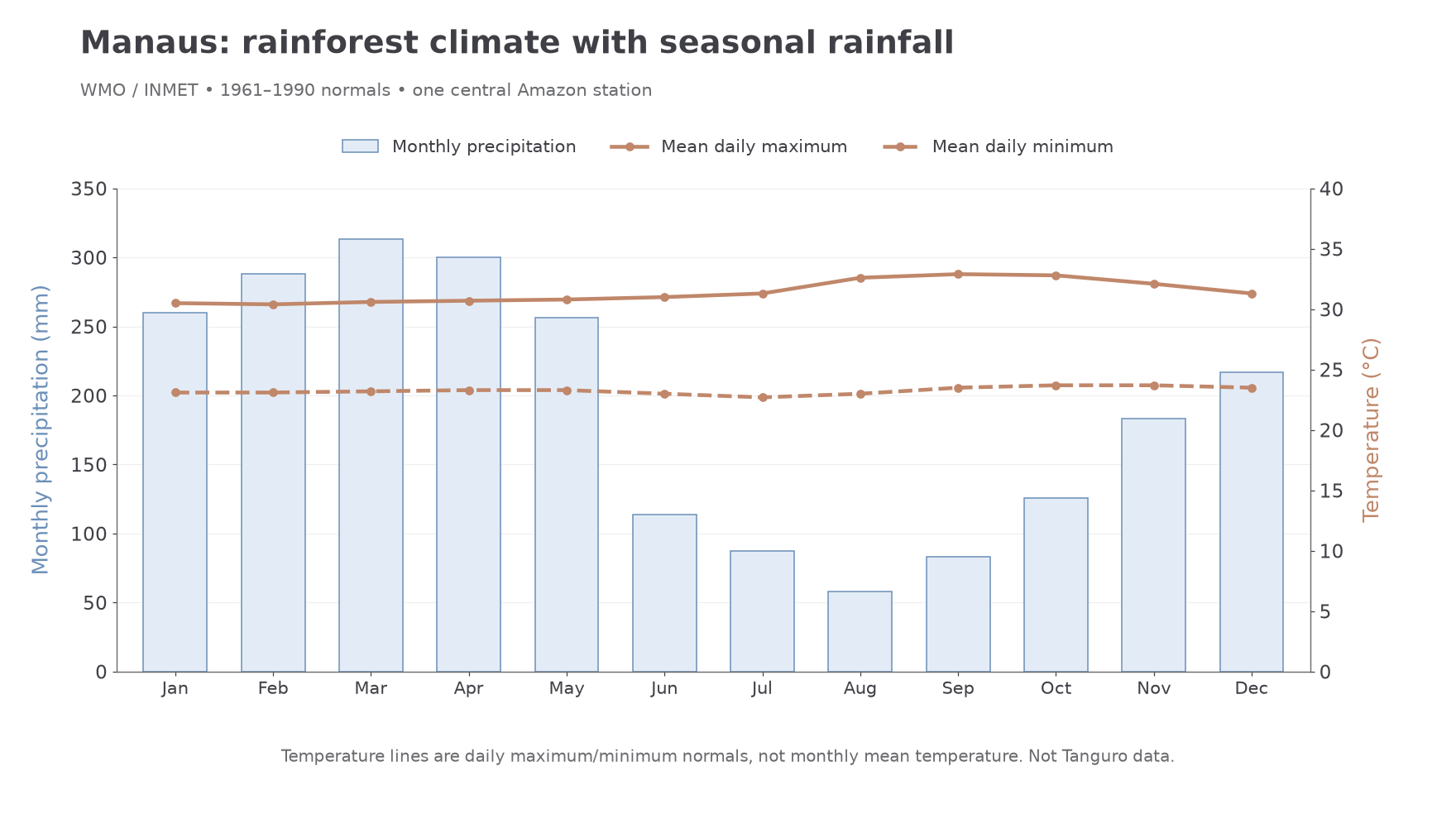
To construct it, place months at equal intervals, start the rainfall axis at zero and label the separate temperature axis clearly. Plot rainfall as bars and temperatures as lines; daily maximum and minimum normals must not be labelled monthly mean temperature. March is wetter than August, while temperatures remain high throughout. Seasonal water stress still depends on stored soil water and root access, not rain in that month alone.
Physical controls on rainforest water
Rainforest water pathways reflect temperature and vegetation together with the storage and transmission properties of soil, rock and relief.
High energy availability encourages evapotranspiration where water can be supplied. Humid air can reduce the evaporative gradient, while deep roots can maintain transpiration after surface soil dries. Intense rainfall may fill canopy storage rapidly and generate considerable throughfall. Whether that water becomes overland flow or enters deeper stores depends on the ground below.
Porosity describes available pore volume; permeability depends on connected openings. Deep, well-structured soils can absorb substantial rain even when they contain much clay, because root channels, aggregates and other macropores transmit water. Beneath them, weathered or fractured rock may store and transmit groundwater, whereas a less permeable layer can encourage perched saturation and throughflow. A high-rainfall forest is therefore not automatically dominated by surface runoff.
Tanguro lies on broad, low-relief terrain in the Upper Xingu, Mato Grosso, over Precambrian gneisses and deeply weathered soils. Neill and colleagues' 2013 synthesis describes highly permeable soils that buffer small catchments against rapid stormflow. The fresh rock's properties do not alone determine flow: its thick weathering mantle, fractures and overlying soil structure are central to the accessible pathways.
Relief changes hydraulic gradients and the connection between hillslopes and streams. On broad interfluves, water can enter deep storage before reaching a channel. Near-channel hollows can be wetter and develop saturation-excess flow, while steep terrain elsewhere in the Amazon may transfer water more rapidly. This spatial variation explains why a catchment water balance needs rainfall, evapotranspiration, streamflow and storage together. Removing trees changes one part of that balance without instantly replacing every subsurface pathway.
Physical controls on rainforest carbon
Rainforest carbon storage results from the balance of plant uptake, tissue turnover, decomposition and mineral protection.
Warmth allows biological activity through much of the year, while water and sunlight support photosynthesis. Dense evergreen vegetation provides a large leaf area and woody biomass store, although canopy shading limits light lower in the forest. Dry-season stomatal closure can restrict uptake, and excessively hot or dry conditions can increase stress and mortality. Temperature therefore influences both the input of carbon and respiratory outputs.
Warm, moist, aerated soils can decompose litter quickly, releasing nutrients for renewed uptake. Living biomass and rapid recycling may contain much of the readily available nutrient supply, but nutrients are not carbon: plant carbon comes mainly from carbon dioxide, while mineral nutrients enter through roots. Soil organic matter contains carbon from litter and roots and contributes to water retention and nutrient exchange. Its amount varies with depth, texture, drainage and land-use history. A small surface litter store does not establish a small total soil-carbon stock.
Rock mineral composition influences the nutrients produced by weathering and the minerals available to bind organic matter. At Tanguro, strongly weathered soils contain iron and aluminium oxides that can bind phosphorus. This helps explain why fertiliser addition need not produce equivalent immediate increases in stream phosphorus. Minerals can also protect some organic compounds against decomposition. Nutrient limitation can constrain growth even where heat, moisture and atmospheric carbon dioxide are abundant.
Floodplain sediments, upland weathering mantles and waterlogged soils differ, so “all Amazon soils are identical and infertile” is an inadequate explanation. Where oxygen is restricted, decomposition pathways differ from well-drained uplands. The most useful judgement specifies the store and condition: living carbon can accumulate rapidly, litter can turn over rapidly, and some deep or mineral-associated soil carbon can persist much longer within the same forest.
Worked explanation of linked cycles
Examine how vegetation connects the water and carbon cycles in a tropical rainforest. Roots absorb soil water and leaves release it through transpiration. At the same time, stomata admit carbon dioxide for photosynthesis. Dry-season water stress can close stomata, reducing both vapour transfer and carbon uptake. A change in available water therefore changes a carbon flux through a specific biological mechanism. Dense canopy also intercepts rainfall and stores carbon in wood; litterfall supplies soil organic matter whose decomposition returns carbon dioxide and whose structure helps retain and transmit water.
The Upper Xingu shows the significance of changing that vegetation. Neill and colleagues' 2013 Tanguro synthesis reports greater streamwater export from soya catchments alongside reduced evapotranspiration. Removing deep-rooted forest and replacing it with seasonal crops reduces atmospheric water return while reducing the standing woody carbon store. Permeable deep soils still route much water below ground, so greater discharge can coexist with limited rapid overland flow. The connection involves changed partitioning between stores and transfers, rather than a complete replacement of infiltration by runoff.
Scale changes the relationship. Extra local streamwater may accompany less evapotranspiration, but widespread forest loss can reduce moisture recycling downwind and increase drought and fire pressure on remaining carbon stores. Conversely, reforestation rebuilds biomass and canopy functions while potentially reducing local water yield through greater evapotranspiration. Vegetation is thus a central link, moderated by soil permeability, rainfall seasonality and the size of the area considered. Water and carbon outcomes must be explained together rather than inferred from tree cover alone.
Water-cycle change in the Upper Xingu
The Upper Xingu provides a named drainage-basin setting in which deforestation and farming alter a naturally seasonal water balance.
The Xingu is an Amazon tributary; Tanguro research examines small headwater catchments in its south-eastern Upper Xingu region. Forest conversion there included pasture followed by soya cultivation. Rainfall varies between wet and dry seasons and between years, so a comparison of streams must account for weather as well as land cover. The central-Amazon Manaus climate graph cannot be substituted for Tanguro's local rainfall record.
Hayhoe and colleagues' study published in 2011 used stream measurements and rating-curve calibration during campaigns in 2007–2009. The 2013 synthesis reported several-fold greater streamwater export from soya catchments than forest catchments. Its explanation emphasised reduced evapotranspiration alongside permeable soils and dominant baseflow. Lower leaf area, shallower rooting and a shorter growing season reduced atmospheric return. More water could therefore pass through the ground to streams, without an equivalent transformation into flashy surface runoff.
These findings qualify a common generalisation. Compaction and clearance can increase quickflow in some tropical soils, but the observed Tanguro response cannot simply be described as rainfall running straight off impermeable fields. Existing soil structure and deep storage buffered event timing. At larger scales, cumulative discharge changes, channel adjustment, impoundments and loss of riparian shade may create other effects.
Paired measurements require a common time interval and comparable catchment areas. Convert discharge to depth per year before comparing differently sized basins. An illustrative set of annual yields is shown below; these numbers are invented to teach presentation and are not the published Tanguro observations.
| Illustrative catchment | Land cover | Annual water yield, mm |
|---|---|---|
| F1 | Forest | 180 |
| F2 | Forest | 240 |
| S1 | Farmed | 600 |
| S2 | Farmed | 660 |
Worked paired-yield comparison
Calculate each group's mean, then divide farmed yield by forest yield:
The farmed sample exports three times the water depth. Plot individual points or grouped bars preserving the replicates, then consider rainfall and storage before attributing the difference to land cover.
Worked second paired sample
Illustrative dataset: two forest basins yield 120 and 160 millimetres; two cleared basins yield 420 and 560 millimetres in the same year. Use the same sequence:
The relative increase is:
“3.5 times as much” is a 250% increase, not a 350% increase. The pattern is compatible with lower evapotranspiration, but rainfall, geology, catchment boundaries and storage may differ. A few headwaters cannot establish the balance of the whole Amazon.
Clearance, farming and carbon stores
Clearance changes living biomass immediately and soil and nutrient stores through a more variable sequence.
Felling removes trees from the living store. Burning transfers much of their carbon to the atmosphere quickly, while unburned residues decompose more slowly and harvested timber may retain carbon for a period. Replacing a woody forest with seasonal crops usually reduces standing biomass and changes the timing of carbon uptake. Harvest exports carbon and nutrients beyond the field boundary, so a high crop growth rate is not equivalent to a large permanent store.
Loss of litter input, soil disturbance, warming and erosion can reduce soil organic carbon. However, soil response varies: deep pools may change slowly, mineral protection can retain carbon, and grasses or crops supply new roots and residues. Carbon lost from trees must not be counted automatically as an identical immediate percentage loss from the whole soil profile.
Fire can temporarily concentrate some mineral nutrients in ash, improving availability near the surface. Subsequent harvest, leaching and erosion can reduce this gain. Exposed soil can lose nutrient-rich particles, while fertiliser supplies nutrients from outside the original forest cycle. At Tanguro, phosphorus binding and deep-soil nutrient retention complicate a simple prediction that every fertiliser input appears immediately in streams. These mechanisms help explain why biomass, soil carbon, plant-available nutrients and river nutrient export require separate measurements.
NASA's 2007 account of tropical deforestation explains the linked risks to soils, carbon and moisture recycling. The chain can reinforce itself: less forest means less transpiration and potentially drier conditions downwind; water stress and fire can then cause further vegetation loss. Its strength depends on regional rainfall, fire use and the extent of clearance, rather than following inevitably from every small cleared plot.
Managing rainforest cycles
Management protects the cycles most effectively when it reduces new disturbance while restoring vegetation and soil functions where they have been lost.
Protecting existing forest retains a carbon store that would take a long time to rebuild. Regeneration on previously cleared forest land is reforestation; establishing trees where forest has not recently existed is afforestation. Growing trees take up carbon and rebuild canopy interception, root networks and litter inputs. Native or appropriately mixed regeneration can restore several functions, but young forest does not immediately reproduce the biomass, species composition or deep-soil processes of old forest.
Riparian forest strips shade streams, supply litter, reinforce banks and intercept some surface sediment. Their effectiveness depends on width, continuity and whether runoff passes through them. Deep groundwater transport can bypass a narrow surface buffer, so buffers cannot replace catchment-wide control of nutrients and land disturbance.
Improved agriculture can maintain ground cover, retain residues, reduce damaging soil disturbance and apply fertiliser in quantities and at times matched to crop demand. Agroforestry combines trees with production, retaining some biomass and recycling. These practices can protect infiltration and soil carbon while reducing pressure to clear more forest. Higher yield only spares forest if governance and economic incentives prevent expansion; efficiency alone does not guarantee that outcome.
There are water trade-offs. Re-establishing trees can improve infiltration and reduce erosion, yet increased interception and transpiration may reduce local streamwater yield. At a regional scale, forest evapotranspiration also contributes to moisture recycling. A successful plan therefore assesses water quality, seasonal supply, soil condition, carbon retention and forest extent together. Management benefits are strongest when measured over suitable timescales and protected against renewed burning or clearance.