H460/03 - Work, productivity and living standards
A more productive firm can produce more with the same labour, yet its workers need not all gain. Connect productivity and labour demand to productive capacity, real incomes and inequality, then judge which policies help households share in the improvement.
Productivity and labour costs
Labour productivity measures output per unit of labour input, while unit labour cost measures labour expenditure per unit of output.
Use consistent periods and inputs. Output per worker can rise because workers work longer hours; output per hour separates that effect. Comparisons of physical output also need comparable quality. For a service with changing quality, simply counting appointments may miss part of the productivity change.
Original illustrative figures for a factory show each worker producing 40 identical components per week in 2024, then 50 in 2025 after training and new machinery. Hours per worker are unchanged. Weekly labour cost per worker, including employer costs, rises from £600 to £660. Productivity rises , while labour cost per worker rises 10%.
The factory's unit labour cost falls from to , a 12% fall. Higher pay and lower labour cost per product can coexist. The exact percentage is not 25% minus 10%; the new cost ratio is . Total production costs might still rise if energy, materials or capital costs increase.
[DIAGRAM: asset_slug: themes-productivity-wages; caption: A 25% productivity rise outweighs a 10% rise in labour cost per worker; description: Exact original-data index graph for 2024–2025 with output per worker rising 100 to 125, labour cost per worker 100 to 110 and unit labour cost falling 100 to 88.]
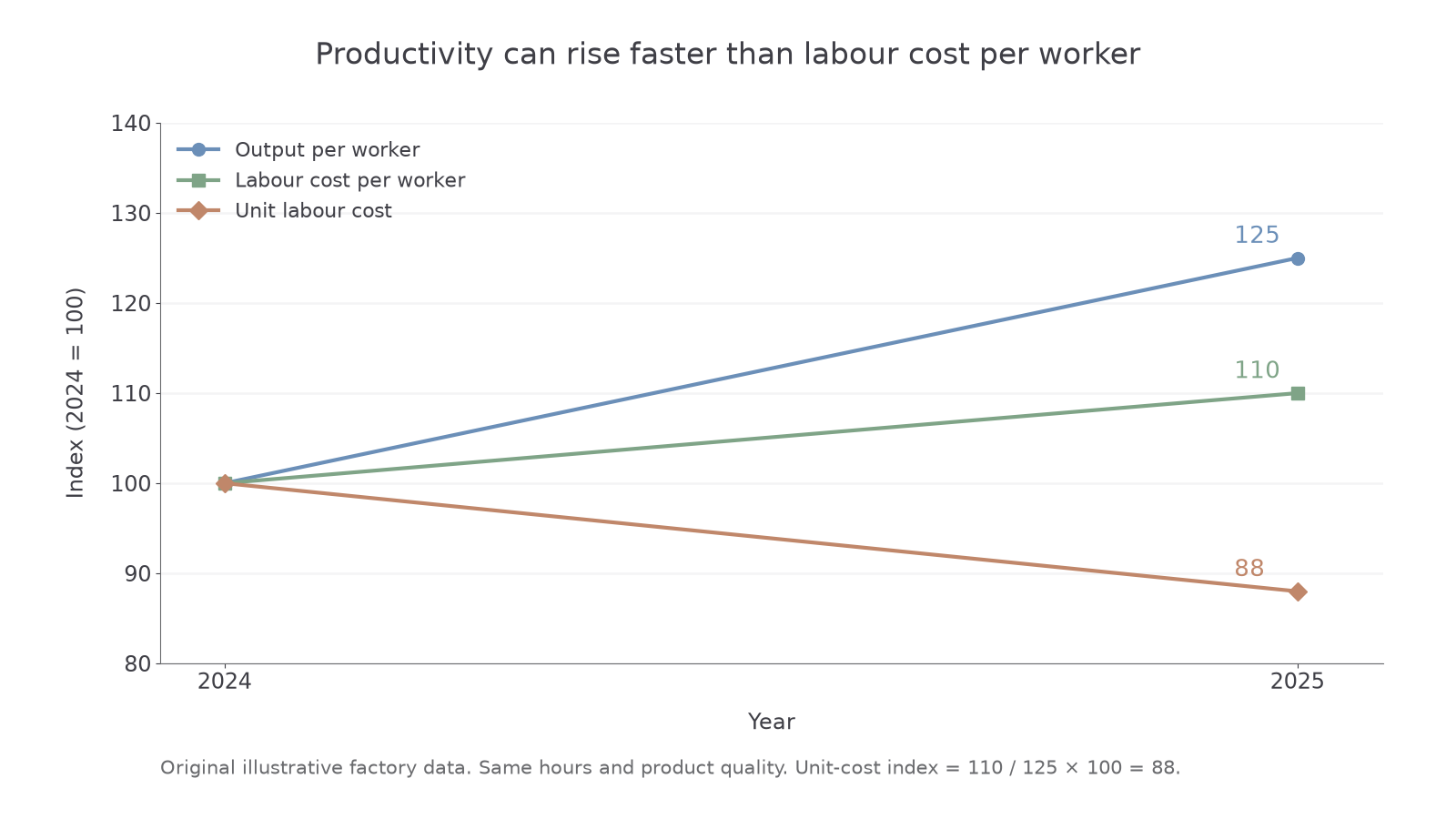
Each series has its own 2024 value equal to 100: a higher productivity line does not mean pounds of productivity. To construct a comparison, calculate the three ratios, use years on the horizontal axis and a labelled common index scale on the vertical axis, and distinguish the series. A supplied graph can show proportional changes; it cannot alone tell us whether output quality improved or why the change occurred.
Productivity and labour demand
A firm demands labour because workers help produce output that it can sell, so productivity changes affect employment through revenue as well as physical production.
Derived demand means demand for labour depends on demand for the output it produces. The marginal revenue product of labour, or MRP, is the additional revenue generated by one more unit of labour: marginal physical product multiplied by marginal revenue. Marginal physical product is additional output, not the average output per worker. In a competitive product market marginal revenue equals the given selling price; a firm facing a downward-sloping demand curve must allow for the revenue effect of changing its price.
Suppose an extra trained worker adds 12 units per hour and marginal revenue is £20 per unit. MRP is £240 per hour. If before training the extra worker added 10 units with the same marginal revenue, MRP was £200. With other determinants constant, the productivity improvement increases the revenue available to justify employing labour. In a competitive labour market a profit-seeking firm expands employment while the additional revenue exceeds the wage and other relevant marginal employment costs; the simple interior choice has MRP equal to the wage.
But if weak product demand lowers marginal revenue to £15, MRP after training is only £180. A productivity rise does not guarantee stronger labour demand when selling conditions change. Nor does adopting a machine always raise demand for every occupation. It may complement technicians but substitute for routine tasks. Higher output and lower prices can create extra demand for workers elsewhere, while displaced workers may lack the skills or location needed for those jobs.
The aggregate employment effect therefore depends on product demand, substitution and adjustment. Trace a particular occupation first; do not infer that fewer workers needed per unit necessarily means fewer workers employed when output can expand.
Who receives the gain?
Higher productivity creates scope for higher real incomes, but institutions and market conditions influence how the gain is divided.
If trained workers become more valuable across competing employers, stronger labour demand can raise wages as firms compete to recruit them. Supply matters: a rapid increase in people with those skills can moderate the wage rise. Occupational mobility is the ability to move between types of work; retraining can help displaced workers enter expanding occupations. Moving house, caring responsibilities and limited information may still prevent a worker from taking an available job.
A dominant local employer may possess monopsony power, facing an upward-sloping supply of labour and paying less than workers might receive with stronger employer competition. Productivity can then increase profits without an equivalent wage rise. Collective bargaining through a trade union can give workers more negotiating power over the gain. Its effects depend on the wage agreement, employment response, product-market demand and the employer's existing power; neither universal job loss nor universal wage gains follow automatically.
Continue this lesson.
You’re previewing NovaLearn without an account. Create a free account to read the rest.
Create free account