3.4 - Policy conflicts and economic trade-offs
Economic policies can improve one objective while making another harder to achieve, but conflicts depend on conditions and time horizons. Compare growth, employment, price stability, the external balance, distribution and environmental sustainability, then explain how an appropriate policy mix can reduce rather than simply accept a trade-off.
Employment, growth and price stability
An increase in demand can support output and employment, but its price effect depends on available productive capacity.
With idle labour and machinery, stronger AD can increase production and firms' demand for labour. Short-run growth and lower cyclical unemployment can then complement each other with limited price pressure. Near capacity, firms compete for scarce inputs and find it harder to expand output, so similar demand growth creates more inflationary pressure. Achieving more employment through demand expansion can conflict with price stability in that situation.
A short-run Phillips curve summarises a possible inverse relationship between inflation and unemployment, conditional on expectations and supply conditions. Lower unemployment can accompany stronger wage and price pressure; contraction may reduce inflation pressure but increase unemployment. The graph is a model of a relationship, not proof that unemployment alone causes every inflation change.
[DIAGRAM: asset_slug: ocr_h460_policy_phillips; caption: A short-run inflation–unemployment trade-off depends on expectations and supply conditions; description: Exact illustrative downward-sloping short-run Phillips curves, with two points on the initial curve and an upward shift after higher expected inflation or an adverse supply shock.]
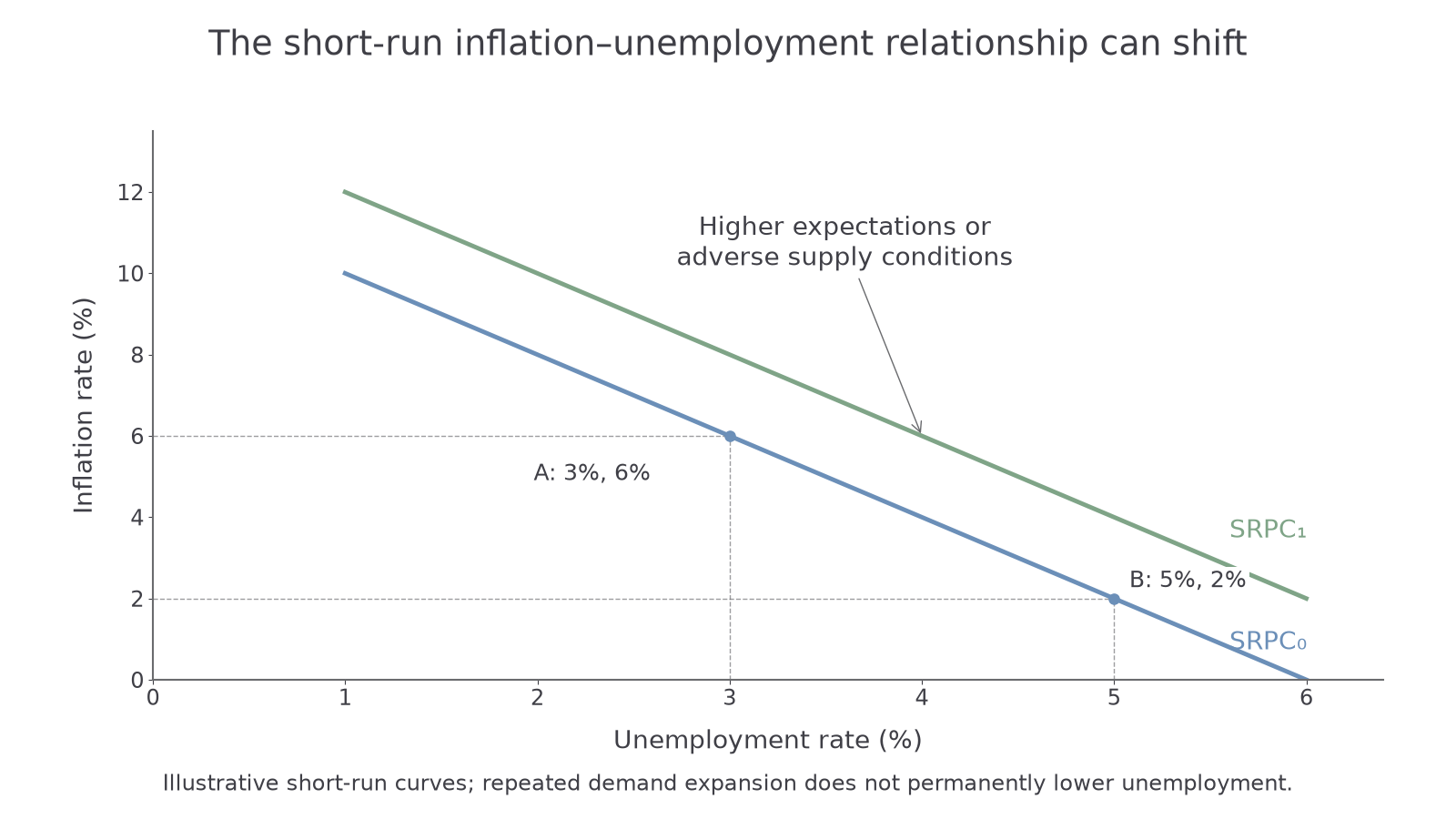
To construct it, put the unemployment rate on the horizontal axis and the inflation rate on the vertical axis. Draw a downward-sloping short-run curve and show an expansionary demand movement toward lower unemployment and higher inflation. A rise in expected inflation or an adverse supply shock can shift the curve upward: inflation is higher at the same unemployment rate. Do not draw a permanent movement down unemployment from repeatedly increasing AD. In the expectations-augmented long-run model, there is no permanent demand-created trade-off; unemployment tends toward its sustainable rate while higher inflation expectations erode the initial effect.
For example, an imported oil shortage can raise production costs while reducing output and employment. Inflation and unemployment can then rise together: policy confronts a changed supply condition rather than moving along an unchanged short-run curve. Restricting AD may prevent continuing domestic price pressure but does not produce more oil. Capacity and cost improvements can make growth and price stability more compatible, though their effects may be delayed.
Growth and the external balance
Domestic spending and exchange-rate changes can connect the growth objective with the current account.
Demand-led growth can increase consumption of imported goods and firms' purchases of imported inputs. If imports rise faster than export receipts and other current-account credits, the current account can deteriorate. This is a possible conflict between short-run growth and a sustainable external position. It is not an identity that every growing economy must develop a deficit: growth in export capacity or stronger foreign demand can improve export receipts at the same time.
Suppose an invented economy initially has goods-and-services exports of £100bn and imports £105bn. A domestic demand expansion raises imports to £113bn while exports remain £100bn. That trade balance worsens from −£5bn to −£13bn. Other current-account components are held unchanged in this illustration; a trade balance alone is not the entire current account.
Currency depreciation can improve export price competitiveness and make imports more expensive in domestic currency. If quantities respond sufficiently after contracts adjust, net exports may rise, supporting AD, output and employment. Yet imported energy and components can raise domestic costs and inflationary pressure. The import bill may initially rise before volumes adjust. Do not assume depreciation simultaneously guarantees higher growth, lower inflation and an improved current account.
Appreciation can reverse those channels: cheaper imported inputs may reduce price pressure, while reduced export competitiveness weakens demand for domestic output. Higher interest rates might support an appreciation, but relative foreign rates, confidence and expectations matter. A supply improvement that lowers unit costs can strengthen competitiveness without the same imported-price penalty, though it takes time and may initially require imported machinery.
The relevant judgement concerns the cause and persistence of the external imbalance. Demand restraint may reduce imports quickly but lower employment. Improving export capacity can address competitiveness while supporting long-run growth, but will not necessarily correct a near-term financing problem. A current-account deficit financed reliably for productive investment differs from one accompanied by fragile external financing.
Distribution, incentives and public finance
Policies that change incomes and public services can create both complementarities and conflicts between distribution, growth and the budget.
Progressive taxes and targeted benefits can reduce disposable-income inequality and support spending by cash-constrained households. Public education or health provision can improve opportunities, productivity and employment, making greater equality and long-run growth complementary. The effect depends on access and effectiveness: a programme nominally open to everyone may mainly benefit those able to use it.
Higher marginal taxes or rapid benefit withdrawal can reduce the net return from extra work or investment, potentially weakening some incentives. Responses vary with behaviour and constraints; redistribution does not automatically reduce growth. Support that removes childcare or health barriers can increase effective labour supply even while reducing inequality. The income effect on hours may also differ from the substitution effect.
Tax cuts intended to encourage work or investment can increase inequality if gains concentrate among higher-income or wealthier households. They may reduce receipts if the taxable base does not expand enough, requiring lower spending or more borrowing. Cutting training to finance a tax cut can undermine the capacity improvement the policy is meant to create. Assess the whole financing arrangement rather than treating the tax measure in isolation.
Continue this lesson.
You’re previewing NovaLearn without an account. Create a free account to read the rest.
Create free account