4.4 - Economic integration and trade negotiations
Removing trade barriers between a group of economies can increase trade without necessarily reducing every resource cost. You will distinguish forms of integration, interpret trade creation and diversion, and judge how international negotiations and WTO rules can support freer trade.
Forms of economic integration
Economic integration reduces barriers and coordinates aspects of economic policy among participating economies. A free trade area removes tariffs and other agreed trade barriers between members, while each retains its own trade policy towards outsiders. Rules of origin identify which products qualify: otherwise imports could enter through the member with the lowest external tariff and be relabelled or redirected to avoid another member's tariff.
A customs union combines internal free trade with a common external tariff or trade policy. This reduces the need for different external tariffs within the union but requires members to agree a common stance. A common market goes further by enabling freer movement of factors such as labour and capital as well as goods and services. Real agreements vary in coverage and implementation, so the category describes their key features rather than a uniform legal template.
A monetary union shares a currency or a closely unified monetary arrangement, with common monetary policy in a currency union. It removes exchange-rate movements between participating currencies but individual members lose their own exchange-rate and interest-rate adjustment. An economic union involves deeper coordination or harmonisation of economic policies and institutions, potentially including fiscal and regulatory rules. Monetary and economic integration are related but are not identical: sharing a currency does not automatically create one national budget.
These forms are often shown as increasing depth, but membership and policy choices need not follow an inevitable sequence. A free trade area can operate without a common currency; a monetary arrangement does not automatically establish unrestricted trade in every sector. Identify the actual feature before assigning a label.
Trade creation
Trade creation occurs when lower trade barriers replace higher-cost domestic production with lower-cost imports from a partner. It can also expand consumption as the domestic price falls. This is a change in the source and cost of supply, not merely an increase in the number of border transactions.
Consider an illustrative small economy initially protected from imports. Domestic supply and demand intersect at £18 and 40 million units. Removing barriers to a partner able to supply at £10 lowers the domestic price to £10. Domestic production falls to 20 million, consumption rises to 80 million and imports are 60 million. Units formerly produced domestically between 20 and 40 million cost more than £10 to produce; partner supply saves those resources. Consumers also buy additional units worth more to them than the £10 resource cost.
[DIAGRAM: asset_slug: trade-creation; caption: Lower-cost partner imports replace expensive domestic production and expand consumption; description: Domestic supply and demand initially meet at price 18 and quantity 40 million. Partner supply at price 10 reduces domestic output to 20 million and increases consumption to 80 million. Production and consumption gains are shaded between the initial equilibrium and the partner price.]
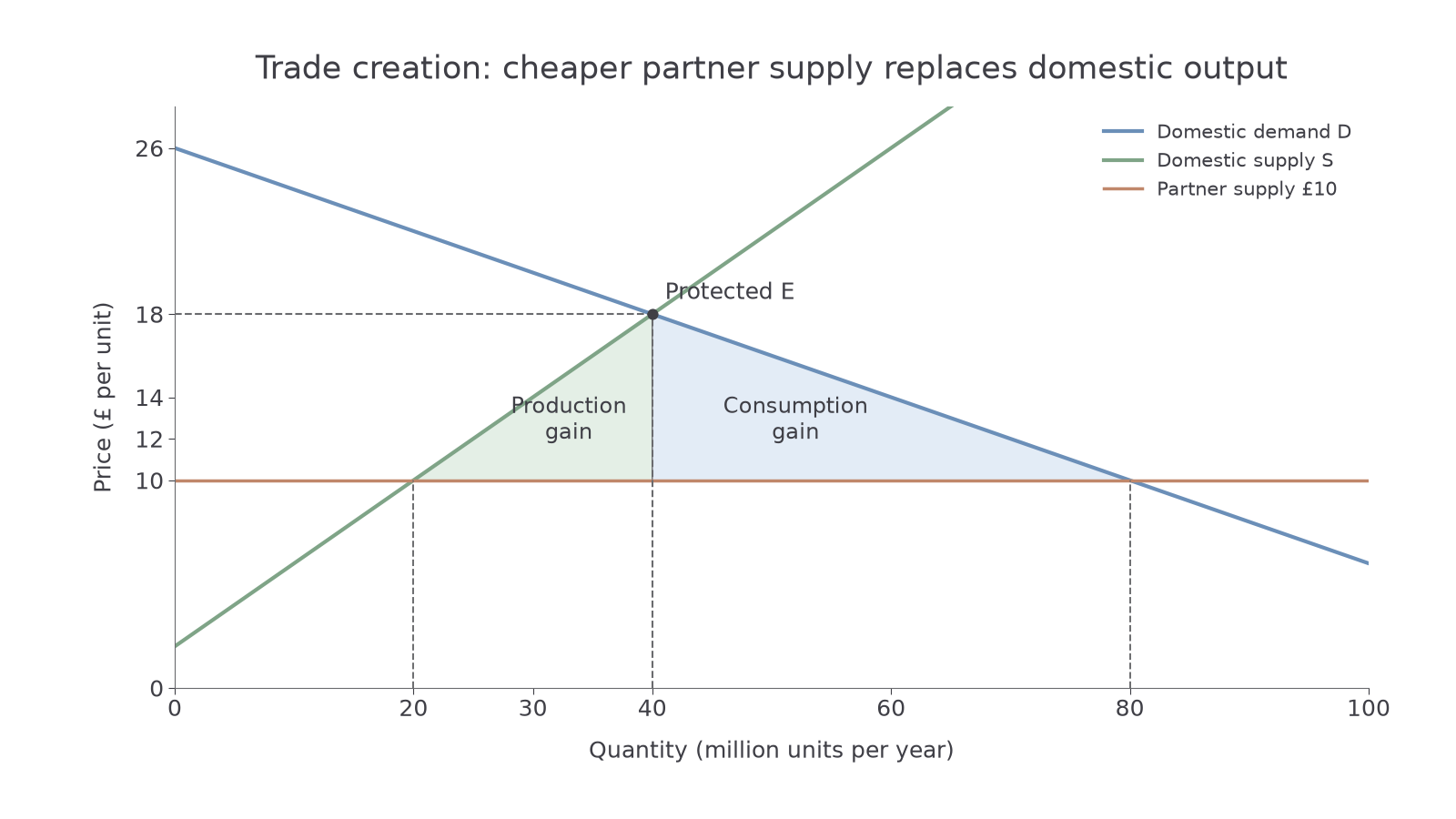
To construct this comparison, label domestic D and S, mark the protected equilibrium, then add a horizontal partner-supply line below it. Project new Qs and Qd. Shade the gain from replacing expensive production between the old and new domestic output, and the gain from extra consumption between old and new consumption. The first gain lies between S and the import price; the second between D and that price. Producer surplus falls but consumer surplus rises by more in this simplified no-externality model.
Removing a binding quota can have a similar price-and-quantity effect by allowing cheaper partner supply to expand. If the quota was not binding or transport costs remove the cost advantage, the claimed creation may be small or absent. Additional imports from a partner are not automatically evidence of an efficiency gain; identify what production they replace and the actual costs.
Trade diversion
Trade diversion occurs when preferences shift imports from a lower-cost non-member to a higher-cost member. Consumers may pay less after joining even while the world uses more resources to supply some imports. Distinguishing the price including a tariff from the underlying cost is essential.
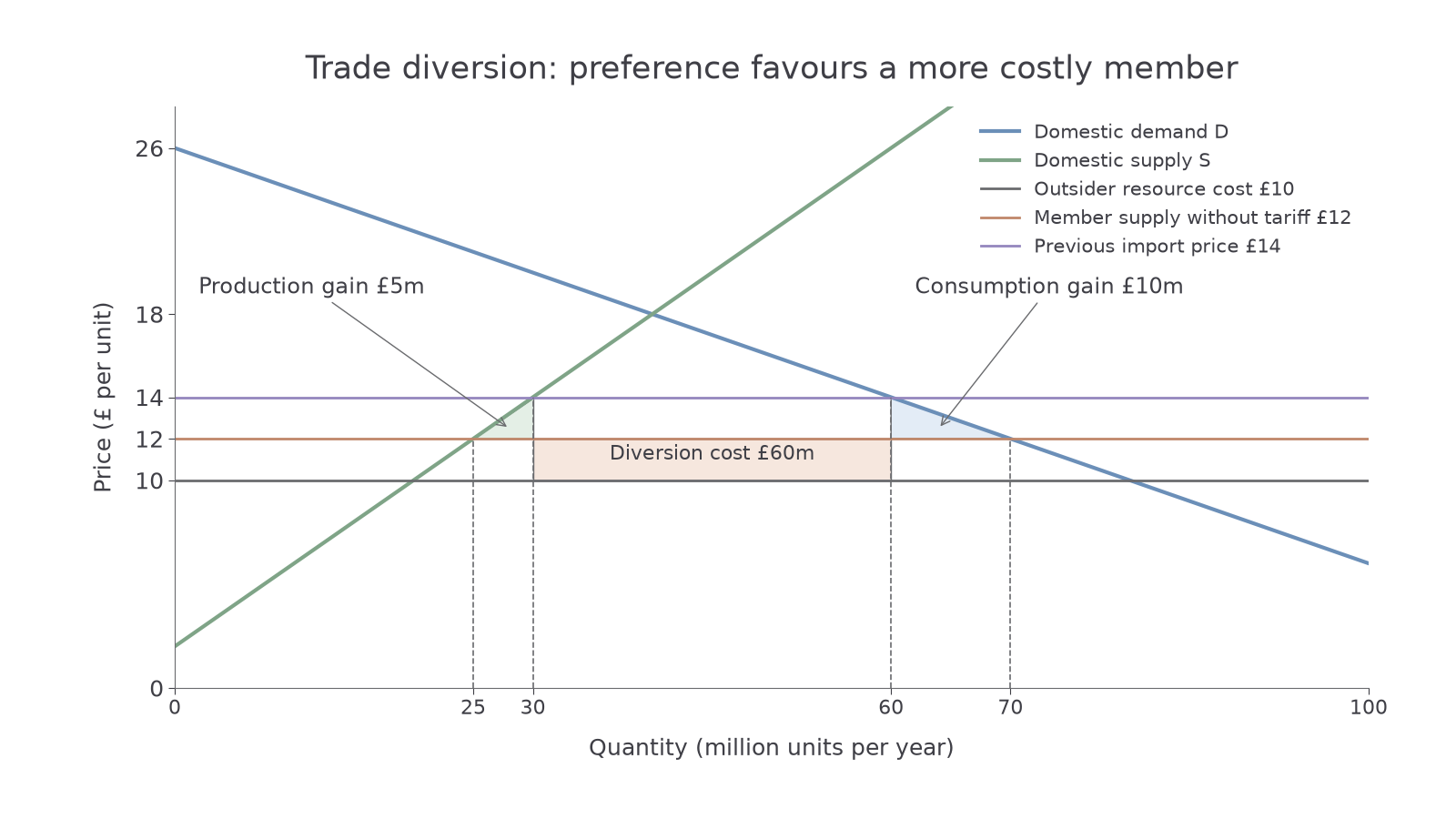
In the illustrative graph, an outsider can supply for £10 and a member for £12. Before integration, a £4 tariff on both means the outsider is chosen at £14. Domestic production is 30 million, consumption 60 million and outsider imports 30 million. Removing the tariff on the member alone makes its £12 supply cheaper to consumers than the outsider's £14 tariff-inclusive price. Domestic output falls to 25 million, consumption rises to 70 million and member imports are 45 million.
[DIAGRAM: asset_slug: trade-diversion; caption: A member preference can lower the consumer price while diverting imports from a cheaper outsider; description: Domestic supply and demand with outsider resource cost 10, member resource cost 12 and previous tariff-inclusive price 14. Output changes from 30 to 25 million and consumption from 60 to 70 million. Two small gains from the price fall and a resource-cost penalty on 30 million diverted imports are shaded.]
Continue this lesson.
You’re previewing NovaLearn without an account. Create a free account to read the rest.
Create free account